
Transferring a vehicle, doesn’t matter if you are selling it, shifting to another state, or re-registering it in a different RTO, it can feel confusing if you’re not familiar with the process.
One of the most important documents required for this process is the No Objection Certificate (NOC) issued by the Regional Transport Office (RTO).
An NOC is an official document issued by the RTO stating that:
- The vehicle has no pending legal or financial liabilities
- There are no pending taxes or challans
- The RTO has no objection to transferring or re-registering the vehicle
Without an NOC, completing inter-state vehicle transfer or re-registration is usually not allowed.
Vehicle NOC services can also be applied online through the government transport portal Parivahan Sewa, where you can complete the online NOC Parivahan step by step process for submitting your application and uploading documents.
Let’s understand the whole process in detail.
Why is NOC Necessary?
A No Objection Certificate plays a crucial role in making sure that the vehicle transfer process is legal, smooth, and transparent without any obstacles.
1. Clearance of Liabilities: An NOC confirms that the vehicle is free from any pending road taxes, traffic challans, legal disputes, or outstanding loans and hypothecation in case the vehicle was financed.
2. Verification of Legal Status: The NOC also verifies that the vehicle
- Is not reported stolen
- Has no police records or involvement in criminal activities
3. Smooth Vehicle Transfer: If you are selling your vehicle in another state or shifting permanently, the NOC allows the new RTO to process the registration transfer without any issues.
4. Legal Protection: Transferring a vehicle without an NOC can lead to legal conflicts, especially in inter-state transfers, as the new RTO may reject your application.
5. Mandatory for Re-Registration: Most RTOs need an NOC before issuing a new Registration Certificate (RC) when the vehicle is being registered in another state.
6. Hypothecation Clearance: In few RTOs, an NOC is needed even for same-state transfers to confirm that any bank loan or hypothecation linked to the vehicle has been cleared.
What Are the Different Types of NOC?
1. Inter-State NOC
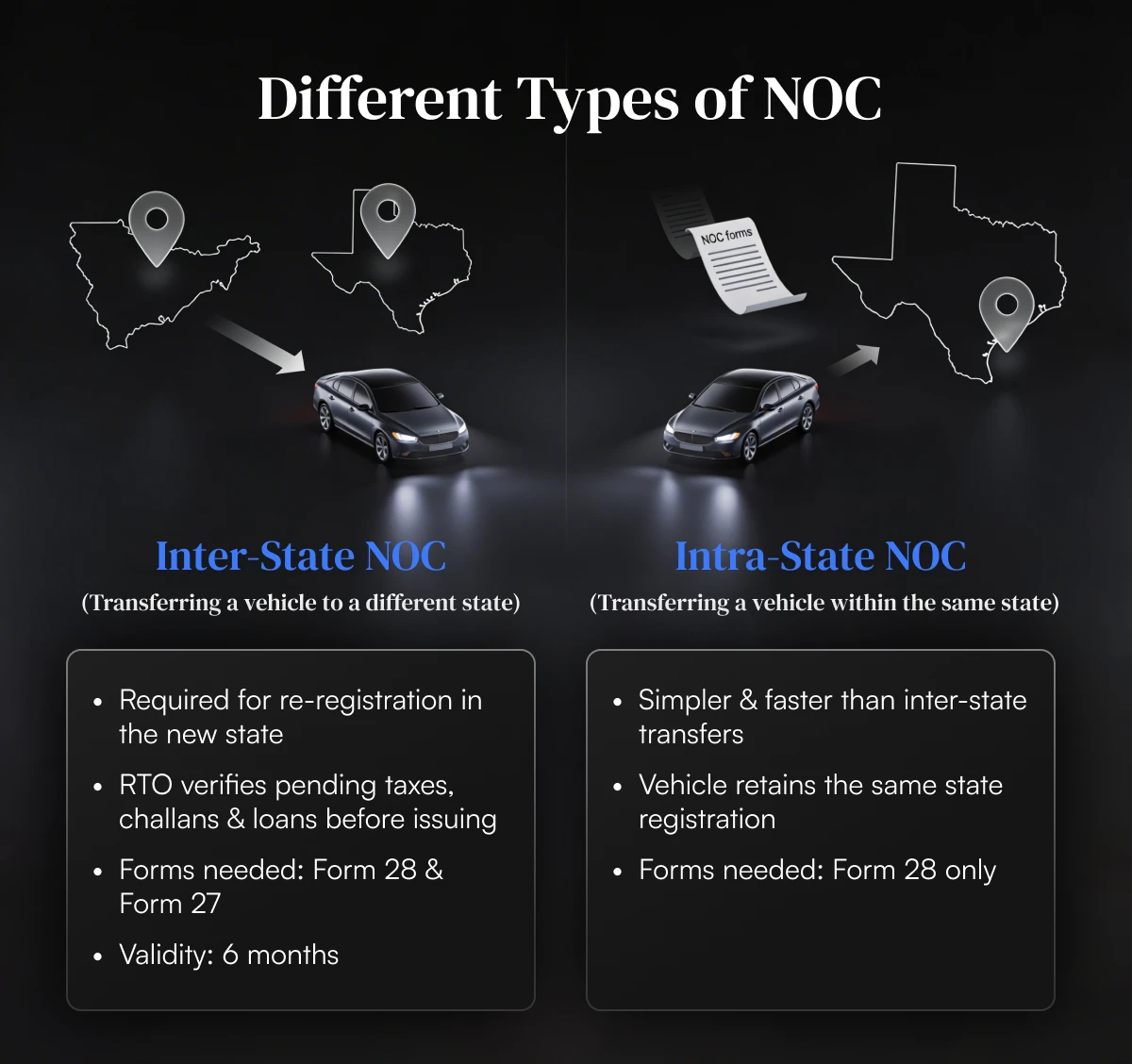
An inter-state NOC is usually needed when a vehicle is transferred from one state to another.
Without this certificate, the new state's RTO will not allow vehicle re-registration. The current RTO verifies that the vehicle has no pending taxes, challans, loans, or legal issues before issuing the NOC.
-- Required Forms for Inter-State NOC:
- Form 28: Application for NOC from the current RTO
- Form 27: Application for assignment of a new registration mark in the new state
-- Validity: The NOC is usually valid for 6 months. If the vehicle is not re-registered within this period, the owner must apply for a fresh NOC.
For Example:
If a vehicle registered in Maharashtra is sold to a buyer in Punjab, an inter-state NOC is required for re-registration in the new state.
2. Intra-State NOC
An intra-state NOC is needed when a vehicle is transferred between RTOs within the same state.
Since the vehicle remains under the same state transport department, the process is typically simpler and faster compared to inter-state transfers.
In many cases, only Form 28 for NOC application may be required. Form 27 is usually not needed because the vehicle keeps the same state registration.
For Example:
Transferring a vehicle from Pune RTO to Mumbai RTO within Maharashtra.
Who Can Apply for an NOC?
To apply for an NOC, you must have a vehicle registered under your name as per the RTO records. Along with that also make sure that there are no pending taxes, traffic challans, or any other legal issues.
And if your vehicle is still under a loan, you will also need to get a NOC from your bank before going forward.
In case you aren’t able to apply in person, a family member or a friend can also apply on your behalf if they have your signed documents.
What Documents Are Required for NOC?
| Category | Documents Required |
|---|---|
| Vehicle Documents | Original Registration Certificate (RC) |
| Vehicle Documents | Valid Insurance Certificate |
| Vehicle Documents | Pollution Under Control (PUC) Certificate |
| Vehicle Documents | Road Tax Payment Receipt |
| Vehicle Documents | Chassis Number / Engine Number Pencil Print (Imprint) |
| Identity & Address Proof | Aadhaar Card / Passport / Voter ID / Driving License |
| Identity & Address Proof | Proof of Current Address |
| Identity & Address Proof | Proof of Permanent Address |
| Identity & Address Proof | PAN Card or Form 60 (if PAN is not available) |
| Financial Documents | Loan Closure Certificate (if the vehicle was financed) |
| Financial Documents | No Objection Letter from the Bank / Financier |
| Application Forms | Form 28: Application for NOC from the current RTO |
| Application Forms | Form 27: Application for assignment of a new registration mark (for inter-state transfer, usually 3–4 copies required, including financier records) |
| Application Forms | Form 29: Notice of transfer of ownership |
| Application Forms | Form 30: Application for transfer of ownership |
| Verification & Compliance | Police Clearance Certificate (may be required if the vehicle is flagged or under verification) |
| Other Supporting Documents | Passport-size Photographs of the vehicle owner |
| Other Supporting Documents | Affidavit (required if RC or other documents are lost) |
| Other Supporting Documents | Insurance NOC (if required by the insurer for transfer) |
| Other Supporting Documents | Fitness Certificate (mandatory for commercial or heavy vehicles) |
Step-by-Step Process to Apply for NOC
How Do You Apply for an NOC Offline?
1. Visit Your Vehicle’s Registered RTO: Go to the RTO where the vehicle is originally registered and make a request for the NOC application form (Form 28).
2. Fill Triplicate Form 28: You must fill Form 28 in triplicate (like three copies of it). The form generally includes:
- Vehicle registration number
- Engine number
- Chassis number
- Current owner details
- Destination RTO (if moving to another state)
*Each copy is submitted to different RTO departments for verification.
3. Attach Required Documents: Submit the filled forms along with the required supporting documents, including the original Registration Certificate (RC), insurance certificate, Pollution Under Control (PUC) certificate, identity and address proof, and a Bank NOC if the vehicle has an active loan. IN addition you will need to provide passport-size photographs, and in some cases, a road tax receipt and chassis imprint may also be needed.
4. Pay the Applicable Fee: The NOC processing fee usually is between ₹100 and ₹300, depending on the state.
Payment methods may include:
- RTO cash counter
- Bank challan
- Online payment (in some RTOs)
5. Vehicle Physical Inspection: In many RTOs, officials carry out a physical inspection of the vehicle to verify details such as the chassis number, engine number, and the overall condition of the vehicle.
6. Police Verification: The RTO may forward the request for police verification to make sure that the vehicle is not reported stolen or to check if it has any pending criminal record or legal dispute.
The whole verification usually takes 1 to 7 days.
7. RTO Verification and Issuance: After all the verification of documents, tax records, and police clearance, the RTO issues the No Objection Certificate (NOC).
The entire offline process usually takes 7 to 30 days, depending on the RTO and verification requirements.
How Do You Apply for an NOC Online?
While you can easily initiate the application process online, the final approval may still involve a visit to the RTO or physical submission of documents.
1. Visit the Transport Portal: Go to the official government portal Parivahan Sewa. (link here)
2. Select Vehicle Related Services: Enter your vehicle registration number and choose your registered RTO.
3. Login and Authenticate: Log in using either your mobile number verification (OTP) or Aadhaar-based authentication (available in some states).
4. Fill the NOC Application: Fill the important details such as:
- Vehicle information
- Transfer destination state or RTO
- Owner details
5. Upload Required Documents: Once you are done with the application, you need to upload scanned copies of all necessary documents, including your RC, insurance certificate, PUC certificate, and identity proof and in case your vehicle has an active loan, attaching a Bank NOC will also be needed for that purpose.
6. Pay the Application Fee: You can also pay the application fee using online payment options such as:
- UPI
- Net banking
- Debit or credit card
7. Print the Acknowledgement Receipt: After the submission, you can download and print the acknowledgement receipt as some RTOs need the printed application and documents to be submitted physically for final verification.
8. RTO Verification: The RTO thoroughly reviews all your submitted documents, checks for any pending traffic challans, checks the hypothecation status, and confirms the vehicle details.
9. Track Application Status: You can track and check the progress of your application through the VAHAN Vehicle Services Portal. (link here)
*The complete process typically takes around 7 to 30 days, depending on verification and RTO processing time.
What Are the Fees and Charges for an NOC?
So basically the RTO fee for issuing a No Objection Certificate usually falls between ₹200 to ₹500 but it can also vary depending on the state.
*Extra charges may be applied if the vehicle is under a loan.
Also you can avoid penalties by being punctual with your applications and submissions. Payments can be made both in cash at the RTO of your state and online through the official portal.
State-Wise NOC Fees Table
| State | NOC Fee (₹) | Notes |
|---|---|---|
| Maharashtra | 200–400 | Inter-state transfer may cost extra |
| Punjab | 250–450 | Hypothecation vehicles pay extra |
| Karnataka | 200–500 | Online payment accepted |
| Tamil Nadu | 200–300 | Fee varies by RTO |
What Special Cases Affect the NOC Process?
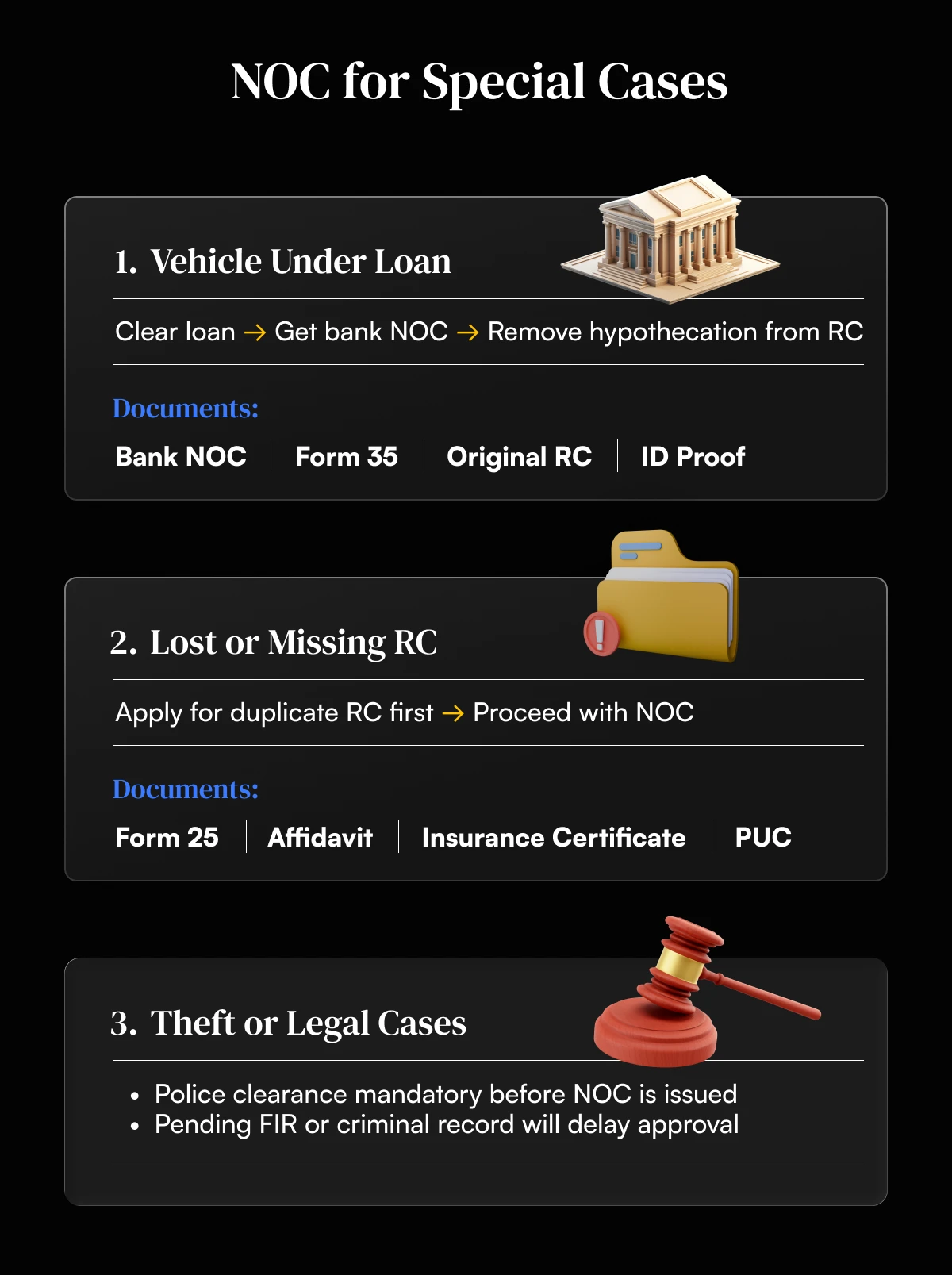
1. Vehicles Under Loan (Hypothecation)
If your vehicle was bought through a bank or finance company loan, the RTO records will show a hypothecation entry linked to the lender, be it a bank or a company.
That’s why before applying for an RTO NOC, you need to make sure to close any outstanding loan and get the hypothecation removed from your RC.
How to do it:
- Repay the entire outstanding loan amount to the bank or finance company.
- Obtain a No Objection Certificate (NOC) from the bank or financier confirming the loan closure.
- Apply for hypothecation termination at the RTO.
Required Documents:
- Bank NOC or loan closure letter
- Form 35 (Hypothecation termination form)
- Original Registration Certificate (RC)
- Identity proof
Once the hypothecation entry is removed from your RC, you're all set to go ahead with the RTO NOC application for vehicle transfer or re-registration.
2. Lost RC or Missing Vehicle Documents
If your original Registration Certificate (RC) has been lost, stolen, or damaged, you first need to apply for a duplicate RC before asking for an NOC.
Here’s how to do it:
1. Apply for a duplicate RC using Form 25.
2. Provide an indemnity bond or affidavit stating that the original RC has been lost.
3. Provide supporting documents such as:
- Identity proof
- Address proof
- Insurance certificate
- Pollution Under Control (PUC) certificate
Once the duplicate RC is issued, you can go ahead with your NOC application at the RTO.
3. Vehicles Involved in Theft or Criminal Cases
In some exceptional cases such as If the vehicle has been reported stolen, involved in a legal dispute, or connected to a criminal investigation, additional verification is usually needed before issuing an NOC.
It might require:
- Mandatory police clearance or police NOC
- Verification that the vehicle is not under investigation
- Confirmation that the vehicle has no pending FIR or criminal record
The RTO may forward the request for police verification to make sure that the vehicle is not reported stolen or to check if it has any pending criminal record or legal dispute.
In some cases, this is also called a police clearance vehicle NOC verification before the final certificate is handed over.
This extra verification step may affect the NOC approval timeline, depending on the status of the police record.
What Role Does the NOC Play in Vehicle Re-Registration?
Once your No Objection Certificate (NOC) is issued, the next step is to complete the vehicle transfer and re-registration in the new state.
Ideally, you should transport the vehicle to the new state within 30 days of receiving your NOC. If the vehicle is being used across states before re-registration, you may need a temporary transit permit to legally use or ride the vehicle.
At the new Regional Transport Office (RTO), you need to submit the following documents to start your re-registration process:
- Form 29: Notice of transfer of ownership
- Form 30: Application for transfer of ownership
- Original NOC issued by the previous RTO
- Registration Certificate (RC)
- Insurance certificate
- Pollution Under Control (PUC) certificate
- Identity and address proof
Keep in mind that you will also need to pay the road tax applicable in your new state (road tax may vary from state to state) so make sure it's paid before your vehicle gets re-registered.
Once you submit your documents, the RTO will verify your vehicle details, tax status, and ownership records. After everything checks out, they will issue a smart card Registration Certificate (RC) with your new state registration number.
The RC smart card usually takes around 15 to 30 days to be issued, depending on how quickly your RTO processes the application. In the meantime, you can keep an eye on your application status through the VAHAN Vehicle Services Portal. (link here)
To put it in simple terms, following these steps will make sure that your vehicle transfer is legal, smooth, and hassle-free, saving you from headaches, delays or any legal trouble down the road.
What Are Common Mistakes to Avoid When Applying for an NOC?
- Not clearing pending dues on time: A lot of people jump straight into the application without clearing their pending taxes, fines, or challans first. Make sure everything is settled before you even begin.
- Applying with an active vehicle loan: If your vehicle still has an outstanding loan, don't make the mistake of applying for an NOC without settling it with your bank first.
- Submitting incomplete or incorrect documents: One of the most common slip-ups is not double-checking your documents before submission. A missing paper or a small error can lead to unnecessary delays.
- Not keeping copies of your NOC: Many people forget to save both physical and digital copies of their NOC, so I would suggest you to always keep them handy, as you never know when you might need them.
- Skipping the hypothecation removal step: If the hypothecation entry is still on your RC, your NOC application won't go through. Get it removed first.
- Having expired insurance or PUC certificates: Applying with outdated insurance or PUC certificates is a mistake that can get your application rejected.
- Not tracking your application status: Most of the applicants simply submit their application and wait without checking its progress. Keep an eye on your status through the VAHAN Vehicle Services Portal or VAHAN NOC status check to stay updated.
- Missing the physical submission deadline: If your RTO needs you to submit documents in person, don't delay. Missing the deadline can lead to rejection and you may have to restart your application.
- Waiting too long after the NOC is issued: Once your NOC is in hand, don't sit on it. Since it is valid for only six months, make sure you apply for re-registration as soon as possible.
How Long Does the Entire NOC and Re-Registration Process Take?
The NOC and re‑registration process usually takes 7-30 days for the NOC and another 15-30 days for the new RC, depending on the RTO’s workload, verification, and whether the vehicle is under loan or has police clearance.
- The NOC itself typically comes within a few days to about a month, depending on how quickly the RTO completes document checks, tax verification, and police verification.
- After the NOC is issued, you must apply for re‑registration in the new state within 6 months; otherwise the NOC becomes invalid.
- The new state RTO usually issues the updated smart‑card RC within 15-30 days once all documents, tax payment, and vehicle inspection are cleared.
Conclusion
Getting an NOC from the RTO might seem like a lot to handle at first, but once you break it down step by step, it's really not that hard.
If you're selling your vehicle or moving to a new state, having your NOC in order before you start the transfer process can save you a lot of time, stress, and last-minute running around (also money sometimes).
So take it one step at a time, keep your documents ready, and you'll have it sorted before you know it.