
.webp&w=1200&q=75)
If you think about it, at some point, you've probably been in a situation where someone needed proof that everyone’s on the same page before things could go forward.
Selling a house? The bank wants to know that there are no loose ends. Paying off a loan? Your lender needs clarity that the debt is cleared.
Changing jobs or relocating your car to another state? There's usually some kind of paperwork involved that basically says, "Yes, no issues here."
That's exactly where a No Objection Certificate, or NOC, comes in.
It's a formal way of documenting that all the right people have given their approval, so that there's no confusion, no conflicts and no loose ends in the future.
What is a No Objection Certificate (NOC)?
A No Objection Certificate (NOC) is an official document issued by a person, organization, or authority stating that they have no objection to a specific action, transaction, or request.
In easy terms, an NOC states that the issuing party gives permission and does not oppose any activity mentioned in the document.
NOCs usually come up in all kinds of situations, be it legal, financial, administrative, wherever you need to show some proof.
Banks typically issue them when a borrower finishes repaying a loan, a housing society might give you one when a flat owner wants to sell their property. Employers, government departments, and other authorities issue them too, depending on what's actually needed.
The core purpose of NOC is pretty straightforward: to keep things transparent and legally valid.
Because it's a written record of approval and it often needs to be in place before a process can move forward at all.
NOC Full Form and Meaning
The NOC stands for “No Objection Certificate.”
It is a formal document that states that the issuing authority does not object to a particular activity or request.
Breaking Down the Term
As you might have noticed, the name itself is pretty self-explanatory ."No Objection" simply means that whoever is issuing the document has no complaints, concerns, or opposition to what's being asked for.
And a "Certificate" is just an official document that acts as proof, usually signed and stamped to make sure that it's legitimate.
For Example
Let’s assume that you've just finished repaying a loan. The bank doesn't just take your word for it, they issue an NOC stating that all your dues have been cleared and they no longer have any claim over your asset, then you can use that document to update your credit records or prove the loan is fully settled.
It's a small piece of paper, but it carries a lot of weight.
What are the types of No Objection Certificates (NOC) and when do you need each?
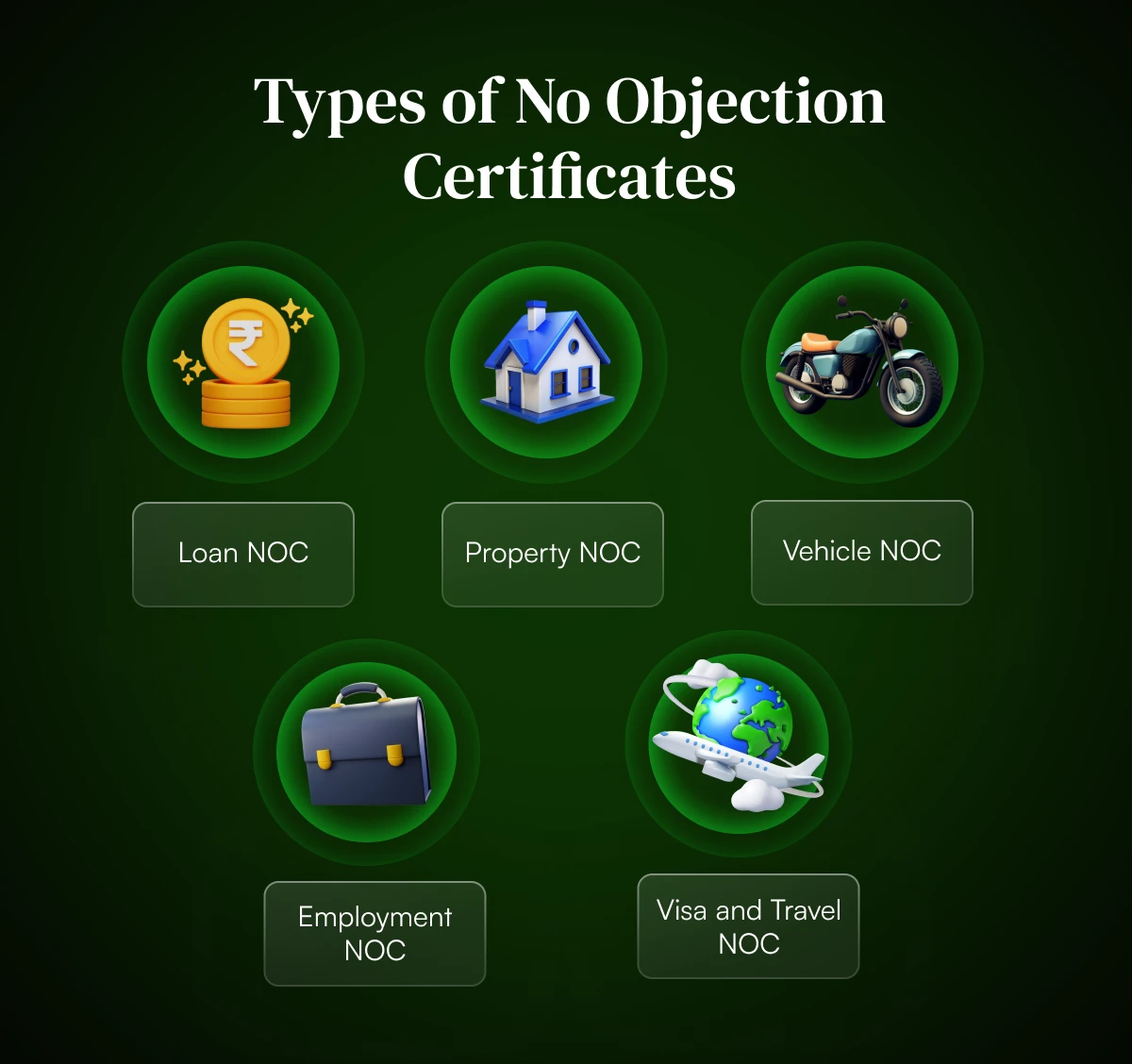
Not all NOCs are actually the same, they have different types, and each one is suitable for the different situation you're dealing with.
1. Loan NOC:
If you have ever taken a loan, you might be familiar with this. Once you fully repay the loan, the bank issues a Loan NOC stating that all dues have been cleared and that they no longer have any claim over your asset.
It's a crucial document to hold on to as it helps keep your credit records accurate, officially closes the loan account, and removes any lien the bank may have had on your property or whatever asset.
2. Property NOC:
This one’s basically for when you're selling a flat or transferring your property to someone else, a Property NOC from the housing society, developer, or local authority confirms that they have no objection to the transaction happening.
Plus banks and registration authorities will usually ask for this before processing anything, so it's one of the first things you'll need to get for your property transfer.
3. Vehicle NOC:
If you are moving to a different state and plan to take your car or bike with you, you will need a Vehicle NOC from your current Regional Transport Office (RTO) before you can re-register your vehicle in your new state.
It makes sure that there are no pending taxes, legal issues, or dues attached to the vehicle and gives you a clean chit before your transfer.
4. Employment NOC:
An Employment NOC is issued by your current employer and it basically confirms that they have no objection to you applying for a job elsewhere.
You’ll come across this mostly in government jobs, where it’s usually a mandatory requirement before your application is even considered.
5. Visa and Travel NOC:
And at the last, If you're planning to travel abroad, your employer, school, or college may need to issue a Travel NOC stating that you have their permission to go.
It's usually needed during visa applications as proof that your organization is aware of and has approved your travel plans.
What information does a standard NOC contain?
This is the part where mostly people are confused. While the format of an NOC can vary depending on who's issuing it and why, but there are few details that every NOC has, such as:
- Name of the Issuing Authority: It doesn’t matter if it's a bank, employer, housing society, or government department, the document will clearly state who is issuing it.
- Name of the Applicant: The person the NOC is being issued for is always mentioned, so that there's no confusion about who it applies to.
- Purpose of the NOC: This one spells out exactly what the NOC is giving the green signal for, be it a loan closure, property transfer, job change, or anything else.
- Statement of No Objection: And this is the most important part of the document, a clear, formal statement that the issuing authority has no objection to the request or action in question.
- Date of Issue: We all know how important the date of issue is on an NOC, especially for time-sensitive processes.
- Official Signature and Seal: This is the crucial part of an NOC, as without a signature and seal, no NOC is legally valid or usable for any purpose.
What is the typical NOC format and structure?
(insert an image as a sample of noc also)
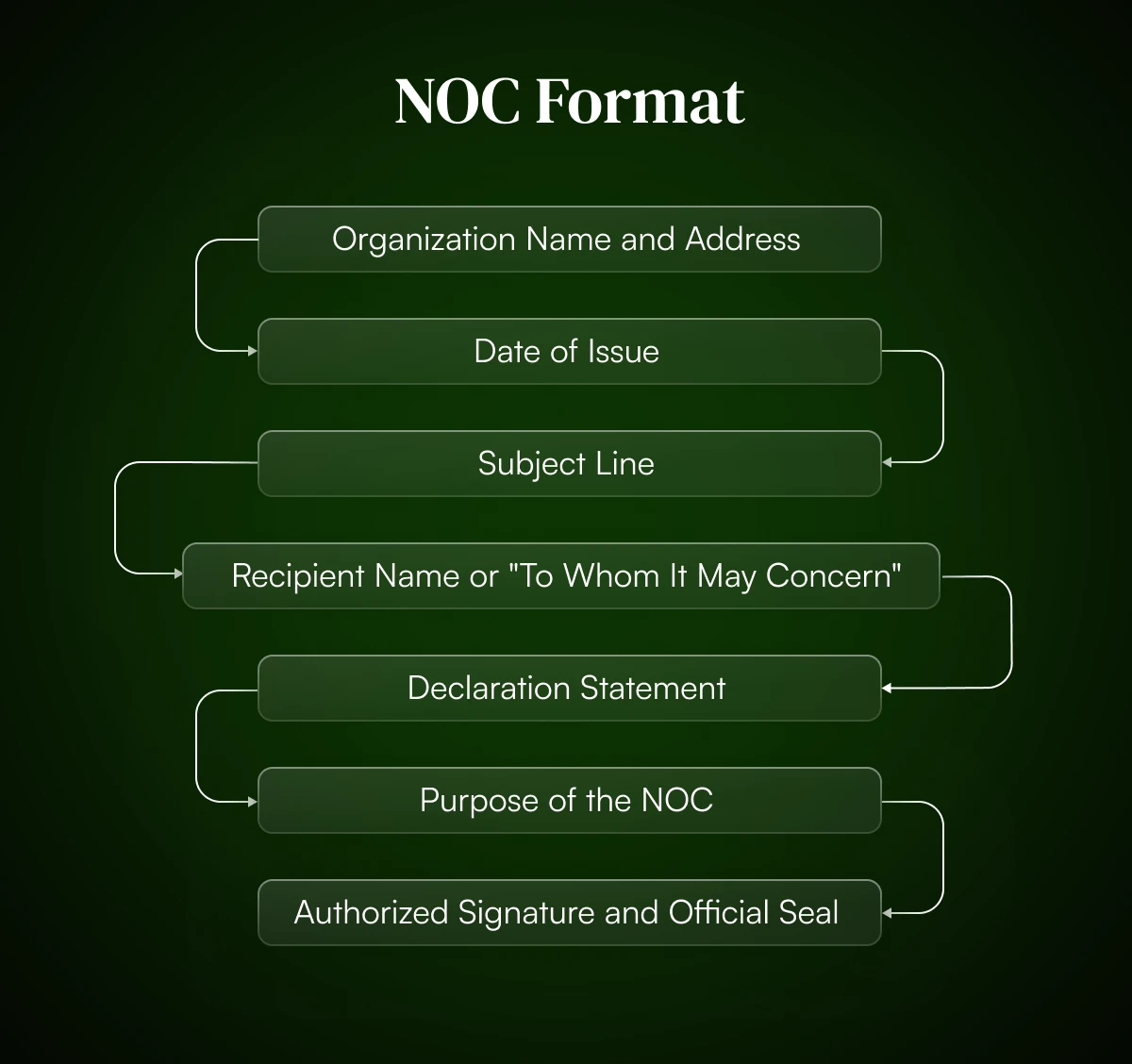
Now, you might be wondering about the exact format of an NOC. While it can vary from one organization to another, most of them are actually kind of the same and follow a structure.
Here’s what it usually looks like:
- Organization Name and Address
- Date of Issue
- Subject Line
- Recipient Name or "To Whom It May Concern"
- Declaration Statement
- Purpose of the NOC
- Authorized Signature and Official Seal
How do you apply for an NOC: step-by-step?
Well, the good news is that applying for an NOC is usually a pretty easy and smooth process.
The exact steps may vary depending on who's issuing it, but this is how it typically works:
Step 1: Figure Out Who You Need It From
The first thing to do is to find out the right authority for your situation.
Need one after repaying a loan? That's your bank. Selling a property? You'll be heading to your housing society or local authority. Moving states with your vehicle? Your RTO is the one to approach.
Getting this right from the start saves a lot of back and forth later.
Step 2: Submit Your Application
Once you know who to approach, you'll need to put in a formal request.
Depending on the organization, this could be a written application, an online form, or even a simple in-person request.
Either way, make sure that you're clear about what you need the NOC for.
Step 3: Attach the Necessary Documents
After submitting, most authorities will ask you for supporting documents along with your application.
These could be your ID proof, loan statements, property documents, or anything else related to your request.
So, it's always a good idea to double-check what's needed beforehand to make sure that you're not making multiple trips.
Step 4: Wait for Verification
And once your application is submitted, the authority will review it and verify the information that you've given. This step makes sure that everything checks out before the NOC is issued.
Step 5: Collect Your NOC
After everything is verified and approved, the authority will issue your No Objection Certificate and just make sure that it carries the official signature and seal before you walk away.
What documents are commonly required for each NOC type?
Typically documents needed for a No Objection Certificate (NOC) can change depending on why you are applying for it and which authority is issuing it.
For example, the documents needed for a loan NOC may be different from those needed for a property or employment NOC.
| Document Name | Purpose |
|---|---|
| Identity Proof (Aadhaar Card, PAN Card, Passport) | Confirms the identity of the person requesting the NOC |
| Address Proof (Utility bill, Aadhaar, Passport, etc.) | Verifies the applicant’s residential address |
| NOC Application Letter | A formal request explaining why the NOC is needed |
| Supporting Documents | Additional documents related to the purpose of the NOC |
Depending on the situation, these documents might come handy:
What are the Common Mistakes to Avoid When Applying for an NOC?
Getting an NOC is actually straightforward, but a few slip-ups can cause delays or even lead to rejection, here’s what to look out for:
1. Getting Your Details Wrong
Something as simple as a typo in your name, ID number, or address can create unnecessary issues so always make sure to double-check your personal details before submitting your application.
It's a small step that can save a lot of your time.
2. Approaching the Wrong Authority
You need to know that not every organization can issue every type of NOC. If you go to the wrong place, you'll just end up wasting everyone’s time.
So make sure that you know where to go according to your situation before you apply.
3. Overlooking the Validity Period
Most of the NOCs come with an expiry date, and using one that's no longer valid can cause more problems for you, in that case always check the dates carefully and make sure your NOC is still valid before you use it.
4. Misplacing the Original Certificate
This one's more common than you'd think. Losing your NOC, especially for something like a loan closure or property transfer is a real headache, so just try to keep your certificate safe and in a memorable place.
What happens if you don’t obtain the required NOC?
I know what you are thinking and yes, it might be tempting to skip the whole NOC part and hope that things work out anyway but honestly, it's not worth the risk.
Not having one when you really need it can lead to a whole chain of problems that are far more stressful to deal with than just getting the certificate in the first place.
For starters, property transfers can hit a wall without one, the process simply won't go ahead if the required NOC isn't in place.
Similarly, while moving to a new state with your vehicle, Without an NOC from your RTO, your re-registration request is most likely to get rejected.
It doesn't stop there either, there’s actually a lot more.
And, in more serious situations, not having the right NOC can lead to legal issues that could have easily been avoided.
So the choice is totally yours to make.
You might also like: How to Get NOC from RTO for Vehicle Transfer
Conclusion
An NOC might just look like a piece of paper, but as you've probably gathered by now, it carries a lot of weight and value.
If you're closing a loan, selling a property, changing jobs, or moving to a new state, having your right NOC with you can make the whole process much smoother and easier.
So the next time you're dealing with any of these situations, don't ignore your NOC, it's a small document that can save you a whole lot of trouble.