
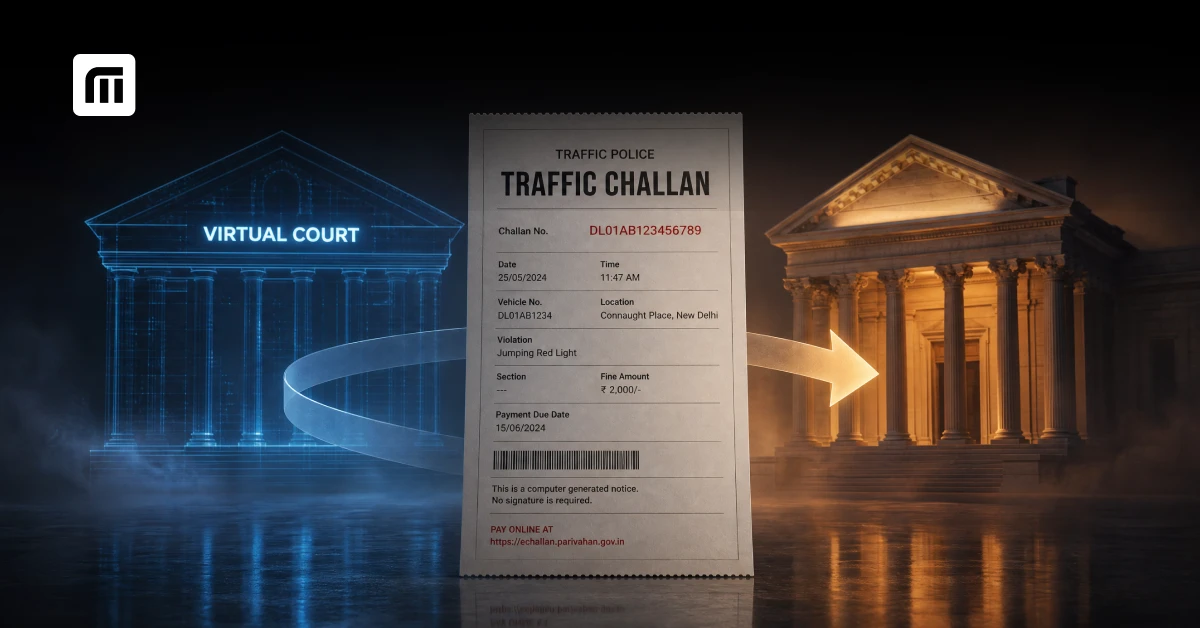
Seeing "Transferred to Court" instead of "Pending" can be a little stressful, especially if you are unaware about it.
But this doesn't always mean that you are in serious trouble. It's a very common part of how challans are processed.
Let’s get to know more about it. Check your latest challan status here.
Why Does a Virtual Court Traffic Challan Get Transferred to a Regular Court?
A virtual court challan may be transferred to a regular court when it cannot be resolved through simple online payment.
Basic reasons include non-payment within the stated period, choosing to contest the challan, disputed facts or evidence, or a need for personal appearance. If your case does need a personal appearance, here's exactly what the physical court visit involves.
Does Non-Payment Within a Deadline Trigger the Transfer?
Yes, it can. However, there is no fixed nationwide rule stating after how many days a challan goes to virtual court or regular court.
The timeline depends on the state, offence and court procedure.
Always follow the deadline shown on the challan, notice, SMS or Virtual Courts portal.
If no action is taken, your case may remain pending or be transferred for further court proceedings. Read what actually happens if a challan stays unpaid for too long.
Does Choosing “Request to Contest” Also Send Your Case to a Regular Court?
Yes. Selecting “Request to Contest” means you do not accept the challan for online settlement.
Your case is then transferred to a regular court, where you can present your explanation and evidence.
After submitting your request, download the acknowledgement or summons and check the assigned court and hearing date.
Can the Magistrate Reject a Virtual Court Case and Require a Physical Hearing?
Yes. If the case involves disputed facts, unclear evidence, document verification or legal arguments, the magistrate may direct it to a regular court.
This does not automatically mean that you are guilty or that a higher fine has been imposed.
It only means the case now needs a formal hearing instead of online disposal. Here's what to carry and expect at that physical hearing.
Virtual Court vs Regular Court: What Does "Transferred" Actually Mean?
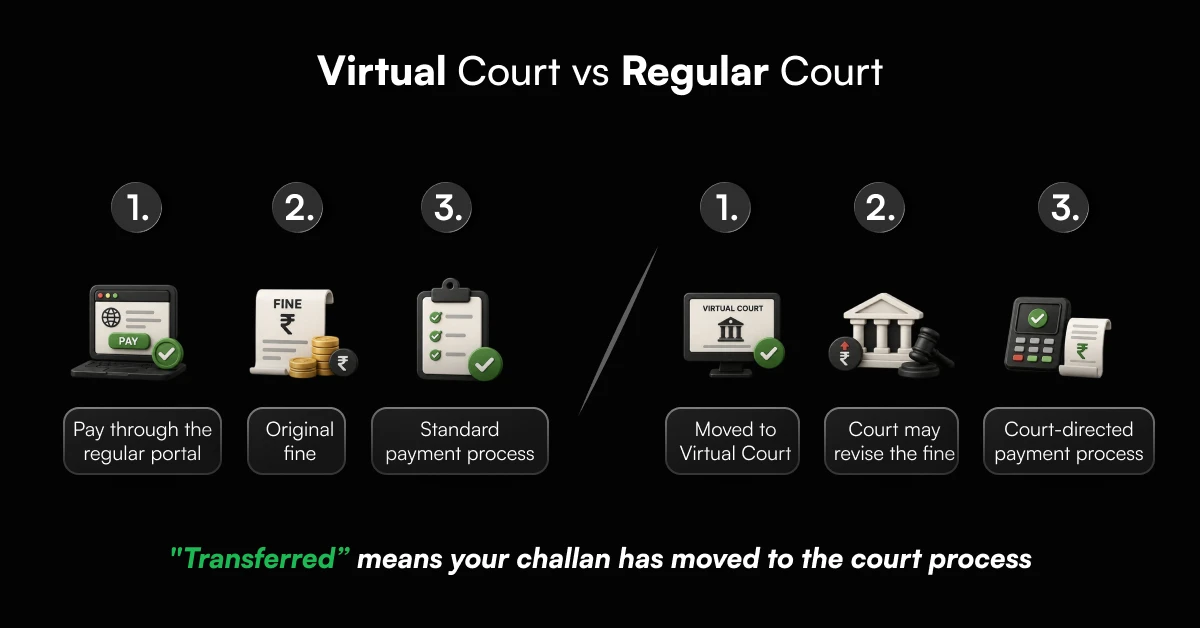
If your challan status suddenly changes to "Transferred to Virtual Court", you don’t need to panic.
It doesn't mean that you've committed a serious offence or that you're in legal trouble.
A virtual court challan simply means that your traffic challan has been moved from the regular payment system to an online court process.
This usually happens when a challan isn't paid within the allowed time or when the offence needs judicial processing.
So, what exactly is a virtual court challan?
It's an online system where certain traffic challans are handled digitally by the court instead of through the regular challan payment portal.
Depending on your case, you may be able to pay the court-imposed fine online, or you may receive further instructions from the court.
Here's the difference between them:
| Regular Pending Challan | Virtual Court Challan |
|---|---|
| Still available for payment through the normal challan portal. | Has been transferred to the virtual court for further processing. |
| Usually has the original fine amount. | The final amount may change based on the court's decision. |
| Can typically be paid directly online. | May need payment through the virtual court process. |
Is a "Transferred" Challan More Serious Than a Regular Pending Challan?
Not necessarily.
A challan pending in virtual court is not always more serious than a regular pending challan.
In many cases, it simply means the payment deadline has passed and the challan has entered the next stage of the legal process.
However, once a challan is transferred to the virtual court:
- You usually can't pay it through the normal challan payment portal.
- The court decides how the case should proceed.
- The payable amount may increase if the court imposes a higher penalty.
- Delaying action further can make resolving the case more difficult.
Check the current traffic fine rate list to see how much it could go up.
What Are the Immediate Consequences of a Transferred Traffic Challan?
When your challan is sent to court, the first thing that changes is how it can be resolved.
It is no longer treated like a regular pending challan that you can simply pay through the usual traffic challan portal.
Instead, your case is now handled by the court.
Depending on your state's process, you may be able to settle it through a virtual court, or you may need to appear before a regular court.
Do You Get Summons, or Just a Status Update?
Not every transferred challan results in an immediate court summons.
Often, the first thing you'll notice is a status update showing that your challan has been transferred to court.
If your case needs your presence, the court may later issue a summons.
If a summons has been issued, you can usually check it online through the Virtual Courts portal using the "View Summon" option.
This helps you know whether you need to appear in court or whether your case can be resolved digitally..
Does the Challan Fine Increase After Transfer to Regular Court?
It can. Once your challan is transferred to a regular court, the original fine is no longer guaranteed to remain the same.
The court reviews your case and decides the final penalty based on the nature of the offence and applicable traffic laws.
If you're wondering about how to pay challan transferred to regular court, the answer depends on your case.
Unlike a regular challan, payment usually cannot be made through the standard challan portal.
Instead, you'll need to follow the instructions given by the court, which may involve paying through the virtual courts portal or appearing before the court to settle the matter. Our guide on the physical court payment process covers this step-by-step.
What Happens If You Ignore a Transferred Traffic Challan?
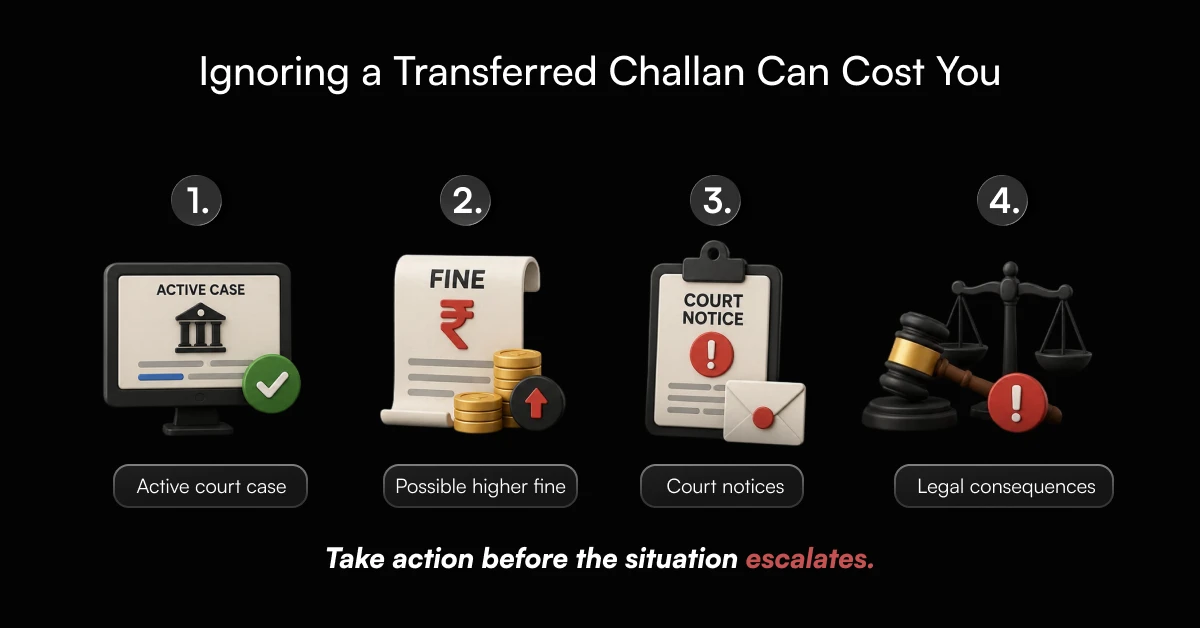
Well, ignoring a transferred challan can make your situation worse.
So, what happens if challan is not paid? Your case remains active in court, and you may have to pay a higher penalty or face further legal action.
If traffic challan is not paid for a long time, or if your vehicle challan is not paid after being transferred to court then you may receive court notices and face additional consequences depending on your offence and your state's rules. See the full breakdown of what happens when a challan is left unpaid.
Can Police Visit, Licence Suspension, or Vehicle Action Happen Next?
Yes, in some cases.
If you continue to ignore a court-transferred challan, the court may issue a summons, and authorities can take further action, including a driving licence suspended status or other legal proceedings where permitted by law.
If your licence is suspended and you are wondering about how to activate a suspended driving licence then it depends on the reason for suspension.
Usually, you'll need to comply with the court's directions and clear pending dues if applicable.
How Do You Check If Your Traffic Challan Has Been Transferred to Court?
The easiest way to check is to use use MyMotor's challan check tool.
With the MyMotor app, you can check challan status using your vehicle number and see whether your challan is still pending, paid, or has been transferred to court.
If it has, you'll also be able to view the latest court challan status or virtual court challan status, depending on how the case is being processed.
Checking your challan regularly helps you catch status updates early, so you can take action even before your case progresses further.
The good thing is, it only takes a few seconds and can save you from unnecessary delays or extra penalties. Download the MyMotor app to get status alerts automatically.
Can You Settle a Transferred Challan via Lok Adalat or Evening Court?
Well, yes, in some cases.
If your challan has been transferred to court, you may be able to settle it through a Lok Adalat traffic challan session or an Evening Court, if your state offers these options.
However, not every Lok Adalat challan is eligible.
It depends on the nature of the offence, the court handling the case, and whether your state has announced a National Lok Adalat traffic challan or special settlement drive. Check who actually qualifies for a Lok Adalat discount.
Who Is Eligible for Lok Adalat Settlement, and How Much Can the Fine Be Reduced?
Only eligible cases can be settled through traffic challan Lok Adalat proceedings.
When a Lok Adalat 2026 for traffic challan is announced, courts usually publish the list of eligible challans in advance.
If your case qualifies, you may be able to settle it quickly without a lengthy court process.
In a few states, the payable amount may also be reduced, but there is no fixed discount.
The reduction, if any, depends on the specific Lok Adalat notification and the court's decision. See our full Lok Adalat eligibility and discount guide.
Can a Challan Transferred to Court Be Sent Back to Virtual Court?
In most cases, no.
Once a transfer to regular court challan is accepted by the court, it usually stays under the court's jurisdiction until the case is resolved.
It isn't usually sent back to the virtual court for payment.
If you're unsure where your challan is being handled, check its latest status before taking any action.
This will tell you whether it needs to be settled through the virtual court or the regular court.
How Does a Transferred Challan Affect Your Driving Record or Insurance?
A single transferred challan doesn't directly affect your insurance premium.
However, repeated traffic violations or serious offences under the Motor Vehicles Act, such as those covered under Sections 177 and 183, can become part of your enforcement history and may lead to stricter penalties.
In most cases, repeated violations can also result in licence-related action by the transport authorities. Compare and renew your car insurance or bike insurance to avoid a high-risk premium hike.
What Should You Do the Moment You See "Transferred to Court" on Your Challan Status?
Don't ignore it. Take action as soon as you notice the status change.
Here's what you should do:
- Check whether the challan has been transferred to a virtual court or a regular court.
- Follow the instructions shown for your case.
- If it's a Virtual Court case, learn how to pay virtual court challan through the official process.
- If you're looking for how to pay challan in virtual court, you'll typically need to use the Virtual Courts portal and follow the payment steps provided for your case.
The sooner you act, the easier it is to resolve the challan and avoid unnecessary delays or legal proceedings.