
Seeing “challan sent to court” can feel stressful when you don’t know what to do next.
But the process is often simpler than it seems.
This step-by-step blog explains how to find the right court, carry the needed documents, and pay or contest your challan without confusion.
Let’s get started. Check your challan status instantly
When Does a Traffic Challan Require a Physical Court Visit?
A physical traffic challan court visit may be needed when the matter cannot be settled through your regular e-challan portal or virtual court.
This usually happens when:
- Your challan has been transferred to a regular court
- The court has issued a summons asking you to appear
- You choose to contest the alleged violation
- No online payment option is available
- The offence needs the magistrate to examine the facts
- Supporting documents or evidence need to be verified
- The matter involves a serious, repeated or disputed offence
However, the words “challan sent to court” do not always mean that you must visit a physical court instantly.
Some challans are first sent to virtual court and can still be settled online. you can still close it via the Virtual Court process.
Which Offences Aren’t Eligible for Virtual Court Payment?
Well, there is no single nationwide list of traffic offences that are always excluded from virtual court.
Eligibility can depend on:
- The type of offence
- The state or traffic department
- Whether the challan is compoundable
- Whether personal appearance has been ordered
- Whether the case has already been transferred to a regular court
- Whether the driver wants to plead guilty or contest the violation
Here’s a simple way to check-
Search for your case on the official Virtual Court portal.
Status shown
What it usually means
| Status shown | What it usually means |
|---|---|
| Pay Fine | The challan may be settled online. |
| Request to Contest | You can dispute the challan and request a court hearing. |
| Transferred to Court | Follow the assigned physical court details. |
| No payment option | The case may require further processing or a court visit. |
Do not assume that a payment option will appear later. Check the court status and follow the instructions shown against your case.
if your case is old or has multiple pending fines, check if Lok Adalat settlement applies to you.
How Do You Know If Your Challan Has Been Sent to Court?
You can check whether your challan has been sent to court by searching for it on MyMotor's challan check tool or on the official e-challan portal using the challan number, vehicle registration number, or driving licence number, where supported.
If it has been transferred, your status may show details such as “Sent to Court,” “Forwarded to Court,” or “Virtual Court,” along with the court name, address, case or CNR number, hearing date, or date of transfer.
You may also receive an SMS confirming that your challan has been forwarded to court.
What Does “Sent to Court” Mean on a Traffic Challan?
It means that the traffic department has forwarded your case to the judicial system for further action.
It does not automatically mean:
- You have been convicted
- You need a lawyer
- You will be arrested
- You must visit the court the same day
- The fine has automatically increased
Read what actually happens if a challan stays unpaid for too long.
Your case may still be available for online settlement through virtual court.
And a physical visit is usually needed only when the matter is assigned to a regular court or the court specifically directs you to appear.
How Do You Find Out Which Court and Date You Need to Visit?
Before travelling, just confirm the following:
- Exact court name
- Court complex or address
- Hearing date
- Courtroom or magistrate details, if available
- Challan, CNR or case number
Do not visit the nearest RTO, traffic police station or district court without checking first.
The matter usually needs to be handled by the court that has jurisdiction over the challan.
Where on the Challan or SMS Is the Court Name and Date Mentioned?
Court details may appear on the printed challan, traffic court summons, virtual court acknowledgement, e-challan status page, eCourts case-status page, or in an official SMS from the traffic department or court.
Look for labels such as “Court Name,” “Court Complex,” “Date of Appearance,” “Hearing Date,” “Next Date,” “Case Number,” “CNR Number,” or “Magistrate Court.”
Since an SMS might have only a reference number or a basic notification, always verify the details on the official portal before visiting the court.
What If the Challan Message Does Not Mention a Court Date?
Well, do not visit the court based only on an incomplete message. Try the following steps to confirm it yourself:
Step 1: Check the e-challan portal: Search using your challan or vehicle details and review the current status.
Step 2: Check Virtual Court: Your matter may still be available for online payment or contest.
Step 3: Search on eCourts: If your case has been registered in a regular court, search using:
- CNR number
- Case number
- Party name
- Court establishment
- Other available case details
Step 4: Contact the concerned office: If no date is being shown online, contact the traffic department or court enquiry section mentioned against the challan.
The case may still be under transfer and may not have received a hearing date yet.
Can You Check the Court Details Online Before Visiting?
Well, yes. It is advisable to verify your court details online before leaving, as this can help you confirm where and when you need to appear.
Depending on your case, the online record may show the court name, court complex, next hearing date, current case stage, case history, orders passed, summons details, or cause-list information.
Before visiting, make sure to save a screenshot or take a printout showing the case number, court name, hearing date, vehicle number, and current status.
This can be useful at the enquiry desk, especially when the original challan or SMS does not give whole information.
What Documents Should You Carry to Traffic Court?
A missing document can delay even a simple challan hearing.
Carry a properly arranged folder instead of relying only on documents stored on your phone.
Here’s a Traffic court document checklist you can refer to:
- Copy of the challan
- Court summons or notice
- Latest case-status printout
- Driving licence
- Vehicle Registration Certificate
- Valid motor insurance
- Valid PUC certificate
- Government-issued photo ID
- Photocopies of important documents
- Payment or transaction proof, if already attempted
- Supporting evidence, if contesting the challan
See the full list of mandatory driving documents in India
Tip: Arrange your papers in the same order as the checklist. It makes verification at the counter much faster.
Do You Need Your Original DL, RC and Insurance, or Copies?
Yes you might, so make sure to carry both originals and copies wherever possible.
| Document format | Why you should carry it |
|---|---|
| Original document | May be needed for verification. |
| Photocopy | May be requested for the court record. |
| DigiLocker or mParivahan copy | Useful as an officially recognised digital backup. |
| Screenshot or downloaded PDF | Helpful, but may not replace an official digital record in every situation. |
Digital DL and RC records available through DigiLocker or mParivahan are officially recognised. Learn how to download or update your RC.
However, the court may still ask to see a specific document or request a photocopy.
And avoid handing over your only original document permanently unless an authorised official formally requests it.
Should You Carry Aadhaar or Another ID Proof Too?
Well, it is useful and enough to carry one valid government-issued photo ID.
This may include:
- Aadhaar
- Voter ID
- Passport
- Driving licence
- Another accepted government ID
Aadhaar is not universally mandatory for every traffic court matter. The purpose of the ID is usually to verify the identity of the person appearing.
What Supporting Documents Help If You Want to Contest the Challan?
Here are the documents you might need in order to contest a challan:
| Issue | Carry This Proof |
|---|---|
| Wrong vehicle/number plate | Vehicle photos, RC, cloning complaint. |
| Wrong location/time | GPS, toll receipt, dashcam, timestamped photos. |
| Vehicle already sold | Sale proof, transfer application, buyer communication. |
| Valid documents | DL, insurance, PUC valid on the offence date. |
Make sure to keep your proof relevant, clear and date-wise. Check the current traffic fine rates to know if contesting is worth the effort
What Happens Step-by-Step When You Reach the Court?
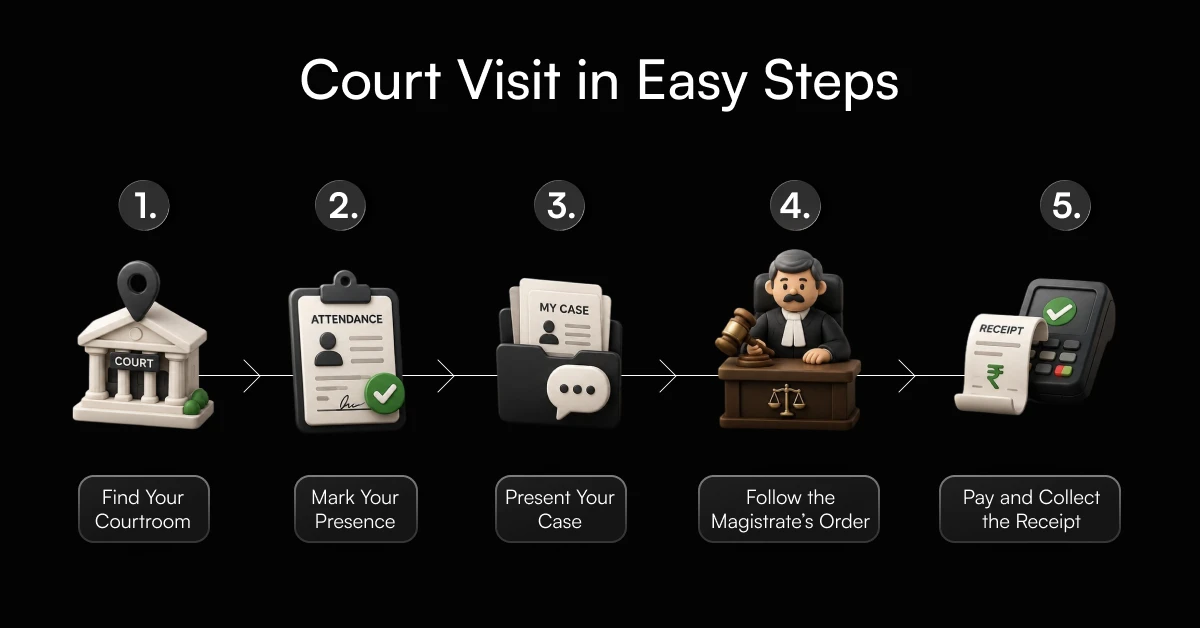
The exact traffic court process may vary, but most physical challan visits usually follow a similar pattern.
1. Enter the court complex
Complete the security check and keep your ID and summons easily accessible.
2. Visit the enquiry or help desk
Here show your:
- Challan
- Summons
- Hearing date
- CNR or case number
Ask for the relevant courtroom, challan counter or traffic magistrate.
3. Mark your presence
Depending on the court, you may need to:
- Sign an attendance sheet
- Submit a summons copy
- Obtain a token
- Register at the help desk
- Confirm your case on the cause list
4. Wait for your case to be called
Your case may be called by:
- Name
- Case number
- Challan number
- Serial number on the cause list
5. Appear before the magistrate
You may be asked whether you:
- Accept the violation
- Plead guilty
- Want to contest the challan
- Have any explanation or evidence
6. Follow the court’s order
The magistrate may:
- Confirm the fine
- Reduce or modify it where legally permissible
- Dismiss the matter
- Ask for additional documents
- Fix another hearing date
- Direct you to the payment counter
7. Pay through the authorised method
Complete the payment only at the designated counter or official digital facility.
8. Collect your receipt
Before leaving, verify that the receipt contains the correct:
- Name
- Vehicle number
- Case or challan number
- Amount
- Date
- Transaction number
How Do You Find the Traffic Magistrate’s Counter?
Go to the court enquiry desk and show your summons or case-status printout.
You can also check the daily cause list for the courtroom number, magistrate name and case number.
And avoid unofficial agents offering cash settlements.
What Does the Judge or Magistrate Actually Ask?
The magistrate may ask whether you are the driver or owner, whether you accept or contest the offence, and whether you have any proof or explanation.
Answer clearly and ask for clarification if needed.
Do You Need to Stand in a Queue or Register At the Help Desk First?
Usually, yes. You may need to visit the entry gate, enquiry desk, attendance counter, courtroom and payment counter.
You can also reach early to complete the process without rushing.
How Do You Pay the Fine at Court-Cash, Card or UPI?
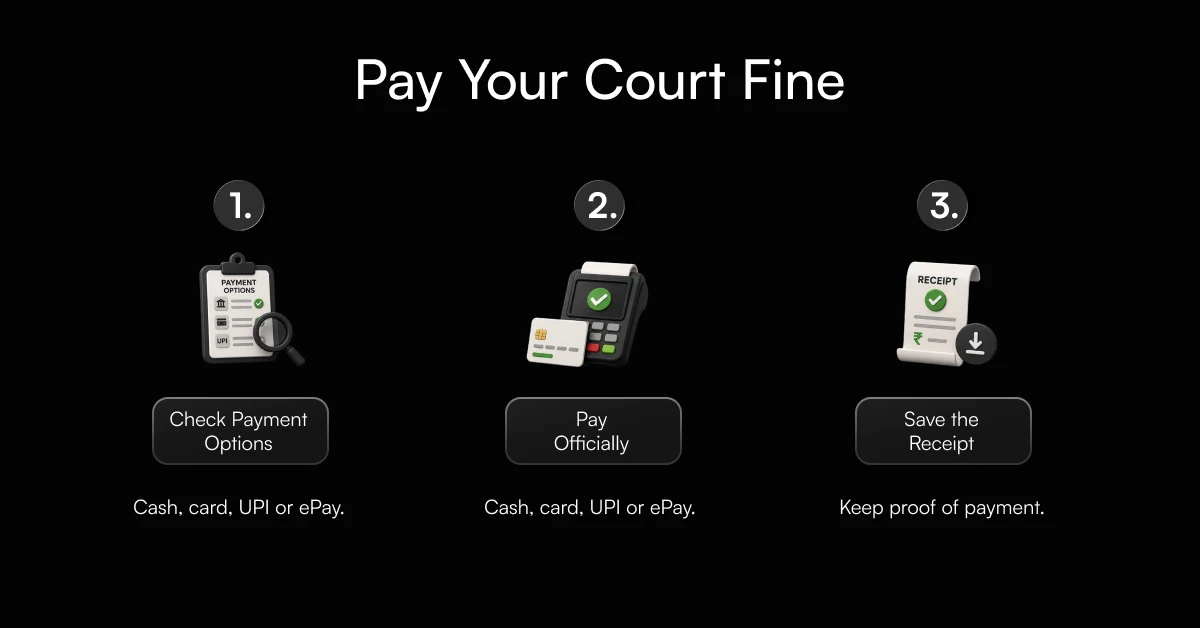
Payment options vary from one traffic court to another.
Depending on the facilities available, the court may accept cash, debit or credit cards, UPI, bank challan, treasury payment, Court ePay, or another authorised online method.
It is advisable to confirm the accepted payment mode at the enquiry or payment counter before proceeding and always collect the official receipt after paying the fine or download the MyMotor app to track all your challan payments in one place
Which Payment Methods Are Accepted in Traffic Court?
Basically, accepted payment methods depend on the court’s facilities and the state system. To avoid inconvenience, remember to carry:
- A working UPI app
- A debit or credit card
- Some cash
- Bank account details, if needed
Safe Payment Options
- Authorised court cash counter
- Official court POS machine
- Government UPI QR code displayed at the counter
- Official Court ePay or Virtual Court portal
- Bank or treasury challan issued by the court
Avoid
- Personal UPI IDs
- QR codes shared through WhatsApp
- Cash payments without an official receipt
- Unauthorised agents
- Unknown payment links received by SMS
Do You Get a Receipt Immediately After Payment?
After making the payment, collect an official receipt or acknowledgement and check that it includes the challan or case number, vehicle registration number, amount paid, payment date, court or department name, and receipt or transaction number.
Do not leave the court based only on a verbal confirmation that your payment has been completed.
What Should You Do If the Payment System Fails?
Do not keep attempting the payment without checking whether the money has already been debited.
Follow this order to be extra safe:
- Take a screenshot of the error
- Check your bank or UPI transaction status
- Note the transaction reference number
- Ask the authorised court counter to verify it
- Check whether a receipt can be reprinted
- Attempt another payment only after confirming that the first one failed
If any amount was debited but the receipt was not generated, keep both the bank proof and the error screenshot.
What If You Want to Contest the Challan Instead of Paying?
Well, you do not have to pay a challan if you believe it is wrong.
You can contest it if the vehicle is not yours, the number plate was read incorrectly, the vehicle had already been sold, or you were not at the mentioned location.
You can also challenge it if your licence, insurance or PUC was valid, the date or place is incorrect, or the evidence does not clearly show the violation.
If your challan appears on the virtual court portal, you may select “Request to Contest.”
Your case may then be sent to a physical court, where you can explain your side to the magistrate.
What Evidence Should You Bring If You Contest the Challan?
Bring evidence that directly answers the allegation. A simple contest file can contain:
- One-page written explanation
- Copy of the challan
- Vehicle and identity documents
- Photographs, receipts or video evidence
- Ownership-transfer records, where relevant
- Original files or devices containing the evidence
For example, if a challan claims your car was in Delhi but you have a toll receipt showing that it was in Jaipur at the same time, place the toll receipt immediately after your written explanation.
Can You Request the Court to Hear the Matter on Another Date?
Well yes, you may request an adjournment, but the court is not needed to grant it.
Give a genuine reason and supporting proof, such as:
- Medical emergency
- Unavoidable travel
- Family emergency
- Missing essential evidence
- Unavailability of a necessary witness
The magistrate will decide whether another hearing date should be given or not.
So, do not skip the hearing merely because you have submitted or plan to submit an adjournment request.
Is Contesting Better Than Paying in Every Case?
Well, that’s not true for every case. Contesting can need more time, paperwork and additional hearings.
It is only useful when there is a real dispute, not simply because you do not want to pay the fine.
| Paying may be practical when | Contesting may be appropriate when |
|---|---|
| The violation is correct. | The challan is factually incorrect. |
| The evidence clearly supports the offence. | The vehicle or number plate is wrong. |
| The fine is straightforward. | You have strong supporting evidence. |
| You want to close the matter quickly. | The case may affect your licence or record. |
| There is no genuine defence. | The allegation involves a serious error. |
What Happens If You Miss Your Court Date?
Usually missing a challan hearing date should not be ignored. Depending on your case, the court may:
- Give another date
- Record your absence
- Issue a fresh summons
- Ask you to explain the non-appearance
- Pass another procedural order
- Take stricter action in serious matters
A missed hearing can also risk your driving licence status - here's how licence suspension works.
And the outcome depends on the offence, previous court directions and the magistrate’s order.
Will the Court Issue a Fresh Date or Penalty?
A fresh date may be given, but it is not automatic.
There is also no single nationwide penalty that applies every time someone misses a traffic court hearing.
So, make sure to check the case history or latest order online to find out what the court has actually directed.
Can Missing the Date Increase the Fine?
Missing one date does not automatically increase the original fine in every case.
However, the delay may create:
- Additional court visits
- Further legal steps
- Travel expenses
- Lost working time
- Lawyer’s fees
- Stricter procedural directions
Your court may also take appropriate action if repeated absences appear intentional.
What Should You Do Immediately If You Missed the Hearing?
Take these steps as soon as possible:
- Check the case status on eCourts
- Look for the latest order or next date
- Contact the concerned court enquiry section
- Keep proof explaining why you missed the date
- Attend on the next date shown
- Seek legal advice if a warrant or serious order has been issued
Do not wait for another SMS. Court records may update online before a fresh message reaches you.
How Long Does the Physical Court Process Usually Take?
Well, there is no fixed duration for a court challan process in India.
A simple matter may be completed in one visit or a disputed case may need several hearings.
What Affects the Waiting Time?
The total time can depend on:
- Number of cases listed that day
- Court crowd
- Availability of the magistrate
- Type of traffic offence
- Whether you plead guilty or contest
- Whether documents need verification
- Payment-system availability
- Need for witnesses or police records
- Previous hearing history
Can a Simple Challan Be Closed the Same Day?
Yes, a minor challan can often be settled on the same day, especially if you reach the right court, your case is listed, and you have all the needed documents.
Once you accept the offence, the magistrate may pass an order, after which you can pay the fine and complete the process.
However, same-day closure is not guaranteed, so keep enough time for the court visit and avoid planning it between other urgent appointments.
How Long Does Payment Confirmation Usually Take?
The physical receipt should normally be issued when the payment is successfully completed.
The online record may take additional time to update because court, traffic-police and e-challan systems may not update simultaneously.
For practical approach:
- Check after 48 to 72 hours
- Check again over the next few working days
- Follow up if the status remains pending for an unreasonable period
This is only a practical follow-up window, not a uniform legal deadline.
After the Court Visit: What Should You Do With the Receipt?
After the court visit, keep the receipt safely because it is your main proof that you appeared before the court, paid the fine and followed the court’s order.
Save the original receipt, court order, payment acknowledgement, bank or UPI transaction proof, and a screenshot of the updated challan status.
Also keep a scanned copy or clear photograph and store the digital files in a cloud folder or email them to yourself for easy access later.
How Do You Confirm the Challan is Closed Online?
To confirm that your challan is closed, check its status on MyMotor's e-challan check page, Virtual Court portal, eCourts Services, or the relevant state traffic-police portal.
Look for updates such as “Paid,” “Disposed,” “Closed,” “Fine Deposited,” or “Case Disposed.”
Since different portals may show different stages, check more than one platform when needed.
Should You Keep a Screenshot or Printed Copy of the Receipt?
Ideally you should keep both.
A printed copy is useful when visiting an office or court counter. A digital copy is useful if the paper fades, tears or gets lost.
Keep the proof at least until:
- The online status is updated
- The case is shown as disposed
- Any licence or vehicle-related issue is cleared
What If the Challan Still Shows Pending After Payment?
Do not pay the same challan again immediately.
First verify all the details, such as:
| Detail to compare | What to check |
|---|---|
| Challan number | Matches the paid challan. |
| Vehicle number | No spelling or digit error. |
| Case number | Correct court case was paid. |
| Amount | Matches the court order. |
| Payment date | Correctly recorded. |
| Transaction ID | Available for verification. |
If everything matches, allow some time for the systems to update and then contact the relevant authority.
What Should You Do If the Challan Is Still Pending Later?
A pending challan after court payment may be caused by a delay in data transfer between the court and traffic department.
It does not always mean that your payment failed, but the issue should not be ignored.
How Long Should You Wait Before Rechecking Status?
A practical follow-up sequence is:
- First check: after 48 to 72 hours
- Second check: after a few working days
- Follow-up: if the status still remains unchanged
There is no single nationwide update period because different states and courts use different systems.
Who Should You Contact If the Status Does Not Update?
Contact the authority currently responsible for the case.
This may be:
- Court payment counter
- Court registry
- Traffic police challan department
- State e-challan helpdesk
- Virtual Court support
- District court technical section
- Concerned High Court support team
Start with the contact details shown on your court receipt, summons or official status page.
What Proof Should You Keep for Follow-Up?
Well, make sure to keep a complete follow-up file containing:
- Challan copy
- Court receipt
- Court order
- CNR number
- Case number
- Vehicle number
- Transaction reference
- Bank statement or UPI proof
- Screenshots showing the pending status
- Complaint or grievance acknowledgement
- Date and name of the office contacted
Share copies during follow-up and keep your original receipt safely with you and keep your vehicle documents backed up using MyMotor's Vehicle RC lookup.