
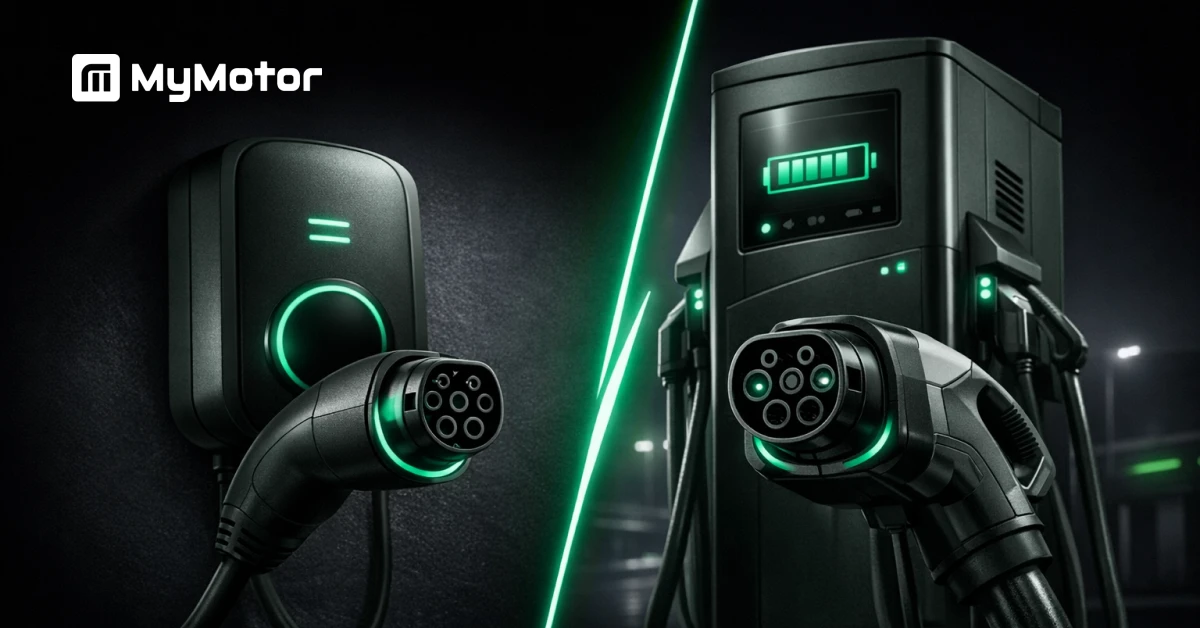
Finding an EV charger is easy. Finding the right charger is where most EV owners get confused. Before choosing a charger, it also helps to understand EV charging connector types like Type 2 and CCS2.
You open the map, see a few charging points nearby, and suddenly you’re staring at terms like AC, DC, Type 2, CCS2, 7 kW, and 50 kW. All you really want is a full battery and a smooth drive.
The good news is that AC and DC charging are not complicated once you understand the basics. In simple terms, AC charging is better for regular everyday use, while DC charging is better when you need speed.
AC vs DC Chargers: What Is the Main Difference?
The main difference between AC and DC charging is where the power gets converted before it reaches your EV battery.
An AC charger sends alternating current to your vehicle first. Your EV’s onboard charger then converts that AC power into DC power, because the battery can only store DC power.
If you want a deeper breakdown of plugs and compatibility, read our EV charging connector guide.
A DC charger does the conversion inside the charging station itself. It sends DC power directly to the battery, which makes charging much faster.
This becomes clearer when you compare charger types with connector standards such as Type 2 and CCS2.
So, in simple words:
- AC charger = power conversion happens inside the car.
- DC charger = power conversion happens inside the charging station.
That is why DC charging is usually faster, while AC charging is commonly used for daily charging.
Which Charger Is Better for Your EV?
There is no single charger that is best for every EV owner. The right choice depends on how you use your car. For model-wise charging times, compare this with our EV charging time guide for Indian EVs.
For everyday charging, an AC charger usually makes more sense. It works well when your car is parked for a few hours at home, in an office, in an apartment, or at a mall. It may be slower, but it is usually more cost-friendly and fits normal daily routines.
A DC charger is better when you need a quick top-up. If your battery is low during a long drive, or you need to add range quickly before continuing your trip, DC charging is the better option because it saves time.
The easiest way to decide is to ask yourself:
- How much time do I have?
- How low is my battery?
- How far do I need to drive?
- Is the right charger available nearby?
- How much will the charging cost?
- How much charging speed can my EV support?
Why Is a DC Charger Faster?
A DC charger is faster because it skips one major step. To understand why connector type matters here, see our EV charging connector guide.
In AC charging, the power first goes through the EV’s onboard charger. That means even if the charger is powerful, your car can only accept power up to its own charging limit.
In DC charging, the charger bypasses the onboard charger and sends high-power DC energy directly to the battery. That is what makes DC fast charging much quicker than AC charging.
But charging speed still depends on other factors too, including battery size, battery temperature, current state of charge, and the EV’s maximum charging capacity.
How Do AC and DC Chargers Compare in Cost?
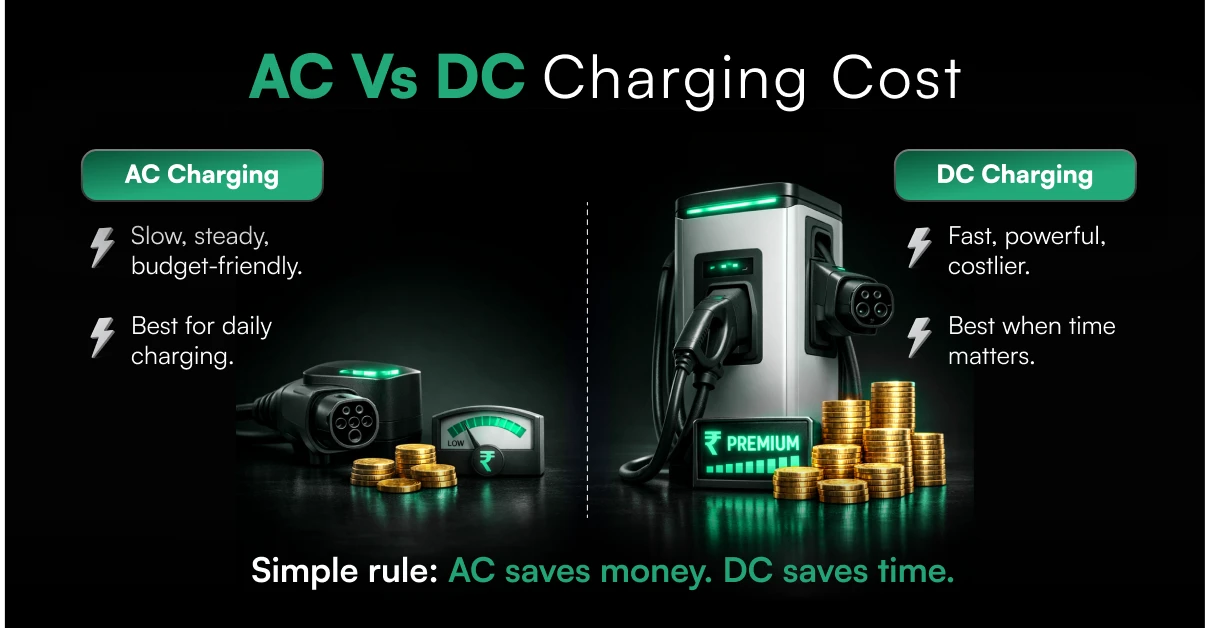
When it comes to cost, AC charging is usually the more affordable option.
AC charging is ideal for daily use because it is slower, simpler, and often used at home or in places where the car stays parked for longer periods. That makes it more practical for routine charging.
DC charging costs more because it uses faster, more powerful infrastructure. The extra cost can still be worth it when you are on a highway trip, low on battery, or short on time.
Cost Difference Between AC and DC Charging
When it comes to cost, an AC charger is usually the more affordable option. It works well for daily charging, especially at home, where your car can stay plugged in for longer hours.
Whereas a DC charger costs more because it uses faster and more powerful charging infrastructure.
But when you are on a long trip, low on battery, or in a hurry, the extra cost can be actually helpful.
| Factor | AC Charger | DC Charger |
|---|---|---|
| Charging speed | Slower | Faster |
| Best for | Daily charging | Fast top-ups |
| Common use | Home, office, parking | Highways, public fast chargers |
| Infrastructure | Simpler and cheaper | More powerful and expensive |
| Time vs cost | Saves money | Saves time |
So, for everyday use, AC charging usually makes more financial sense. For travel or emergencies, DC charging is worth the extra cost because it gets you moving faster.
Is DC Fast Charging Safe?
Yes, DC fast charging is safe when used properly.
Modern EVs are built with battery management systems that control charging speed, temperature, and power flow to protect the battery. That system helps prevent damage during fast charging sessions.
That said, frequent DC charging can generate more heat than AC charging. Over time, too much heat may affect battery health if fast charging is overused. That is why many EV owners use DC charging when needed and AC charging for routine use.
When Should You Use an AC Charger?
Use an AC charger when you have enough time and do not need a quick charge.
AC charging is the better choice when:
- You are charging at home.
- Your car is parked overnight.
- You are at the office for several hours.
- You are parked at an apartment, mall, or public parking space.
- You want a lower-cost charging option.
- You do not need urgent range.
- You want a regular everyday charging routine.
For most EV owners, AC charging is the simplest and most convenient daily habit.
When Should You Use a DC Charger?
Use a DC charger when speed matters more than cost.
DC charging is the better choice when:
- You are on a long drive.
- Your battery is low and you need quick range.
- You are charging at a highway EV charging station.
- You have limited time.
- You need a quick top-up before continuing your trip.
- You cannot wait for slow charging.
- You are travelling between cities.
DC charging is especially useful when you need to reduce waiting time and get back on the road quickly.
Use the MyMotor app on Google Play to find DC fast chargers near you in real time — check live availability before you drive.
What Are the Common Charger Types in India?
In India, most electric cars use Type 2 for AC charging and CCS2 for DC fast charging. These are the most common connector standards you will see at home chargers and public charging stations.
What Is Type 2 Charging?
Type 2 is the standard AC charging connector used widely in India and Europe. It is commonly used for home charging, office charging, and slower public charging points.
What Is CCS2 Charging?
CCS2 is the standard DC fast charging connector used across India for fast charging. It is designed for higher power delivery and is the connector you will usually see on public fast chargers and highways.
Read: EV Charger connector guide
Why Do Connectors Matter?
Not every charger works with every EV. If the connector type does not match your vehicle’s inlet, the car simply will not charge. That is why connector compatibility is just as important as charger speed.
How Do You Choose the Right Charger for Your EV?
The best charger is the one that matches your routine, your budget, and your EV’s charging capability.
If you mostly drive short distances and can plug in overnight, AC charging is usually enough. If you take frequent highway trips or need fast top-ups, DC charging becomes more useful.
Before choosing a charger, check these things:
- Your EV’s supported charging type.
- Your EV’s maximum AC and DC charging limit.
- Connector compatibility.
- Charger availability — check 3,000+ live stations across 30+ networks before you leave.
- Charging cost.
- Your parking time.
- Your daily driving distance.
That simple checklist helps you avoid choosing the wrong charger at the wrong time.
What are the Common Mistakes EV Owners Make While Choosing Chargers?
Choosing the nearest charger is not always the best decision.
Here are the most common mistakes EV owners make:
- Choosing only the nearest charger.
- Not checking whether it is AC or DC.
- Not checking connector compatibility.
- Assuming every public charger is fast.
- Ignoring the EV’s charging capacity.
- Not checking charger availability.
- Not checking pricing before reaching.
- Not checking payment options.
- Using DC charging when AC charging is enough.
- Waiting until the battery is too low.
A little checking before you leave can save time, money, and battery stress.
What Is the Best Charging Strategy for Daily Use?
The smartest charging strategy is to use AC charging for routine use and reserve DC charging for travel or emergencies.
That gives you the best mix of convenience, cost, and battery-friendly habits. For most EV owners, the practical routine is simple: charge at home overnight, use public DC charging only when you actually need speed.
If you own a car like the Tata Nexon EV, manufacturer specs show clear differences between AC and DC charging times. Tata’s published specifications list 10% to 100% charging in about 6.6 hours with a 7.2 kW AC fast charger and 10% to 80% in about 40 minutes with a 60 kW DC fast charger.
conclusion
AC charging is better for daily, low-cost, long-duration charging. DC charging is better for fast top-ups, highway stops, and urgent situations.
If you understand your driving pattern and your EV’s charging limits, choosing the right charger becomes easy. The best rule is simple: AC for routine, DC for speed. To find both AC and DC chargers near you across 30+ networks, download the MyMotor EV charging app — available free on Google Play.