
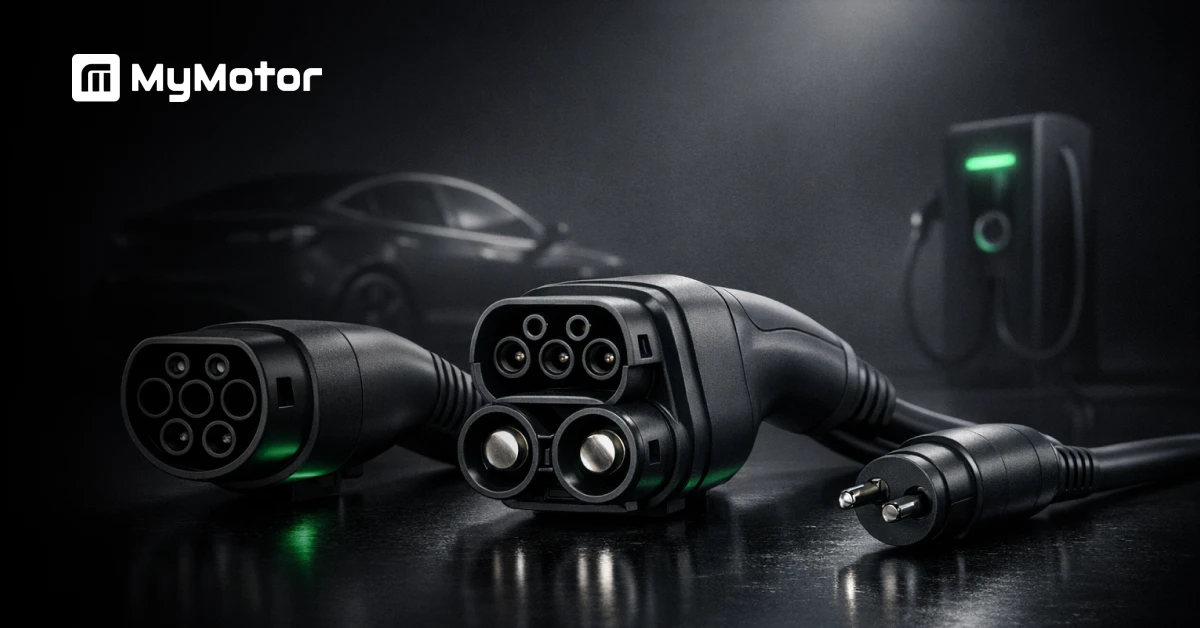
Not all EV chargers are the same. Not all plugs fit every car.
And if you've been to a charging station only to find that the connector doesn't match you know how frustrating that is.
But why do some EVs charge in 30 minutes while others take hours? Why does one charging cable look nothing like another?
It all comes down to connector types.
Let’s start to know more.
What are EV charging connector types?
EV charging connector types are the different plug and socket designs used to connect an electric vehicle to a charger.
They are quite similar to phone chargers.
Not every cable fits every phone. Similarly, not every EV charger fits every EV.
The connector type usually depends on the vehicle model, charging speed, and whether it supports AC or DC charging.
Common EV charging types in India consist of slower AC chargers for daily use and faster DC chargers for quick top-ups.
Why Do EV Connector Standards Vary by Region?
Now, EV connector standards vary because different countries built their EV systems differently.
Europe usually uses Type 2 and CCS2, Japan uses CHAdeMO, China has GB/T, and India follows a mix of local and global standards.
That is why a connector common in one country may not be the main standard in another.
What Is the Difference Between AC and DC Charging Connectors?
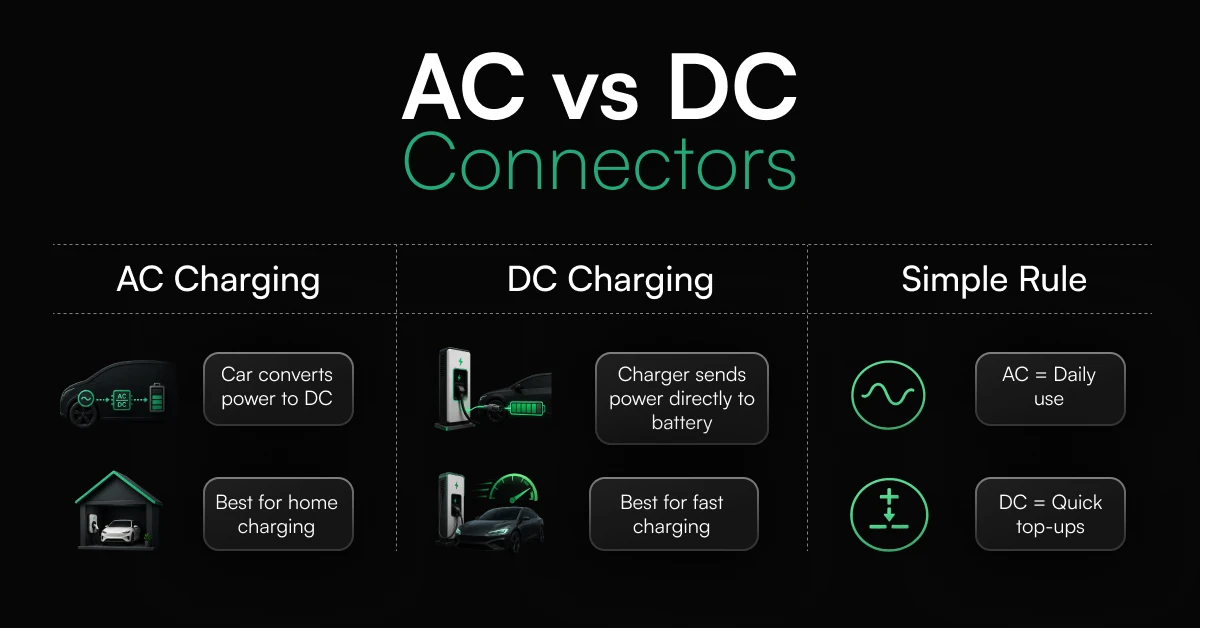
Well here the main difference is how power reaches the battery.
In AC charging, the charger sends AC power to the vehicle.
The car then converts it into DC power using its onboard charger. This makes AC charging quite slower and better for homes and daily charging.
In DC charging, the charger converts the power first and sends DC power directly to the battery.
This makes DC charging much faster and useful for highways, malls, and public fast-charging stations.
AC charging = slower, ideal for daily charging.
DC charging = faster, ideal for long drives.
Which EV Charging Connector Types Are Most Common?
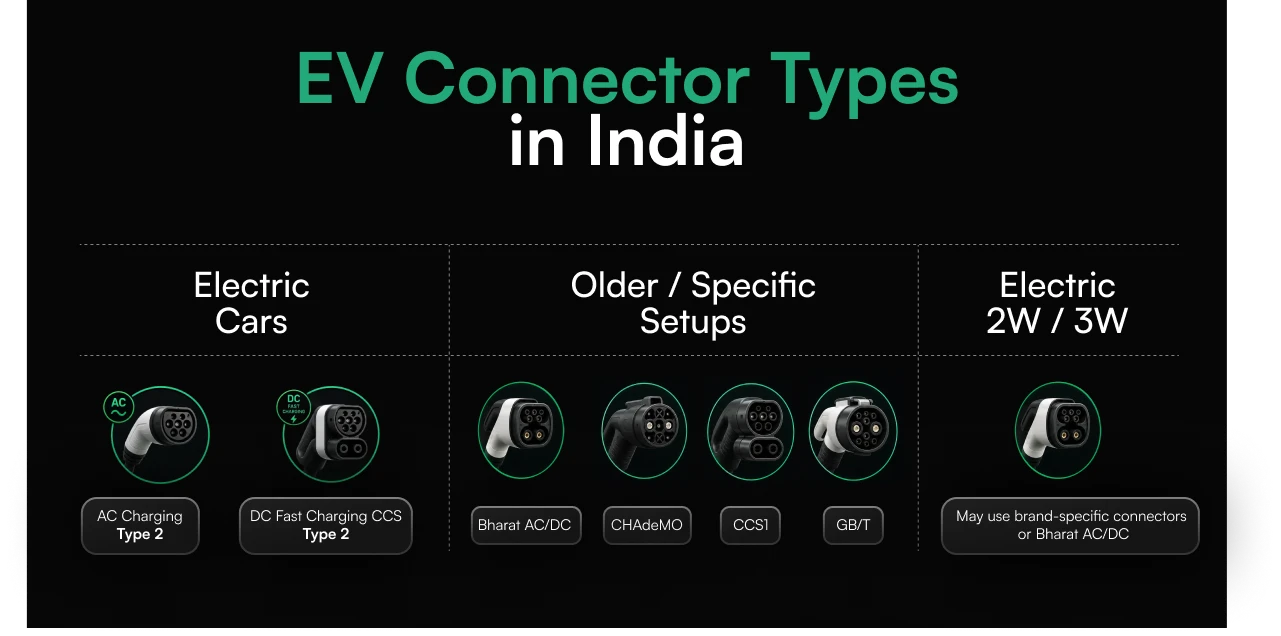
The most common EV charging connector types include Type 1, Type 2, CCS Type 1, CCS Type 2, CHAdeMO, and NACS.
In India, for most electric cars, Type 2 is commonly used for AC charging, while CCS Type 2 is widely used for DC fast charging.
Obviously, other connector types exist globally, but they might not be that common in India.
1. What Is Type 1 or J1772?
Type 1, also called J1772, is an AC charging connector mostly used in North America and some older EV models.
It is mostly used for slow or regular charging, like home charging or public AC charging. Type 1 does not support DC fast charging on its own.
In really easy words, Type 1 is an older-style EV charging connector for AC charging, but it is not the main standard for most new EVs in India.
2. What Is Type 2 or Mennekes?
Type 2, also called Mennekes, is one of the most widely used AC charging connectors, specifically in Europe and India.
It is commonly used for home chargers, office chargers, mall chargers, and other public AC charging points.
And many EV cars in India use Type 2 for regular AC charging, so think of Type 2 as an everyday charging plug for many electric cars.
3. What Is CCS Type 1?
CCS Type 1 is a fast-charging connector based on the Type 1 design.
It combines your regular Type 1 AC connector with extra pins for DC fast charging. This also allows one vehicle port to support both AC and DC charging.
CCS Type 1 is usually used in North America and is not that common in India.
4. What Is CCS Type 2?
CCS Type 2 is one of the most important EV charging connector types in India.
It is based on the Type 2 connector but adds two larger pins for DC fast charging.
This means the same vehicle port can support normal AC charging and faster DC charging also.
In India, CCS Type 2 is mostly seen on electric cars and public fast chargers.
5. What Is CHAdeMO?
CHAdeMO is a DC fast-charging connector that was mainly used by some Japanese EV brands.
It was quite popular in the earlier phase of EV adoption, but many newer EV markets have shifted to CCS connectors for fast charging.
In India, CHAdeMO might still be seen at some older charging stations, but it is not really the main connector for new electric cars.
6. What Is NACS or Tesla’s Connector?
NACS stands for North American Charging Standard.
It started as Tesla’s connector and is now becoming more popular in North America.
It can support both AC charging and DC fast charging through a compact connector. However, NACS is only relevant in markets like the US and Canada.
For Indian EV owners, NACS is not the connector to look for right now. Type 2 and CCS Type 2 are more suitable for the majority of electric cars in India.
Which Connector Types Are Used in India?
In India newer electric cars use Type 2 for AC charging and CCS Type 2 for DC fast charging, while some older or specific setups may use Bharat AC/DC, CHAdeMO, CCS1, or GB/T.
To check which connector types are available at public chargers near you, use the MyMotor EV charging app — it maps 3,000+ stations across Type 2, CCS2, CHAdeMO, and Bharat AC/DC connectors in one place.
Which Connectors Are Most Common in Indian EVs?
Well, for modern electric cars in India, Type 2 and CCS Type 2 are the most suitable EV charger types.
1. Type 2 is commonly used for regular AC charging. This is the kind of charging people usually use at home, offices, malls, or society charging points.
2. CCS Type 2 is commonly used for DC fast charging. This is what many public fast chargers use when you want a quicker top-up during a long drive.
For 2 wheelers and 3 wheelers, connector types can vary more.
Some of the brands use their own connector designs, while some charging systems may follow Bharat AC/DC or newer light EV charging standards.
So, for scooters and e-rickshaws, it is always better to check the vehicle brand’s suggested charger instead of thinking that every charger will fit.
Are Indian Chargers Compatible With Imported EVs?
Sometimes, yes. But not always.
If an imported EV supports Type 2 AC charging or CCS Type 2 DC fast charging, it has a good chance of being compatible with many Indian public chargers.
So, these are among the most useful EV charging types for electric cars in India.
But if the imported EV uses a connector like NACS/Tesla connector, CCS Type 1, CHAdeMO, or GB/T, compatibility might be limited.
That’s why, before buying or using an imported EV in India, don’t just look at its battery range.
Also check which EV charger types it supports, especially if you plan to use public charging stations.
How Do Connector Types Affect Charging Speed?
Different EV charger types support different charging speeds.
AC connectors are usually slower and better for daily charging, while DC connectors are faster and better for quick top-ups.
Which Connectors Support Slow, Fast, and Rapid Charging?
For regular daily charging, AC connectors are usually used. And for faster charging, DC connectors are used.
Now, the most common one for many Indian electric cars is CCS Type 2. This is mostly found at public fast-charging stations and highway chargers.
Some other DC EV charging types, like CHAdeMO, CCS Type 1, or GB/T, might also support fast charging, but they are less common in India compared to CCS Type 2.
So, in very easy words -
- AC Type 2 = regular charging
- CCS Type 2 = fast or rapid charging
- CHAdeMO / CCS1 / GB/T = fast charging, but less common
Does Connector Type Limit Charging Performance?
Yes, but it is not the only factor.
The connector decides what kind of charging your EV can accept.
For example, if your EV only supports AC charging, you cannot use a DC fast charger just because you have access to it.
But charging speed also depends on the vehicle’s battery, onboard charger, charger power output, battery temperature, and current battery percentage.
So, even if two EVs use the same EV charger types, most probably they might not charge at the same speed.
The connector opens the door, but the vehicle decides how much power it can actually take.
How Do I Know Which Connector Fits My EV?
To know which connector fits your EV, check your vehicle’s charging port, manual, or the charging details in your car/app.
Since most electric cars clearly mention which electric car charger plugs they support, it’s not that hard.
How Can I Check My Car’s Charging Port?
Well the easiest way is to look at the charging port in your car and match its shape with the connector type.
For example, since many electric cars in India use Type 2 for AC charging and CCS Type 2 for DC fast charging.
If your port has a regular Type 2 shape with two extra large pins at the bottom, it is usually CCS Type 2.
You can also check:
- Your car’s owner manual
- Manufacturer’s website
- Charging section inside your EV app
- Label near the charging port
- Charger details shown at a public charging station
This will help you understand which types of electric car chargers your EV and you can safely use that.
Should I Use an Adapter For Compatibility?
Well, you should use an adapter only if it is approved by your vehicle manufacturer or charging provider.
Adapters can help in a few cases, but they are not always safe or reliable.
One wrong adapter can cause charging failure, overheating, or damage to your vehicle’s charging system.
Also, an adapter does not always increase charging speed.
If your EV supports only slower AC charging, using a different plug will not magically make it DC fast charging compatible.
So, before using any kind of adapter, check whether it matches your EV’s supported electric car charger plugs, power rating, and safety requirements.
What Should I Consider Before Buying an EV Charger?
Before buying an EV charger, check your car’s charging port type, power support, connector compatibility, and installation safety.
Is Home Charging Different From Public Charging?
Well, yes, home charging and public charging are quite different.
Home chargers are usually meant for regular, overnight charging. They are more suitable for daily use because you can plug in your EV at night and start the next day with enough range.
Most home chargers use AC charging, which is kind of slower but better for routine charging.
On the other hand, public chargers are suitable for quicker top-ups, especially during long drives or when you need range urgently.
So, before buying a charger, think about your use case. If your EV is parked at home every night, an AC charger may work.
But if you travel long distances very often then you should also know which electric car charging plugs your EV supports at public chargers.
What Safety and Compatibility Factors Matter Most?
Here, the most important thing is compatibility.
Your charger should match your EV’s charging port type and the power level your vehicle can safely accept.
Also check whether your home’s electrical wiring can handle the charger load or not.
Your charger should always be installed by a qualified technician, with proper earthing, circuit protection, and safety checks.
Before buying, make sure to look at:
1. Connector type: Does it match your EV’s charging port?
2. Power rating: Can your vehicle and home wiring support it?
3. Installation safety: Is the wiring, earthing, and protection system correct?
4. Brand approval: Is the charger recommended or supported by your EV manufacturer?
5. Weather protection: Is it safe for outdoor parking areas?
What iSEs the Future of EV Charging Connectors?
The future of the EV charging connector is heading towards fewer, more standardised plug types. In the meantime, download the MyMotor app to find compatible public chargers for your specific EV and connector type across India.
But it may not become one single connector worldwide because different regions still follow different EV charging types and standards.
Will NACS Become a Global Standard?
NACS, also known as Tesla’s connector, is actually becoming very important in North America.
It has now been standardised as part of the SAE J3400 family, which makes it easier for more EV brands and charging networks to adopt it.
But that does not mean NACS will become the global standard.
In Europe and India, Type 2 and CCS Type 2 are still more relevant for most electric cars.
India’s official EV charging standards continue to list multiple connector types, including Type 2, CCS2, Bharat AC/DC, CHAdeMO, CCS1, and GB/T across different charging levels.
So, NACS might become the dominant connector in North America, but globally, different regions may continue using different standards.
Will Connector Standards Become Simpler Over Time?
Most likely, yes. As EV adoption grows, charging networks and carmakers will try to reduce confusion for users.
Instead of having too many EV charging types, markets may slowly shift towards fewer, more common standards.