
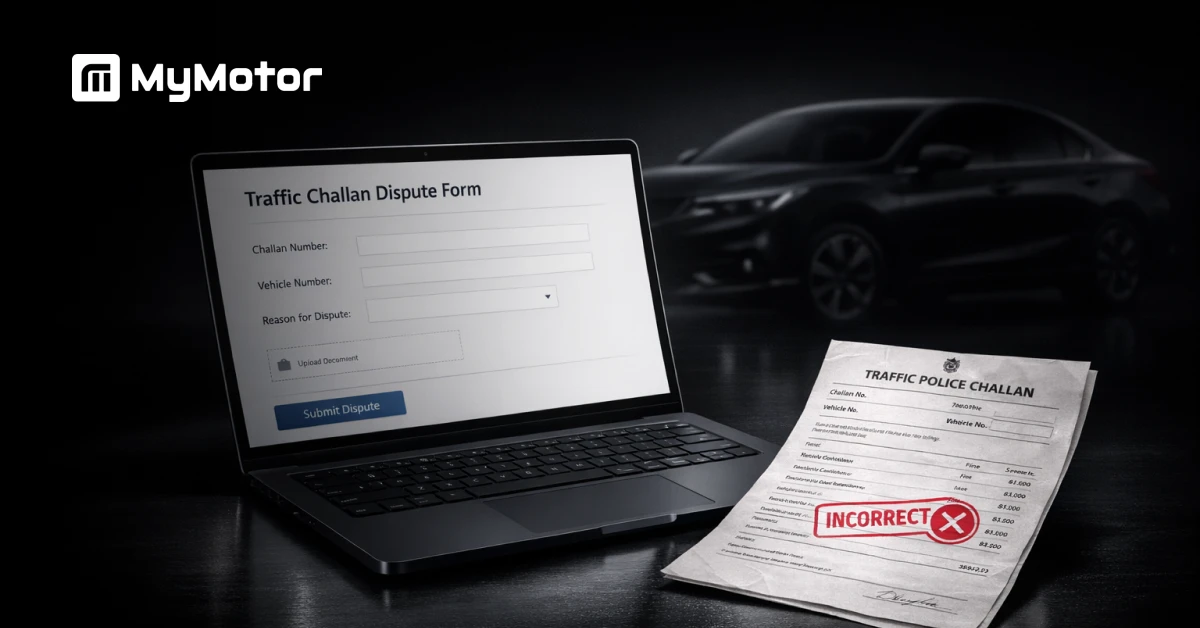
Have you ever checked your challan status and found one that makes totally zero sense?
Wrong place, wrong time, maybe your vehicle was parked at home all day. So, before you panic or just pay up, take a breath.
These errors are more common than you'd think and you don't have to accept a challan that isn't yours.
Let’s get to know how to deal with it.
What Is a Wrong Traffic Challan?
Well, a wrong traffic challan is a fine issued to your vehicle by mistake, even though the violation was not committed by you.
It may still appear in your online challan record due to an error in the system.
A valid traffic challan is issued when your vehicle actually breaks a traffic rule. A mistaken challan happens when the offence is wrongly attached to your vehicle..
How Can You Contest a Wrong Traffic Challan Online in India?
Now, if you receive a wrong traffic challan, you can actually dispute it online through the official e challan system by checking the e challan check details, submitting a complaint, and uploading proof that the violation was incorrectly issued.
Here’s how to do it in easy ways:
- Visit the official Parivahan eChallan portal.
- Use the e challan check option to search using your challan number, vehicle number, or driving licence details.
- Open the challan and check the full details date, time, violation type, location, and any photo attached.
- Go to the complaint or grievance section available on the portal.
- Enter the challan number or vehicle registration number to start the dispute process.
- Select the issue category that matches your case, such as wrong vehicle, incorrect offence, duplicate challan, or sold vehicle.
- Explain clearly why the challan is incorrect. Mention the exact mismatch and keep it short and factual.
- Upload supporting proof like RC copy, screenshot, travel proof, sale documents, or any evidence that supports your claim.
- Submit the request and save the complaint number so you can track your challan status later.
What Are the Reasons You May Receive an Incorrect Challan?
Well, there can be a lot of reasons for this honestly but here’s a list of the most common reasons:
1. Number plate misread by camera
Traffic cameras read number plates automatically, but if the image is blurry, the plate is dirty, or lighting is poor, the system may read one or two digits wrong and issue an e challan to the wrong vehicle.
2. Duplicate or fake number plate issue
In a few cases, another vehicle may be using a duplicate or copied number plate. If that vehicle breaks a rule, the challan may show up against your registration.
3. Vehicle sold but RC transfer not updated
If you sold the vehicle but its RC is still in your name, any new violation can still appear in your challan history until ownership records are officially updated.
4. Wrong location or time attached
Sometimes the challan may show a place or timing where your vehicle was never present and this can happen due to syncing errors or incorrect tagging in the system.
5. Manual entry error by officer
Not all challans are fully automated.
In some cases, an officer enters the registration number manually, and a simple typing mistake can issue the challan to the wrong person.
6. Same vehicle type or color confusion
If another vehicle looks very similar to yours and has a close registration number, it can sometimes create confusion while reviewing footage or issuing fines.
What Documents and Proof Should You Keep Ready?
To dispute a wrong traffic challan, keep your rc and any proof that shows the violation was issued by mistake.
Clear documents can make the complaint process faster and easier.
| Document / Proof | Why it helps |
|---|---|
| RC copy | Confirms the vehicle registration details and ownership linked to the challan. |
| Driving licence | Helps verify that the complaint is being raised by the registered owner or driver. |
| Screenshot of challan | Useful to keep a copy of the exact violation details, date, and location before raising the complaint. |
| GPS or location history | Can help show where your vehicle actually was when the violation supposedly happened. |
| CCTV or photo evidence | If available, this can strongly support your claim, especially for location-based disputes. |
| Sale agreement (if sold vehicle) | Very useful if the vehicle was already sold but the RC transfer is still pending in your name. |
| Service center receipt | Helps prove the vehicle was parked at a garage or workshop during that time. |
| Witness proof | If someone was with you or can confirm the vehicle’s actual location, it may help in some cases. |
How to Check Complaint Status After Raising Dispute
Now, after disputing a wrong challan, you can usually track your challan status online using the complaint or grievance reference number. Here’s how to check it:
- Visit the Parivahan eChallan portal or the same portal where you raised the complaint.
- Open the grievance or complaint tracking section.
- Enter your complaint reference number or ticket number. This is the number you received when the dispute was submitted.
- Check the current status shown against your complaint.
Where do you track grievance status after submitting a complaint
- Pending: Complaint is submitted but not yet reviewed.
- Under review: Your documents are being checked by the traffic authority.
- Resolved: The complaint has been processed, and the challan may be cancelled or updated.
When should you follow up if there is no update?
- If the e challan check still shows no update after several days, it’s a good idea to check again using the same ticket number.
- If the status stays unchanged for too long, contact the local traffic helpdesk or grievance support linked to that challan status page.
What If Your Complaint Is Rejected?
If your complaint against a wrong online challan is rejected, you can still take further action by contacting the local traffic authority or taking forward the issue legally.
If your online dispute doesn’t work, start by contacting the local traffic police office that issued the challan and explain the issue with your proof.
You can also send the details again through the official support email or visit the city traffic grievance office for a manual review.
In cases where the penalty is high, the offence is serious, or the wrong challan affects things like resale or ownership records, approaching the traffic court may be an option also.
How Can You Avoid Wrong Challans in Future?
Well, a few simple habits can help you catch or reduce the chances of a wrong online challan before it causes you trouble later.
- Check your challan regularly: Do a quick e challan check from time to time, even if you haven’t received any alert.
- Update RC after selling the vehicle: If your RC transfer is delayed after sale, new challans may still come to your name.
- Keep contact details updated: Make sure your phone number and address linked to the vehicle are current so you receive any challan notifications.
- Verify registration details: Check that your vehicle number, owner details, and RC information are correct in the records.
- Save travel records during long trips: GPS history or trip records can help if a wrong challan appears for a different location.
- Check your vehicle on the official portal monthly: A quick monthly check on the challan portal can help spot any incorrect entry before it becomes a bigger issue.
Conclusion
Always remember that if a challan doesn't look right, don't just let it sit there.
It won't go away on its own, and a small ignored fine can cause problems with your RC, your resale, even routine paperwork.
The fix is pretty simple: check your challan status on MyMotor, raise a complaint, follow up once or twice. You can also download the MyMotor app to get instant challan alerts and track your vehicle fines on the go.
And that's it, a little effort now, and you're done.