

IDV, or Insured Declared Value, is the estimated value of your car used by your insurance company.
It is the maximum amount your insurer pays if your car is stolen or declared a total loss, subject to policy terms and applicable deductions.
Your IDV also affects how much you pay for your car insurance.
But how is this value decided, and should you get a higher or lower IDV?
This blog explains how IDV works, how it's calculated, and what to check before buying or renewing your car insurance.
Let’s get started! Planning to renew or buy a policy? You can compare car insurance options on MyMotor as you read.
What Does IDV Mean in Car Insurance?
IDV is the value assigned to your car by your insurer when you buy or renew an own-damage or comprehensive insurance policy.
It refers to your car's insured value and decides the maximum payout for theft or total loss.
Getting to know about the insured declared value helps you choose the right coverage instead of just picking the cheapest premium.
What Is the Full Form of IDV in Car Insurance?
The IDV full form is Insured Declared Value.
It's the agreed insured value of your car for the policy period.
For example, if your car's IDV is ₹6 lakh, that is usually the maximum amount considered for a covered total loss or theft claim before any deductions.
Is IDV the Same as the Market Value or On-Road Price of My Car?
Not exactly. Although IDV is meant to show your car's current market value, it's calculated using insurance valuation rules.
And here's how IDV vs market value differs:
- IDV: The insured value stated in your policy.
- Market value: The approximate price your car could get in the used-car market.
- On-road price: What you paid when buying the car, including registration charges, road tax, insurance and other applicable costs.
Your IDV might be lower than your car's resale value because insurers use depreciation and their valuation guidelines.
Why Is IDV Called the “Sum Insured” of a Car Insurance Policy?
In car insurance, the sum insured is the maximum coverage amount available for the insured vehicle.
Your IDV acts as this limit for total loss and theft claims under own-damage coverage.
That's why you'll often see the terms IDV and sum insured used together in car insurance documents.
According to the IRDAI Motor Insurance guidance, IDV should show the vehicle's current market value.
How Is IDV Calculated in Car Insurance?
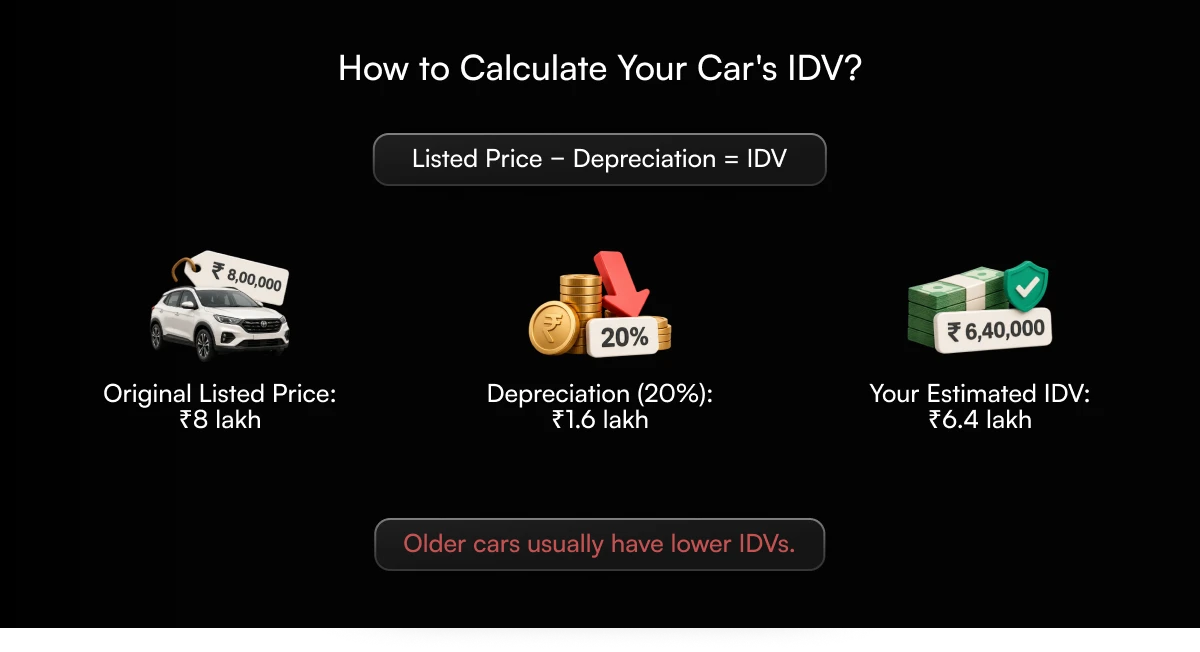
Your car's IDV is usually calculated using the manufacturer's listed selling price, its age and the applicable depreciation rate.
As your car gets older, its value usually decreases, which is why your IDV also changes when you renew your insurance.
What Is the IDV Formula (Manufacturer’s Selling Price Minus Depreciation)?
The standard IDV calculation formula is:
IDV = Listed Selling Price - Depreciation
Plus the depreciated value of separately insured accessories, where applicable.
For example, suppose your car's manufacturer's listed selling price is around ₹8 lakh and it falls in the 1–2-year age bracket.
With 20% depreciation:
- Listed selling price: ₹8,00,000
- Depreciation (20%): ₹1,60,000
- Estimated IDV: ₹6,40,000
*This is an illustrative calculation. Your insurer's actual quote may vary depending on the applicable listed price, accessories and policy terms.
What Is the Depreciation Rate by Car Age?
Well, the standard Indian motor insurance IDV depreciation chart uses the following age-based rates:
| Age of Car | Depreciation Rate |
|---|---|
| Up to 6 months | 5% |
| Above 6 months to 1 year | 15% |
| Above 1 year to 2 years | 20% |
| Above 2 years to 3 years | 30% |
| Above 3 years to 4 years | 40% |
| Above 4 years to 5 years | 50% |
These are the standard Indian Motor Tariff IDV depreciation rates reproduced in insurer documentation.
They are used to establish IDV for total loss and constructive total loss purposes, not to calculate depreciation on single parts during routine repairs.
How Is IDV Calculated for Cars Older Than 5 Years?
For cars older than five years, the standard schedule does not state another fixed depreciation percentage.
Instead, the IDV for old cars is decided through agreement between the insurer and policyholder, considering factors such as the vehicle's age, model and valuation.
You can compare quotations from different insurers to understand if the suggested IDV is okay or not.
Are Accessories Included in IDV?
Yes, accessories can be included in IDV, but it depends on whether they are part of the manufacturer's listed price or separately declared and covered.
For example, if you've installed an expensive music system or any other additional equipment, make sure to inform your insurer.
Accessories that aren't included in the standard vehicle value might need separate valuation and additional premium.
Why Does IDV Matter for Your Claim and Your Premium?
IDV influences two important things: how much you may get if your car is stolen or written off, and how much you pay for your own-damage insurance coverage.
How Does IDV Affect a Total Loss or Theft Claim?
If your car is stolen and cannot be recovered, or is declared a total loss after an accident, your insurer usually uses the policy's IDV as the basis for settlement.
For example, if your car has an IDV of ₹5 lakh, an eligible total loss claim may be settled up to that amount, subject to deductibles, salvage treatment and other policy conditions.
This is why the relationship between IDV and claim settlement matters a lot when buying insurance.
How Does IDV Affect Your Car Insurance Premium?
Well, usually a higher IDV means a higher own-damage premium because the insurer is covering a higher vehicle value.
A lower IDV can reduce that part of your premium, but it also reduces the maximum amount available for a total loss or theft claim.
Other factors, including vehicle model, location, past claims, discounts and add-ons, affect your final premium too.
Does a Higher IDV Always Mean a Better Policy?
Not really.
A higher IDV may give more protection against a major loss, but an unrealistically high value can make your insurance more expensive without even guaranteeing a larger payout.
The better approach here is to choose an IDV that smartly shows your car's value and is accepted by your insurer also.
What Is the Difference Between High IDV and Low IDV?
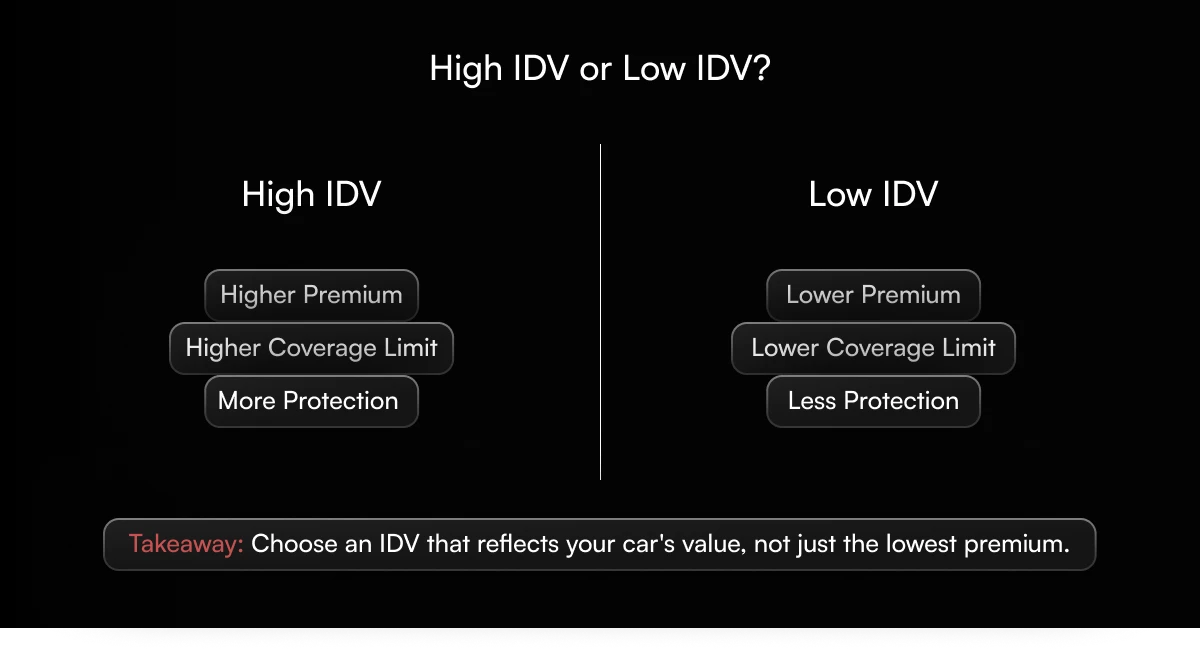
Now, choosing between a high IDV vs low IDV is all about balancing your insurance cost with your financial protection.
| Factor | High IDV | Low IDV |
|---|---|---|
| Own-damage premium | Usually higher | Usually lower |
| Total loss coverage | Higher maximum | Lower maximum |
| Theft claim amount | Higher potential payout | Lower potential payout |
| Financial protection | More, if justified | Less |
| Main concern | Paying extra for unnecessary coverage | Being underinsured |
What Are the Pros and Cons of Choosing a High IDV?
A higher IDV can be useful when your car has a higher insured value and you want enough protection against theft or total loss.
The downside is that your premium might increase.
Choosing the maximum IDV available isn't really the best decision. The value should still be realistic.
What Are the Risks of Choosing a Low IDV to Save on Premium?
A lower IDV might make your insurance look cheaper today, but it could leave you with a bigger financial gap after a big loss.
For example, if your car is worth around ₹6 lakh but you've insured it for ₹4.5 lakh, you may find the settlement not enough to replace it.
So, how much IDV should you choose?
Aim for a suitable value that shows your car's current worth rather than just selecting the lowest option to save money.
Can You Change or Negotiate Your IDV When You Renew?
Yes, you can often request a different IDV when renewing your car insurance, given that it falls within the insurer's accepted valuation guidelines.
How Do You Increase or Decrease IDV at Renewal?
Well, when you renew your policy, check the IDV offered by your insurer.
Some insurers allow you to adjust it within a permitted range.
You can also compare quotes from other insurers to see if they offer a more suitable value for you.
Before finalising your car insurance renewal IDV, compare both the premium and the coverage you're getting.
Don’t wait for the last day: check when your car insurance expires and start comparing at least two weeks early
Can You Change IDV After Buying the Policy?
Well, changing IDV during an active policy isn't always very easy.
You usually need to contact your insurer and request a policy endorsement.
Any adjustment depends on the insurer's approval, underwriting rules and applicable premium changes.
It's easier to review your IDV before purchasing or renewing the policy.
How Do You Check IDV and Get a Quote for Car Insurance Online?
Buying car insurance online makes it a lot easier to compare premiums, IDV options and coverage from different insurers.
However, don't just look at the price alone.
Two policies with similar premiums may offer different levels of protection.
How to Compare Car Insurance Online by IDV and Premium
Here’s how to do it, when comparing policies:
- Enter your car's registration and vehicle details. Not sure your details are correct? Check your vehicle details by registration number first, so your quote reflects the right model and registration year.
- Get a quote for car insurance from multiple insurers.
- Compare the IDV offered in each quote.
- Check your own-damage premium, deductibles and add-ons.
- Choose a policy that offers suitable coverage at a good price.
An online car IDV calculator or insurer quotation tool can help you estimate the value before making a decision.
What Details Do You Need to Get a Quote for Car Insurance?
To get a car insurance quote online, insurers commonly ask for:
- Car registration number
- Make, model and variant
- Registration year and location
- Fuel type and engine details
- Previous insurance and claim history
- Current policy details, if renewing
Keeping your RC and previous insurance policy handy can make the process much easier. If you’ve misplaced either, check your RC and insurance status online.
What to Check Before Buying Car Insurance Online Besides IDV
Your IDV matters, but it isn't the only thing to review before purchasing.
Check whether the policy offers appropriate own-damage coverage, useful add-ons, reasonable deductibles and access to a convenient cashless garage network.
Also, read the exclusions and claim conditions carefully.
The IRDAI's motor insurance guidance suggests comparing coverage, deductibles and IDV alongside premiums rather than just choosing a policy based on price alone.
How Is IDV Treated in a Total Loss or Theft Claim?
IDV becomes especially important when your car is stolen, badly damaged or declared beyond economical repair.
However, the final claim amount depends on the type of loss and your policy conditions.
What Is Constructive Total Loss and How Does IDV Apply?
Constructive Total Loss (CTL) occurs when repairing or recovering your car becomes too expensive compared to its insured value.
Under standard motor insurance policy wording, a car may be treated as a constructive total loss when the aggregate cost of retrieval and/or repair exceeds 75% of its IDV.
For example, suppose your car has an IDV of ₹6 lakh and the assessed repair and retrieval costs exceed ₹4.5 lakh.
The insurer may treat it as a constructive total loss, subject to the policy conditions.
What Deductions or Depreciation Can Reduce My Payout?
Now, even if your car's IDV is ₹6 lakh, you might not get exactly ₹6 lakh in your bank account.
Your final claim settlement may be affected by:
- Compulsory or voluntary deductibles.
- Salvage or wreck value, depending on how the damaged vehicle is handled.
- Outstanding finance or loan settlement arrangements, where applicable.
- Policy exclusions or other applicable conditions.
For eligible total loss claims, the agreed IDV is usually used without applying further age-based depreciation during the same policy period.
However, partial damage claims follow different rules for repair costs and replacement parts.
What Is IDV for Electric Cars and New Cars?
Whether you've just bought a new car or switched to an electric vehicle, IDV stays an important part of your insurance coverage.
Does IDV Work Differently for an EV?
The basic principle stays the same.
An electric car's IDV shows its insured value after applicable depreciation.
However, the vehicle's battery, electronic components and repair costs can make coverage details especially important.
When comparing EV insurance, review battery-related exclusions, add-ons and the insurer's repair network. If you’re new to EV ownership, our guide on how to find a charging station before you travel covers the practical side.
Is the Battery Covered Under IDV?
For electric cars with an owned, manufacturer-fitted battery, the battery is usually considered part of the insured vehicle value.
However, coverage depends on the policy terms.
Damage caused by accidents may be covered under own-damage insurance, while battery degradation, normal wear and tear or certain electrical failures might be excluded.
And if your EV uses a battery subscription or battery-as-a-service arrangement, confirm how the insurer treats the battery before buying coverage.
Considering an EV? See where to charge before you buy with our EV charging stations finder.