
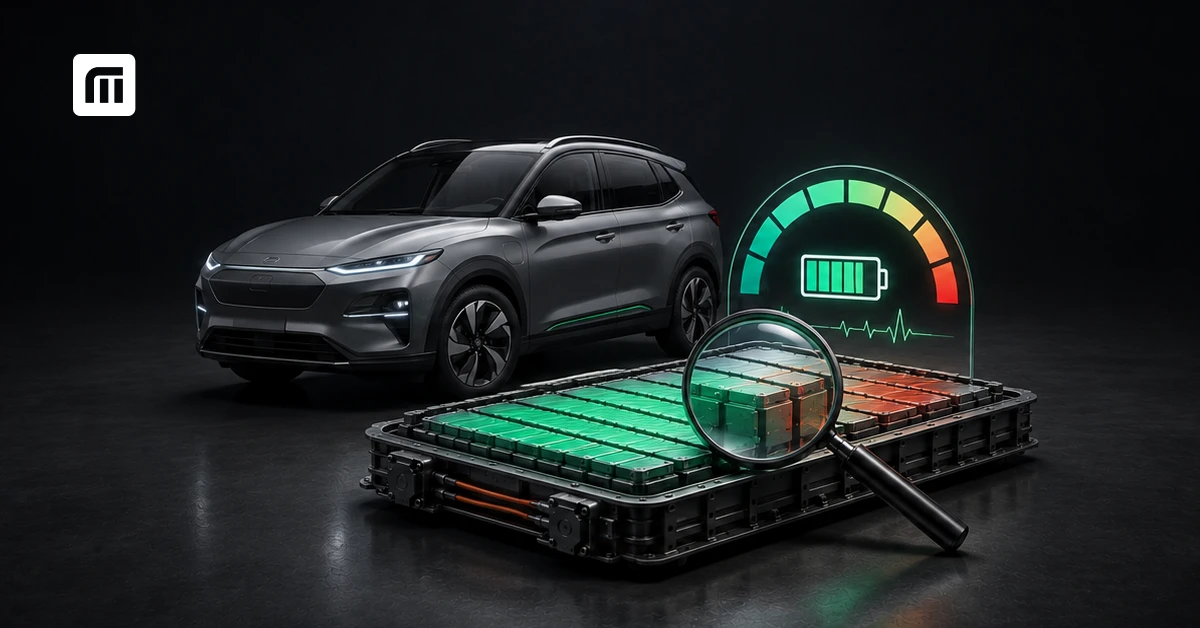
Found a used EV that looks like a great deal? Before you get too excited about the price, take a closer look at the battery.
A proper used EV battery check can tell you much more than the kilometres or dashboard range ever will. This guide covers the key checks, warning signs, and numbers you should know before you buy, plus what it will cost you if the battery isn't as healthy as it looks.
Why Is Battery Health the Most Important Check on a Used EV?
A healthy EV battery determines far more than how many kilometres you can travel between charges. It affects usable driving range, charging behaviour, performance, resale value, and potentially one of the biggest repair bills you could face after buying the vehicle.
Modern EV battery management systems monitor parameters including State of Charge and State of Health because battery condition directly affects performance, reliability, and usable life. That's why battery health matters more in a used EV, even when everything else about the vehicle seems fine.
What Makes an EV Battery Different From Checking a Used Petrol Car's Engine?
With an older petrol or diesel vehicle, a mechanic can learn a lot from physical signs - smoke, abnormal engine noise, oil leaks, weak compression, gearbox behaviour, exhaust condition.
An EV battery is different. Most of the important information happens electronically inside a sealed high-voltage battery pack. Its Battery Management System (BMS) monitors cell voltage, temperature, charge level, and battery-health estimates. A five-minute visual inspection simply isn't enough.
Why Can't You Judge Battery Health From Kilometres Driven or Dashboard Range Alone?
Because battery ageing is affected by more than distance. Temperature, charging rate, charging habits, driving pattern, thermal management, and how much time the battery spends at different charge levels can all influence degradation.
Research into EV battery ageing shows that charging behaviour, charging rate, ambient conditions, and vehicle use all affect long-term capacity. So a five-year-old EV with 25,000 km isn't automatically healthier than one with 50,000 km.
Dashboard range isn't proof either - it's an estimate influenced by recent driving style, HVAC use, speed, temperature, traffic, and energy consumption. Real-world EV range varies considerably with operating conditions. Think of the dashboard range as a useful clue, not a battery health certificate. Before you go further, it's worth taking a moment to check your vehicle's RC and ownership history - battery claims are easier to verify once you know who actually owned and drove the car.
What Is State of Health (SoH) and What's a Good Number?
If there's one abbreviation to remember before buying a used EV, it's SoH.
State of Health (SoH) indicates how much usable battery capacity remains compared with the battery when it was new. For example, assume an EV originally had approximately 40 kWh of usable battery capacity. If degradation means it can now effectively store around 36 kWh under comparable conditions, its capacity-based SoH would be roughly 90%.
The exact calculation varies between manufacturers and battery-management systems - don't assume every brand calculates or displays SoH the same way. Accurate SoH estimation is itself a complex technical problem, not a simple direct measurement.
How Is SoH Different From the Battery's Current Charge Percentage (SoC)?
This is one of the easiest EV terms to confuse.
- State of Charge (SoC) tells you how full the battery is right now.
- State of Health (SoH) tells you how much capacity the battery can still hold compared with when it was healthier or new.
Here's an easy way to picture it: if a new bottle holds 1 litre, filling it completely means it's at 100% charge. But if that bottle shrinks over time and can now hold only 800 ml, you can still fill it to 100% charge - you simply have less total capacity than before. The same idea applies to an EV battery. A battery showing 100% charge can still have 80% SoH.
What SoH Is Considered Healthy at 3, 5 and 8 Years in Indian Conditions?
There's no government-mandated age-to-SoH chart. Battery chemistry, thermal management, climate, and usage differ too much for that. For a used buyer, though, these can work as practical shopping benchmarks:
| Vehicle age | Buyer-friendly SoH benchmark | What it means |
| Around 3 years | 90%+ is reassuring | Normal-looking degradation for a well-kept vehicle |
| Around 5 years | 85%+ is reassuring | Still potentially a strong used-EV battery |
| Around 8 years | 75–85% can remain usable | Examine price, range needs and remaining warranty carefully |
| Any age | Below 70% deserves serious caution | Replacement/repair economics become much more important |
Why pay particular attention to around 70%? Because several manufacturers use 70% battery health as an important warranty threshold. Tata's current HV battery warranty terms refer to intervention if the battery falls below 70% SoH, while Ola's qualifying battery-warranty coverage and Ather's Eight70 programme also use 70% battery-health language. That doesn't mean a battery suddenly becomes unusable at 69% - it means 70% is a point at which a buyer should become much more cautious.
At What SoH Should You Walk Away From a Used EV?
There's no universal percentage where every used EV becomes a bad purchase. But if the SoH is below roughly 70%, don't proceed like it's a normal used vehicle. At that point, ask:
- How much real-world range remains?
- Is battery degradation covered under the remaining warranty?
- Will that warranty transfer to you?
- What does an authorised workshop quote for repair or replacement?
- Is the seller's asking price already discounted enough to account for the battery?
A 68% SoH EV at the right price with confirmed warranty coverage could make sense. An 82% SoH EV with no history, suspicious battery repairs, and an unrealistic asking price might not.
How Can You Check a Used EV's Battery Health Before Buying?
Ideally, don't rely on just one method. A proper used EV battery check in India should combine diagnostics, history, and a real-world drive.
Can the OEM or Authorised Service Centre Print an Official SoH Report?
This should be one of your first requests. Ask the seller to take the vehicle with you to an authorised service centre and request a battery diagnostic report or battery-health assessment.
Not every OEM exposes exactly the same information to customers, and some may provide diagnostic findings rather than a neat certificate showing one SoH percentage. Still, an authorised workshop may have access to far more BMS information than you'll see on the dashboard. Ask them specifically to check: battery SoH, cell-voltage differences, battery fault codes, charging faults, thermal-management issues, and previous HV battery repairs.
If a seller strongly refuses an authorised battery inspection without a convincing reason, treat that as a red flag. It's also worth doing your own paperwork check in parallel - confirm the seller's challan and RC status before you invest time in a workshop visit.
Can an OBD-II Scanner With an EV App Read Battery Health?
Sometimes, but with an important catch. A generic OBD scanner doesn't magically understand every EV battery. Some EV-specific apps can read battery information exposed by a particular vehicle's BMS - potentially including SoH, temperatures, cell voltages, and charging data. But compatibility and accuracy differ significantly between models.
If you use an OBD tool:
- Make sure the scanner and app support that EV model.
- Use it for reading data, not changing vehicle settings.
- Compare its results with an authorised workshop whenever possible.
- Be suspicious of any app that produces a very precise SoH number without explaining where that data came from.
Is a Full-Charge Range Test a Reliable DIY Check?
It's useful, but not enough on its own. Suppose the seller charges the vehicle to 100% and the dashboard shows 350 km that doesn't prove the battery can actually deliver 350 km.
Instead, take a meaningful test drive and observe:
- Starting charge percentage
- Distance travelled
- Ending charge percentage
- Energy consumption and AC usage
- Driving conditions
- Whether the percentage falls smoothly or suddenly
- Any unusual power limitation or battery warnings
Compare the result with realistic range expectations for the same model, not its most optimistic advertised figure. Speed, traffic, HVAC load, and battery temperature can all change real-world energy consumption considerably use the range test to confirm your battery-health findings, not replace them.
Are Third-Party Battery Health Inspection Services Worth Using?
They can be, usually when:
- The EV is expensive.
- The manufacturer's workshop won't provide meaningful battery-health data.
- The vehicle is outside warranty.
- It's an ex-fleet or commercial vehicle.
- The seller's history is incomplete.
But ask what the inspection actually includes. A professional-looking PDF isn't automatically useful. A good report should identify the vehicle/VIN and explain whether its conclusion comes from BMS data, usable-capacity testing, charging behaviour, cell-voltage analysis, or another diagnostic method. The more transparent the raw data, the more useful the report.
What Causes Faster Battery Degradation in Indian Conditions?
EV battery degradation happens gradually and is quite normal. The question when buying used is whether it has happened faster than expected. India can be a demanding environment because high ambient temperatures and intensive vehicle use can increase battery thermal loads. Battery-ageing research consistently identifies temperature and operating conditions as important degradation factors.
Does Frequent DC Fast Charging Speed Up Degradation?
Potentially, yes - especially when high charging rates repeatedly combine with unfavourable battery temperatures or other stressful conditions. Battery research has shown that extreme or repeated high-rate charging can contribute to faster degradation, although the actual effect varies considerably with battery design, charging rate, and thermal management.
That doesn't mean "fast charging used = bad EV." Modern EVs actively manage charging speed and battery temperature, and occasional highway fast charging is normal. What deserves more attention is a vehicle that has spent years doing high-utilisation duty with repeated fast-charging sessions every day which is why ex-fleet EVs need a deeper inspection.
Does India's Heat and an Always-Charge-to-100% Habit Damage Batteries Faster?
Most likely yes - heat matters. Higher battery temperatures can accelerate ageing reactions, which is why good battery thermal management is so important. Studies examining lithium-ion ageing have found significantly greater degradation under elevated-temperature conditions.
Charging habits matter too, but avoid applying generic internet rules blindly different vehicles use different battery chemistries, usable buffers, and charging strategies. The safest advice is simple: follow the manufacturer's charging recommendations for that exact EV.
Does Battery Chemistry (LFP vs NMC) Affect Degradation Rate?
Yes, but chemistry is only part of the story. LFP (Lithium Iron Phosphate) batteries are usually known for strong cycle life and thermal stability. NMC (Nickel Manganese Cobalt) chemistry provides high energy density, helping manufacturers package more energy into a smaller or lighter battery.
Comparative battery research usually finds LFP cells capable of strong cycle-life performance and lower capacity fade under many conditions compared with NMC, while temperature and how the battery is operated remain highly important. So don't buy purely on chemistry badge, a carefully managed NMC battery can be healthier than an abused LFP battery. For a used EV, actual SoH beats assumptions based on chemistry.
Is the Battery Warranty Transferable to a Second Owner?
Sometimes yes, sometimes the coverage changes. An EV battery warranty transfer in India can depend on the manufacturer, model, original registration type, warranty package, kilometre limit, and whether ownership-transfer procedures have been completed. As part of this check, you can also verify the vehicle's RTO registration details to confirm the first registration date and registration type, both of which affect warranty eligibility.
What Is the Typical Battery Warranty Offered by Tata, MG, Hyundai, Ola and Ather?
1. Tata EV: Tata now offers longer or "lifetime" HV battery coverage on several current models for eligible first registered owners, but second-owner terms may differ. For example, from the second registration onwards, qualifying Tiago.ev coverage becomes the standard 8 years/1,60,000 km from first registration, and the new owner must inform Tata of the ownership transfer. Other newer models have different limits, so the exact VIN and model matter.
2. MG: Warranty depends on the model. The MG ZS EV currently lists 8 years/1,50,000 km for the first registered owner. The Windsor was launched with lifetime battery warranty for the first owner, while MG documentation states that after an ownership change its HV battery warranty becomes 8 years/1,60,000 km from the first delivery date.
3. Hyundai: Currently lists an 8-year/1,60,000 km battery warranty for models including the IONIQ 5 and CRETA Electric.
4. Ola Electric: Current support information lists a base battery warranty of 3 years/50,000 km, with qualifying extended/top-up plans going as high as 8 years/1,25,000 km. Ola states that qualifying battery top-up warranty coverage can transfer to a subsequent owner for the remaining period.
5. Ather: The Eight70 programme can extend qualifying battery coverage to 8 years/80,000 km with a 70% battery-health assurance. Ather also states that the policy transfers to the new owner when a scooter is sold.
These policies can change and even differ between variants or purchase dates, so always check the warranty applicable to the specific VIN, not just today's advertised warranty for a new vehicle.
How Do You Transfer Battery Warranty When Buying Used?
Before completing your purchase:
- Ask for the original invoice and warranty documents.
- Check the vehicle's first registration date.
- Confirm the current kilometre reading.
- Complete the RC ownership transfer.
- Contact the OEM or authorised dealer and update the registered owner.
- Ask for confirmation that the remaining battery warranty is valid in your name.
- Keep written proof.
Do this before assuming warranty value while negotiating the price. (If you're unsure how RC transfer works step-by-step, see our full guide on transferring vehicle ownership online )
What Warranty Red Flags Should You Watch For With Ex-Fleet EVs?
Commercial usage needs extra attention because some special "lifetime" or promotional warranties are limited to private registrations or particular ownership conditions. For example, Tata's current lifetime HV battery warranty terms specify eligibility conditions including registrations in the names of private individuals for applicable vehicles.
With an ex-fleet EV, check:
- Was it commercially registered?
- Does the same battery warranty apply?
- Has the mileage limit already been crossed?
- Has the battery been replaced before?
- Was any battery repair done outside the authorised network?
- Are warranty documents actually available?
Don't price an ex-fleet car assuming it carries the same battery protection as a privately owned version until the manufacturer confirms it. And remember - if the vehicle is still registered commercially, it needs commercial vehicle insurance, not a private car policy, which changes your ongoing running cost too.
How Much Does an EV Battery Replacement Cost in India?
Unlike tyres or brake pads, manufacturers don't always publish a simple retail price for a complete traction battery. Costs vary based on battery capacity, chemistry, model generation, whether individual modules can be repaired, labour, taxes, and whether the entire battery actually needs replacement. Treat any online EV battery replacement cost figure for 2026 as a budgeting estimate until an authorised workshop gives you a written quote.
What's the Replacement Cost for 2W, 3W and 4W EV Batteries?
Electric two-wheelers: Full-pack replacement estimates commonly fall around ₹45,000 to ₹1.2 lakh, depending heavily on battery size and model. Recent market estimates put several 3–4 kWh scooter packs around ₹65,000–₹90,000, with larger packs costing more.
Electric three-wheelers: Lithium-battery replacement costs vary between e-rickshaws, cargo vehicles, and L5 electric autos. Current market estimates broadly place lithium e-rickshaw packs around ₹60,000 to ₹1.2 lakh, while larger commercial three-wheeler packs can approach ₹1–1.5 lakh or more.
Electric cars: This is where the number can jump into several lakhs. Independent 2026 estimates for a Nexon EV-sized battery, for example, commonly fall in the region of roughly ₹5.5–7 lakh, although actual manufacturer quotes can differ by battery size, pack generation, and whether a full pack is truly needed.
These are indicative market ranges, not official fixed OEM price lists. Always request a vehicle-specific quotation before using battery-replacement cost to value a used EV.
At What Point Does Replacement Cost Make a Used EV a Bad Deal?
Do this calculation before buying:
What you pay for the EV + What you'll spend fixing it + Any likely battery costs = What the EV actually costs you
Imagine a used EV costs ₹5 lakh. It looks like a bargain compared with a similar ₹8 lakh vehicle. But if its battery is badly degraded and an out-of-warranty repair could cost another ₹3–4 lakh, that bargain disappears very quickly. Before you finalise a number, it's worth running the full cost on a car loan EMI calculator so a potential battery repair doesn't blow up your monthly budget later.
What Are the Red Flags to Walk Away From When Buying a Used EV?
A low SoH figure is the obvious one, but some warning signs are much less obvious.
What Service-History Gaps Should Worry You?
Be cautious when you see:
- Missing service records
- Long unexplained gaps between services
- Battery or BMS warning lights
- Previous high-voltage battery work with no invoice
- Accident or flood history
- Unexplained battery replacement
- Cooling-system problems
- Uncompleted recalls or software campaigns
- Third-party modifications to the battery, charger, or high-voltage system
One missing service invoice isn't necessarily a disaster. A seller who can't explain anything about the battery's history is a different matter.
What Do Inconsistent Range Claims or Vague Seller Answers Signal?
Range can vary with driving style, traffic, AC use, and weather, so inconsistent numbers don't automatically mean a bad battery. But vague answers are a reason to verify. Ask for: battery SoH or diagnostic report, battery repair/replacement history, charging history, and any battery warning alerts. Don't rely on claims - check the data too.
Is a Heavily Fast-Charged Ex-Fleet or Ex-Rental EV Riskier to Buy?
It can carry more battery wear because fleet EVs usually cover more kilometres and charging cycles, often with frequent fast charging. But ex-fleet doesn't automatically mean a bad battery. Check: SoH + diagnostics + warranty + service history + price. If these look good, an ex-fleet EV can still be a sensible buy.
Used EV Battery Health Checklist: Before You Pay
- Get an official SoH report from an authorised service centre
- Cross-check with an EV-compatible OBD scanner if available
- Take a real-world range test, not just a dashboard-charge check
- Ask for full service history and any BMS warning history
- Confirm whether the battery warranty is transferable, and to what terms
- Check if the vehicle was privately owned or commercially registered
- Get a written battery replacement quote if SoH is borderline
- Factor battery risk into your final negotiated price
Once you've verified the battery, the next step is protecting the vehicle properly - compare and buy comprehensive car insurance before you drive it home. If you're planning regular charging stops, it also helps to find nearby EV charging stations along your usual routes in advance.