
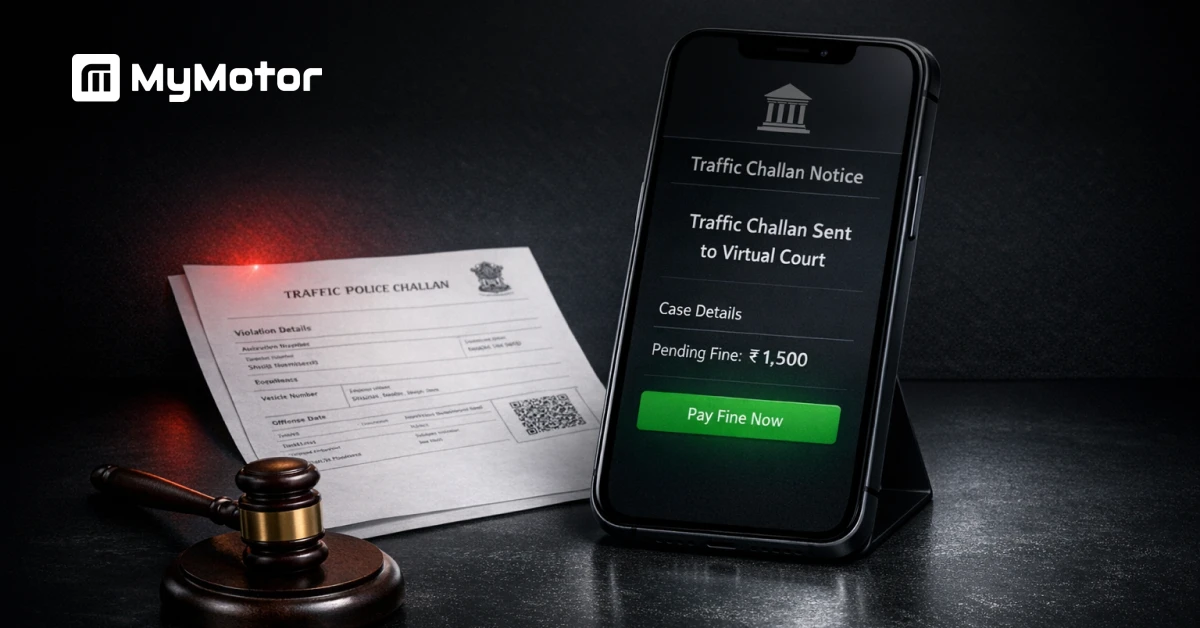
"Sent to Virtual Court" sounds serious, right? It kind of is, but it's also very fixable. This happens when a challan stays pending for too long or involves a serious violation.
And yes, with India's traffic system going fully digital, they will obviously notice. Well, in most cases, you can still fix this online but ignoring it is no longer an option.
Let's break down exactly what this means and how to deal with it quickly.
What does “traffic challan sent to virtual court” mean?
A traffic challan sent to Virtual Court means your e challan is no longer being treated as a regular traffic fine now.
Instead, the case has been transferred into an online judicial system where it is processed digitally through a Virtual Court platform.
In simple words, your challan has moved from a normal payment stage to a legal settlement stage.
Usually, this happens when:
- a traffic challan remains pending for a long time
- multiple violations are linked to the same vehicle
- or the offence is considered serious enough for court processing.
A lot of people confuse a regular e challan, a court challan, and a Virtual Court challan because they sound very similar.
But there’s an important difference between them.
A regular e challan is the usual online fine issued by traffic police for violations like overspeeding, signal jumping, wrong parking, or not wearing a helmet.
These can be paid directly online.
A court challan is more serious because the matter has been escalated for legal processing, this meant visiting a traffic court physically and handling the case there.
Now, a Virtual Court challan is basically the online or virtual version of that process.
Instead of going to court in person, many traffic challan cases are now handled online through the Virtual Court system.
Depending on the case, you may get options to pay the fine digitally, plead guilty, or request a hearing, just like a normal court process.
Why does a traffic challan get sent to Virtual Court?
An e challan Virtual Court case usually happens when a traffic challan is left unpaid for too long, involves repeated traffic violations, or includes a serious offence like drunk driving or reckless driving.
Once this happens, the challan moves from a normal payment process into judicial processing through the Virtual Court system.
Before this, many people ignored a challan thinking nothing would happen immediately.
But with traffic systems becoming more digital and connected, unpaid challans are now tracked much more strictly.
Read: Challan Sent to Court for Disposal 2026: Virtual Court Payment Process
Non-Payment of E-Challan Within the Deadline
One of the biggest reasons a challan gets sent to Virtual Court is simple and that is it wasn't paid on time.
In many states, if an e challan remains unpaid for around 60 to 90 days, it may automatically move toward court processing. This is especially common with camera-based challans that people forget about or keep postponing.
1. Repeated Traffic Violations
Well, repeated offences linked to the same vehicle can also trigger an e challan Virtual Court case.
This includes things like:
- Overspeeding repeatedly,
- Jumping signals multiple times,
- Dangerous driving habits.
When the system notices a pattern of repeated violations, the matter may be escalated further.
2. Serious Offences
Nowadays, some violations are treated more seriously from the beginning itself.
These include:
- Drunk driving,
- Driving without a licence,
- Reckless driving, Or
- Offences that risk public safety.
In such cases, the challan may directly move into the Virtual Court system instead of staying as a regular traffic fine.
3. Ignoring Previous Notices or Summons
Sometimes drivers receive SMS alerts or challan notices but simply choose to ignore them, assuming the issue will disappear on its own.
But today’s digitally connected systems keep track of pending challans in far better ways.
If notices continue to be ignored, the case may eventually get transferred to Virtual Court.
How can you check Virtual Court challan status online?
Well there are severals ways through which you can check your virtual challan court status such as:
Method 1: Through the Virtual Court Portal
This is the most direct way to check whether your challan has been moved to Virtual Court.
Here’s how you can do it:
- Visit the official Virtual Court website
- Select your state from the list
- Enter your vehicle number, challan number, or notice number
- Verify your details through OTP, if required
- You’ll then be able to see any pending court challans linked to your vehicle
If your challan has already entered judicial processing, the portal may also show payment options or the next steps to take.
Method 2 : Through the Parivahan E-Challan Portal
You can also check any pending e challan details through the Parivahan portal.
Just enter your:
- vehicle number,
- challan number,
- or driving licence number
The portal will display your pending challans, payment status, and in some cases whether the matter has moved to virtual court or not.
This method is useful if you want to quickly check all challans linked to your vehicle in one place.
What should you do after your challan goes to Virtual Court?
That’s a common doubt that people mostly have, and here’s what all can be done once your challan reaches virtual court.
1. Pay the Fine Online
If the violation is valid and you don’t want to contest it, the easiest option is usually to pay your e challan online.
In many Virtual Court cases, you’ll see a “Plead Guilty” option. This simply means you accept the offence and agree to pay the fine digitally without further hearings.
Most portals support common online payment methods like:
- UPI,
- debit or credit cards,
- net banking,
- and mobile wallets.
Once the payment is done, make sure to download and save the payment receipt or challan copy for future reference.
It can help avoid confusion later if the payment status doesn’t update instantly.
2. Contest the Challan
Not every challan is always correct and sometimes contesting an e challan genuinely makes sense.
For example:
- the vehicle number may be incorrect,
- you may receive a duplicate challan,
- or the violation evidence itself could be wrong.
In such situations, you can choose to contest the challan instead of directly paying it.
Depending on the system in your state, you may get an option to request a hearing or submit proof supporting your case.
If the issue is genuine, contesting the challan can help avoid paying an incorrect fine.
3. Attend Hearing (If Required)
Some cases may require a hearing, especially if:
- the challan is being disputed,
- the offence is serious,
- or additional verification is needed.
In such situations, hearings can happen online through the virtual court system itself. But for more serious violations, authorities may still ask for a physical appearance.
Before attending any hearing, keep these documents ready:
- RC (Registration Certificate)
- DL (Driving Licence)
- Challan copy
- ID proof
How do you pay a Virtual Court challan online step by step?
If your e challan has already been transferred to Virtual Court, here’s how you can usually complete the payment process step by step.
Step 1: Open the Virtual Court Portal
Start by visiting the official virtual court website on your phone or laptop. This is where court-linked traffic challans are handled digitally.
Once the portal opens, you’ll see options related to pending challans and online payments.
Step 2: Choose Your State
Next, select the state where your e challan was issued.
This is important because traffic challan records are managed state-wise, and selecting the correct state helps the system fetch your challan details properly.
Step 3: Enter Challan or Vehicle Number
You’ll now be asked to enter details like:
- challan number,
- vehicle registration number,
- or notice number.
Most people simply use their vehicle number if they don’t have the challan details handy.
Step 4: Verify OTP
In many cases, the system will send an OTP to your registered mobile number for verification.
Enter the OTP to continue accessing the challan information linked to your vehicle.
Step 5: View Offence Details
Once verified, the portal will display:
- pending challans,
- offence details,
- fine amount,
- and the current virtual court status.
Before moving ahead, quickly check that the violation details are correct.
Step 6: Select “Plead Guilty”
If you agree with the violation and want to settle the matter, choose the “Plead Guilty” option.
This basically means you accept the offence and are ready to pay the fine without contesting the e challan further.
Step 7: Make the Payment
You can now complete the payment using:
- UPI,
- debit or credit card,
- net banking,
- or other available online payment methods.
The process is usually quick and works similarly to any regular online payment.
Step 8: Download the Acknowledgement
After successful payment, don’t forget to download the acknowledgement or payment receipt.
Keeping a copy saved on your phone or email is always a smart idea in case you need proof of payment later.
Can you contest a Virtual Court challan?
Yes, you can contest a virtual court challan if you believe the e challan was issued incorrectly or there’s an error in the violation details.
But not every e challan issued is accurate.
Sometimes technical errors, incorrect camera captures, or duplicate entries can create problems.
You may want to contest the challan if:
- the challan was issued to the wrong vehicle,
- your vehicle number was cloned or misused,
- the challan was already paid earlier,
- or the violation evidence itself looks incorrect.
For example, some people receive challans from locations they’ve never even visited. In cases like these, blindly paying the fine doesn’t really make sense.
How to Contest It
If you decide to challenge the e challan, the process usually starts by requesting a hearing through the virtual court system.
Depending on the state and type of offence, you may be asked to:
- submit supporting proof,
- upload documents,
- or explain your side during a hearing.
Useful proof can include:
- payment receipts,
- location evidence,
- vehicle details,
- or screenshots showing errors in the challan.
What happens if you ignore a Virtual Court challan?
Well, ignoring a Virtual Court challan isn't like ignoring a parking ticket. The longer you leave it, the messier it gets. Here's what can actually happen:
- Higher penalties: Fines can grow over time depending on the offence and state rules. That small challan? It gets more expensive the longer it sits.
- Court summons: Keep ignoring it and you might get formally summoned. At that point, it's no longer a quick online payment, it's actual legal proceedings.
- Licence trouble: Serious offences like drunk driving, dangerous driving, or repeated speeding can put your licence at risk if the case stays unresolved.
- Vehicle seizure: Unlikely for a single small challan, but multiple ignored cases? That's a different story.
- RC transfer headaches: This is where most people get caught off guard. Trying to sell your vehicle or transfer ownership? Pending challans will show up and block the process until everything's cleared.
How can you avoid your challan reaching Virtual Court?
You know the easiest way to avoid the whole Virtual Court situation? Don't let it get there in the first place and here's how:
1. Check your challans regularly
A quick challan check every few weeks using mParivahan or Parivahan is all it takes.
Most people don't ignore challans on purpose they just forget.
2. Pay fines early
Sounds obvious, but this is exactly where most people slip up.
The "I'll handle it later" mindset is what sends challans to Virtual Court in the first place. Pay it early, pay it cheap.
Read: What Happens If You Don’t Pay a Traffic Challan on Time?
3. Keep your documents updated
Make sure your RC, licence, insurance, and PUC are current and linked to the right contact details.
If your info is outdated, you might not even receive challan notifications until it's too late.
4. Drive carefully and consistently
One challan is an accident.
Multiple challans start looking like a pattern in the system, and patterns attract stricter action.
Repeated speeding, signal jumping, or reckless driving can make things complicated fast.
5. Use a reminder platform
Apps like MyMotor let you track challan status, monitor documents, and get reminders for things like insurance and PUC renewals all in one place.
It's a simple way to make sure nothing slips through the cracks.
Conclusion
So the bottom line? Don't panic, but don't ignore it either.
Most Virtual Court challans can be resolved online in minutes; the hardest part is actually sitting down to do it.
Build a small habit of checking your challan status regularly, keep your documents updated, and let platforms like MyMotor handle the reminders, it is as simple as that.