
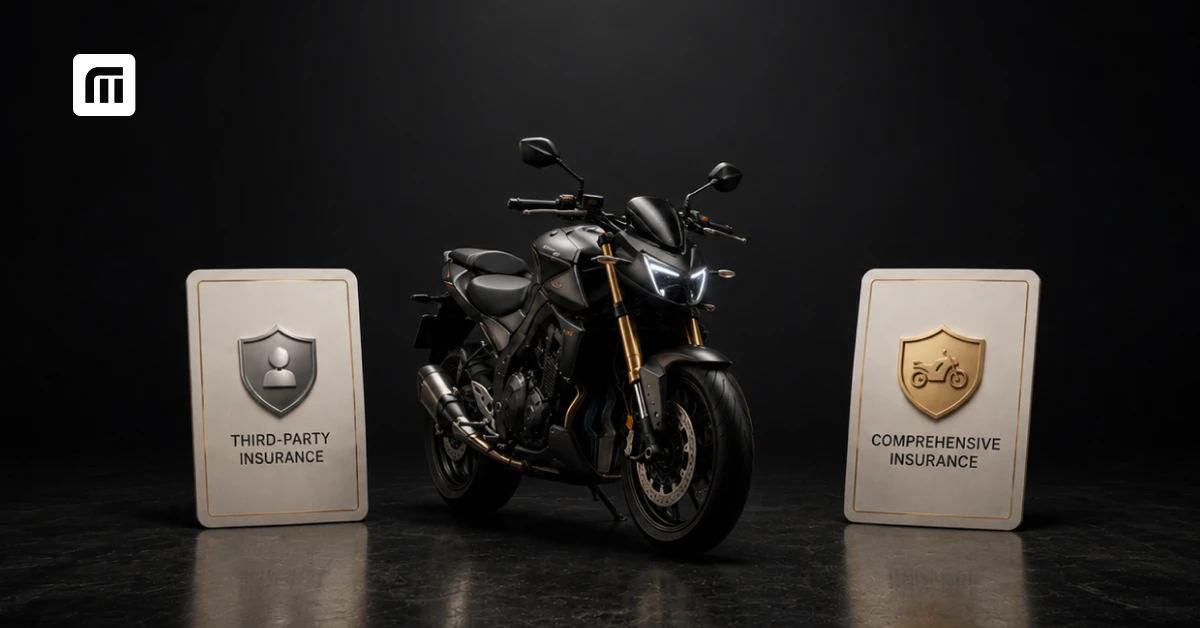
Choosing the right bike insurance doesn't have to be hard or confusing. Whether you're buying a new bike or renewing an old one, the main choice is usually between third-party and comprehensive insurance. Know what each option covers and choose what fits you best. Let's get started.
What Is Third-Party Bike Insurance and What Does It Cover?
Third-party bike insurance protects you financially if your two-wheeler causes injury, death, or property damage to someone else. For example, if you accidentally hit another vehicle and damage it, your third-party liability cover for the bike can cover the legal liability arising from that damage.
A liability-only two-wheeler policy usually covers:
- Injury or death of a third party
- Damage to third-party property
- Legal liability arising from an insured accident
For scooters and motorcycles, third-party property damage cover is limited to ₹1 lakh, while liability for third-party death or bodily injury is not capped in the same way, and compensation is decided under the applicable legal process.
Is Third-Party Bike Insurance Mandatory in India?
Yes. Under Section 146 of the Motor Vehicles Act, a motor vehicle cannot be used on a public road without the required insurance against third-party risk. That's why third-party two-wheeler insurance in India is mandatory, whereas own-damage or comprehensive cover is optional. Worth knowing: riding without valid insurance can also mean a pending bike challan on your record - check yours here before it adds up.
What Does Third-Party Bike Insurance NOT Cover?
This is where the limitation becomes quite important. Basic third-party bike insurance does not pay to repair or replace your own bike. So if you:
- Crash into a wall
- Damage your bike in an accident
- Have your bike stolen
- Lose the bike in a fire
- Suffer flood or cyclone damage
The third-party liability portion will not pay for your bike. Those risks fall under own-damage bike insurance, which you get through a comprehensive policy or a standalone own-damage policy.
What Is the Third-Party Bike Insurance Premium in 2026?
Third-party base premiums are regulated rather than freely priced by each insurer. Below are the currently applicable base premium slabs for private petrol/diesel two-wheelers:
| Engine Capacity | Annual Base TP Premium | 5-Year TP Premium for a New Two-Wheeler |
| Up to 75cc | ₹538 | ₹2,901 |
| Above 75cc up to 150cc | ₹714 | ₹3,851 |
| Above 150cc up to 350cc | ₹1,366 | ₹7,365 |
| Above 350cc | ₹2,804 | ₹15,117 |
These are base third-party premiums applicable taxes and other policy components may affect the final amount you pay. These slabs come from the Motor Vehicles Rules, 2022, and current insurer information continues to reference these notified rates. Once you know where your bike falls, you can compare quotes and buy or renew your bike insurance in a couple of minutes.
What Is Comprehensive Bike Insurance and What Does It Cover?
A comprehensive two-wheeler policy gives you better protection. Instead of just covering your liability toward other people, it combines third-party liability with protection for loss or damage to your own bike too. Depending on the policy terms, own-damage protection includes:
- Road accidents and collisions
- Theft
- Fire and explosion
- Floods
- Cyclones and storms
- Earthquakes
- Landslides
- Riots and malicious acts
- Other covered accidental damage
Standard two-wheeler policy wordings include risks such as fire, theft, flood, earthquake, accidental external damage, riots, malicious acts, and landslides. So if you want bike insurance theft and fire cover along with accident protection, comprehensive insurance is usually the more suitable option.
What Add-Ons Can I Include With Comprehensive Bike Insurance?
Add-ons let you customise your comprehensive or standalone own-damage policy. Common comprehensive bike insurance add-ons include:
- Zero depreciation: Reduces depreciation deductions on eligible replaced parts.
- Engine protection: Helps with specific types of engine damage covered by the add-on.
- Roadside assistance: Help during breakdowns or emergencies.
- Return to invoice: Provides better protection in eligible total-loss or theft cases.
- Consumables cover: Covers specified consumable items used during repairs.
- NCB protection: Helps protect your No Claim Bonus in specified situations.
- Pillion or personal accident covers: Where offered and applicable.
Availability, bike-age limits, exclusions, and claim limits differ between insurers, so don't buy an add-on just because its name sounds useful — check what it actually covers. IRDAI-filed two-wheeler products include options such as zero-depreciation, engine protection, roadside assistance, and return-to-invoice covers.
Does Comprehensive Insurance Cover Theft and Natural Calamities?
Usually, yes. Standard own-damage protection can cover theft as well as insured natural events such as floods, earthquakes, cyclones, and landslides. That can make comprehensive insurance quite useful if your bike is parked outdoors, you live in a flood-prone area, or replacing the bike from your own pocket would be difficult. Remember, though: coverage is always subject to policy terms, exclusions, and deductibles.
What Is Insured Declared Value (IDV) and How Does It Affect My Premium?
Insured Declared Value, or IDV, is the insured value used for your vehicle under the own-damage section. It's calculated using the manufacturer's listed selling price and applicable depreciation. For bikes over five years old or discontinued models, the IDV may be agreed between you and the insurer.
A higher IDV usually means greater protection in an eligible total-loss or theft claim, but it can also increase your own-damage premium. A very low IDV may make your premium look attractive, but it could leave you with a lower payout if the bike is stolen or declared a total loss. So don't automatically choose the lowest IDV just to save a little on premium.
Third-Party vs Comprehensive Bike Insurance: What's the Real Difference?
The easiest way to understand the third-party vs comprehensive bike insurance difference is to ask: whose damage is being covered? In simple terms, third-party insurance majorly protects you against liabilities toward someone else. Comprehensive insurance adds protection for your own bike as well.
| Feature | Third-Party Insurance | Comprehensive Insurance |
| Third-party injury/death | Covered | Covered |
| Third-party property damage | Covered | Covered |
| Damage to your own bike | Not covered | Covered subject to policy terms |
| Theft of your bike | Not covered | Usually covered |
| Fire damage | Not covered | Usually covered |
| Flood/natural calamity damage | Not covered | Usually covered |
| Add-ons | Very limited/not OD add-ons | Multiple OD add-ons available |
| IDV | Not relevant for TP-only cover | Important |
| NCB on own-damage premium | No | Yes, if eligible |
| Legally mandatory | Yes | No |
| Premium | Usually lower | Usually higher |
Third-party insurance is usually the cheaper option because the coverage is much narrower. Comprehensive insurance costs more because it includes an own-damage component and may include optional add-ons. But don't compare premiums alone - a policy that saves you ₹1,000 today may not feel cheap if you later have to pay ₹25,000 from your own pocket after an accident.
Which One Pays For Damage to My Own Bike?
Comprehensive insurance or standalone own-damage insurance. Third-party insurance does not cover your own bike's accident damage, theft, fire, or insured natural-calamity damage.
Which Bike Insurance Should You Choose in 2026?
There isn't one best bike insurance policy for everyone. Your decision should usually depend on:
- Bike value
- Bike age
- Repair costs
- Where you park it
- How frequently you ride
- Theft and flood exposure
- How easily you could pay for a major repair yourself
Is Third-Party Insurance Enough for an Old Bike?
Sometimes, yes. If your bike is old, has a low market value, and you could comfortably pay for repairs or replace it yourself, a third-party-only policy might be reasonable. But old bikes don't automatically mean comprehensive insurance is a waste - an eight-year-old bike can still be expensive to repair, and theft, fire, or flood can still result in a major financial loss. For bikes older than five years, insurers can determine the IDV by agreement with the policyholder, so compare the available IDV with the own-damage premium before deciding.
Should New or Expensive Bikes Go For Comprehensive Cover?
For a new or expensive bike, comprehensive insurance usually makes more financial sense.
Think about a bike worth ₹2 lakh or ₹3 lakh - saving a few thousand rupees by choosing only third-party insurance means you'd still be paying for your own accident repairs or potentially absorbing the entire loss if the bike is stolen.
For higher-value bikes, that risk is much harder to justify. And if you're financing the purchase, it's worth checking your monthly payout on a bike loan EMI calculator so your insurance and EMI budgets line up together.
How Does Bike Age Affect the Third-Party vs Comprehensive Decision?
As your bike gets older:
- Its IDV usually falls
- Some add-ons may no longer be available
- The benefit of certain premium-heavy add-ons may decrease
- You may become more comfortable self-funding smaller repairs
That means comprehensive insurance should be reviewed every year instead of renewed automatically.
What Are the New IRDAI Rules for Bike Insurance in 2026?
Bike insurance rules are often misunderstood because long-term third-party insurance and own-damage insurance follow different structures. Here's what matters in 2026.
Is 5-Year Third-Party Insurance Still Mandatory for New Bikes?
Yes. For a new two-wheeler, third-party insurance is provided for a five-year period. IRDAI's motor-insurance guidance continues to state that third-party cover under a bundled policy for a new two-wheeler remains valid for five years.
But here's something people often miss: you do not necessarily need five years of own-damage insurance. IRDAI withdrew long-term package products that combined both TP and own-damage for the full five-year period. A common structure is therefore five-year third-party cover with a shorter own-damage term, which can then be renewed separately.
Have Third-Party Premium Rates Changed in 2026?
As of August 19, 2026, the commonly published base rates for private two-wheelers continue to follow the notified slabs of ₹538, ₹714, ₹1,366, and ₹2,804, depending on engine capacity, with separate five-year premiums for new bikes. Current insurer pages still point to the same notified motor TP rate schedule. So don't assume your third-party premium has increased simply because your total renewal quote is higher — your final quote may also contain own-damage premium, add-ons, or other applicable policy components.
Can I Buy Own-Damage Cover Separately From Third-Party?
Yes, standalone own-damage insurance is available for vehicles that already have valid third-party insurance. That means if you already have a long-term third-party policy, you can still buy own-damage protection separately rather than purchasing another TP cover.
How to Switch or Upgrade From Third-Party to Comprehensive Insurance?
Suppose you bought only third-party insurance and later realise you want protection for your own bike too. You don't necessarily have to stay underinsured till the TP policy expires — you can usually go through a standalone own-damage policy while your existing third-party cover is active. The insurer may ask for vehicle details and, depending on its underwriting process, may need an inspection before providing OD cover.
Can I Upgrade Mid-Policy or Only at Renewal?
You can potentially add own-damage protection before your third-party policy expires by buying standalone OD cover. So rather than thinking of it as "cancelling TP and converting it into comprehensive insurance," think of it as: existing TP cover + new standalone OD cover = broader protection. The exact issuance process depends a lot on the insurer.
Will I Lose No Claim Bonus (NCB) If I Switch Insurers?
Not simply because you change insurance companies. NCB is associated with the policyholder's claim-free record and can usually be carried forward when switching insurers, subject to verification and the new insurer's process.
Also remember that NCB applies to the own-damage premium, not the third-party premium so standard NCB discounts can rise from 20% after one claim-free year to as much as 50% after five or more consecutive claim-free years.
Keep your previous policy and NCB records in hand while switching.
For a full breakdown of how NCB is calculated and transferred, see our related detailed guide on No Claim Bonus in car insurance.
How to Claim Bike Insurance: Third-Party vs Comprehensive Process?
The bike insurance claim process in India depends on what kind of claim you're making. A third-party claim usually involves legal liability toward another person. An own-damage claim focuses on repairing, replacing, or compensating for damage to your insured bike.
How Does a Third-Party Claim Work?
If an accident involving your bike injures another person or damages their property:
- Tell your insurer as soon as possible.
- Report the accident to the police wherever needed.
- Keep proof such as photographs and accident details.
- Store your insurance policy, RC, and driving licence.
- Cooperate with your insurer and any legal proceedings.
Third-party compensation claims may be dealt with through the Motor Accident Claims Tribunal (MACT), depending on the nature of the case. Third-party liability policies cover legal liability arising from injury, death, and property damage caused to third parties.
What Documents Are Needed for a Third-Party Insurance Claim?
Depending on your accident and insurer, you may need documents such as:
- Insurance policy details
- Registration Certificate
- Valid driving licence
- FIR or police documentation
- Accident photographs/evidence
- Claim form
- Details of the people and vehicles involved
- Medical or property-loss documents where relevant
The exact documents can differ, especially in injury or fatal-accident cases, so follow the insurer's and legal authority's requirements. If you don't have a copy of your RC handy, you can pull up your vehicle RC details here.
Read: Why Do Insurance Claims Get Rejected in India?
How Do You Make a Comprehensive Own-Damage Claim?
For accidental damage to your own bike, the process usually looks like this:
- Inform the insurer quickly.
- Submit the claim form, RC, driving licence, and repair estimate.
- Allow the insurer or surveyor to inspect the damage where needed.
- Get repairs completed through a network garage for a cashless claim, or follow the reimbursement procedure.
- Submit final repair bills and supporting documents.
- The insurer settles the admissible amount according to policy terms, deductibles, and applicable depreciation.
For theft, you normally need to lodge an FIR immediately and provide additional police and vehicle documents.
How Long Does a Comprehensive Own-Damage Claim Take?
There isn't one fixed timeframe for every bike insurance claim. An accident claim with complete documents can move much faster than a theft, total-loss, or disputed claim. The timeline depends on factors such as:
- How quickly you tell the insurer
- Vehicle inspection or survey
- Repair estimate approval
- Availability of parts
- Cashless vs reimbursement claim
- Missing documents
- Police investigation, if involved
So instead of relying on a generic "X-day settlement" promise, check your insurer's claim process and keep your documents in one place from day one.
If you also own a car, the same third-party-vs-comprehensive logic applies - you can compare car insurance plans here too. And whenever you're ready to decide on your bike, you can compare third-party and comprehensive bike insurance quotes now.