
India’s EV revolution is no longer waiting for the future. It is already on the road.
From electric scooters in daily traffic to electric buses on city routes, the shift is happening. But for EV adoption to grow at scale, India needs more than just vehicles. It needs affordable EVs, reliable charging stations, smoother subsidies, cleaner public transport, and stronger local manufacturing. That is where PM E-DRIVE comes in.
What is the PM E-DRIVE scheme?
PM E-DRIVE is India’s national scheme to support EV adoption, expand charging infrastructure, and strengthen the country’s EV manufacturing ecosystem. It stands for PM Electric Drive Revolution in Innovative Vehicle Enhancement and is implemented by the Ministry of Heavy Industries. The scheme was originally notified in September 2024 with an outlay of ₹10,900 crore, and it has since been extended to run until 31 March 2028 within the same outlay.
Why was PM E-DRIVE launched?
PM E-DRIVE was launched to make EV adoption easier, more affordable, and more practical for Indian buyers and fleet operators. It is designed to solve the three biggest adoption hurdles: upfront cost, charging access, and ecosystem readiness.
What is the scheme trying to achieve?
The scheme aims to make EVs more accessible, reduce pollution, support public transport electrification, and create a stronger domestic EV ecosystem. It also supports testing, charging deployment, and category-specific demand incentives.
Why was PM E-DRIVE needed?
PM E-DRIVE was needed because EV adoption in India was growing, but buyers still faced barriers like high upfront cost, limited charging access, and uncertainty about long-distance use. A national policy push helps remove those barriers faster than market demand alone.
Why do EVs still feel expensive?
Even though EVs can be cheaper to run, the initial purchase price is still a challenge for many buyers. Demand incentives are important because they reduce the amount people have to pay at the time of purchase.
Why is charging infrastructure so important?
Charging matters because EV ownership becomes difficult if chargers are not easy to find, reliable, or fast enough for daily use. PM E-DRIVE’s charging support is meant to expand the public network and reduce range anxiety.
Why does India need a national scheme now?
India’s EV market is growing unevenly across cities and vehicle types. A central scheme helps create scale, standardization, and confidence across two-wheelers, three-wheelers, buses, ambulances, trucks, and charging stations.
What are the key features of PM E-DRIVE?
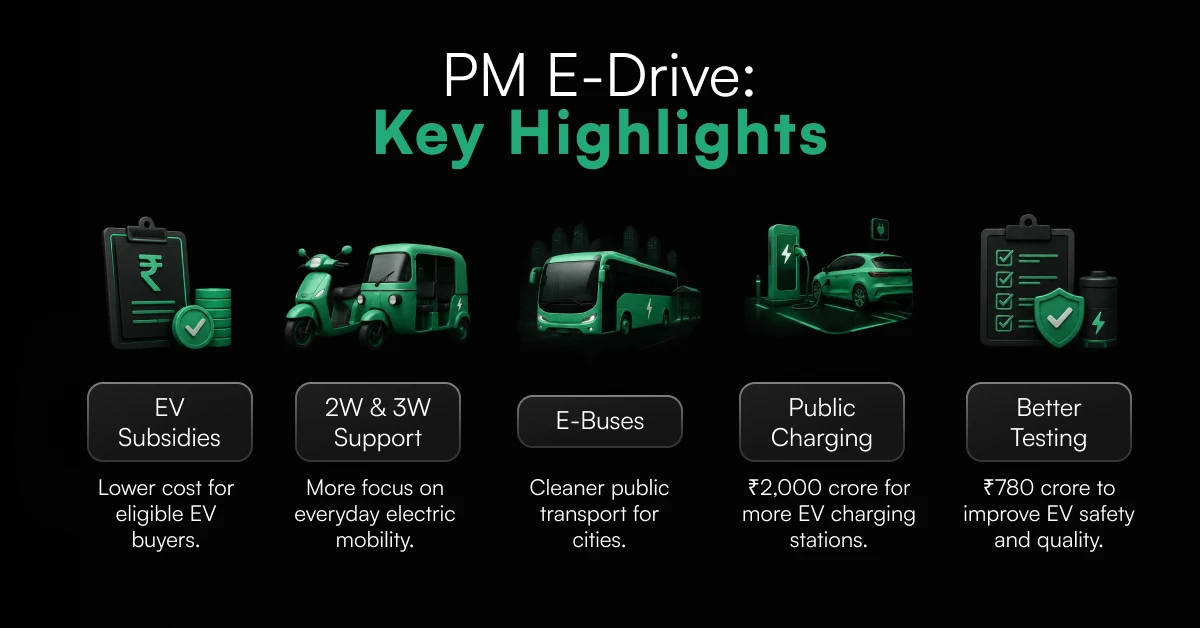
PM E-DRIVE is designed to do more than just subsidize vehicles. It also supports charging infrastructure, public transport electrification, battery-related ecosystem growth, and better testing capacity.
What demand incentives does PM E-DRIVE offer?
The scheme offers demand incentives for eligible EV categories to reduce the upfront cost for buyers. These incentives are especially important for electric two-wheelers, three-wheelers, and fleet vehicles.
How does the e-voucher system work?
PM E-DRIVE uses an e-voucher system to simplify subsidy claims. The buyer gets the benefit at purchase time, while the OEM later claims reimbursement through the official process.
Why does the scheme support electric two-wheelers and three-wheelers?
Two-wheelers and three-wheelers are major EV adoption segments in India because they are used heavily for commuting, delivery, and last-mile transport. Supporting these categories gives the biggest impact fastest.
Why is the charging budget important?
The scheme has a major charging focus, including a ₹2,000 crore allocation for public charging infrastructure. Recent government reporting has also shown active disbursal for new public charging points under the scheme.
Why is testing agency support included?
PM E-DRIVE also includes ₹780 crore for upgrading testing agencies. That matters because EV safety, quality, and certification become more important as new models and charging systems enter the market.
Which vehicles are covered under PM E-DRIVE?
| Category | What PM E-DRIVE Supports |
|---|---|
| Electric two-wheelers | Demand incentives for eligible registered e-2Ws |
| Electric three-wheelers | Support for e-rickshaws, e-carts, and L5 e-3Ws |
| Electric buses | Large-scale procurement for public transport agencies |
| Electric ambulances | Support for cleaner emergency transport |
| Electric trucks | Incentives linked with scrapping old trucks |
| Charging infrastructure | Fast chargers for e-2Ws, e-3Ws, e-4Ws, and e-buses |
| Testing agencies | Upgradation of EV testing infrastructure |
PM E-DRIVE covers a broad set of EV categories, including electric two-wheelers, three-wheelers, buses, ambulances, trucks, charging infrastructure, and testing agencies.
Which vehicle categories get support?
- Electric two-wheelers.
- Electric three-wheelers.
- Electric buses.
- Electric ambulances.
- Electric trucks.
- Charging infrastructure.
- EV testing agencies.
How many EVs are targeted?
The scheme targets support for 24.79 lakh electric two-wheelers, 3.16 lakh electric three-wheelers, and 14,028 electric buses.
What is the bus focus under PM E-DRIVE?
The scheme has a large allocation for electric buses, with deployment planned across major cities. This is one of the strongest signs that the scheme is not just about private EV buyers, but also about public transport transformation.
How does PM E-DRIVE subsidy help EV buyers?
PM E-DRIVE helps EV buyers by reducing the upfront cost of eligible electric vehicles. The subsidy is applied at the time of purchase rather than being paid later as a refund, which makes the buying process simpler for customers.
Who actually gets the benefit?
The buyer gets the reduced price at purchase time, the dealer applies the incentive, and the OEM later claims reimbursement from the government. That makes the process more convenient and reduces the burden on the customer.
Why is this better than a delayed refund?
Because buyers do not have to wait for a later payout. They see the benefit immediately in the final purchase price, which is more useful for people comparing EVs with petrol or diesel alternatives.
What were the proposed incentive rates?
For e-2Ws and e-3Ws, demand incentives were proposed at ₹5,000 per kWh for FY 2024–25 and ₹2,500 per kWh for FY 2025–26, subject to caps and eligibility rules.
How does the PM E-DRIVE e-voucher work?
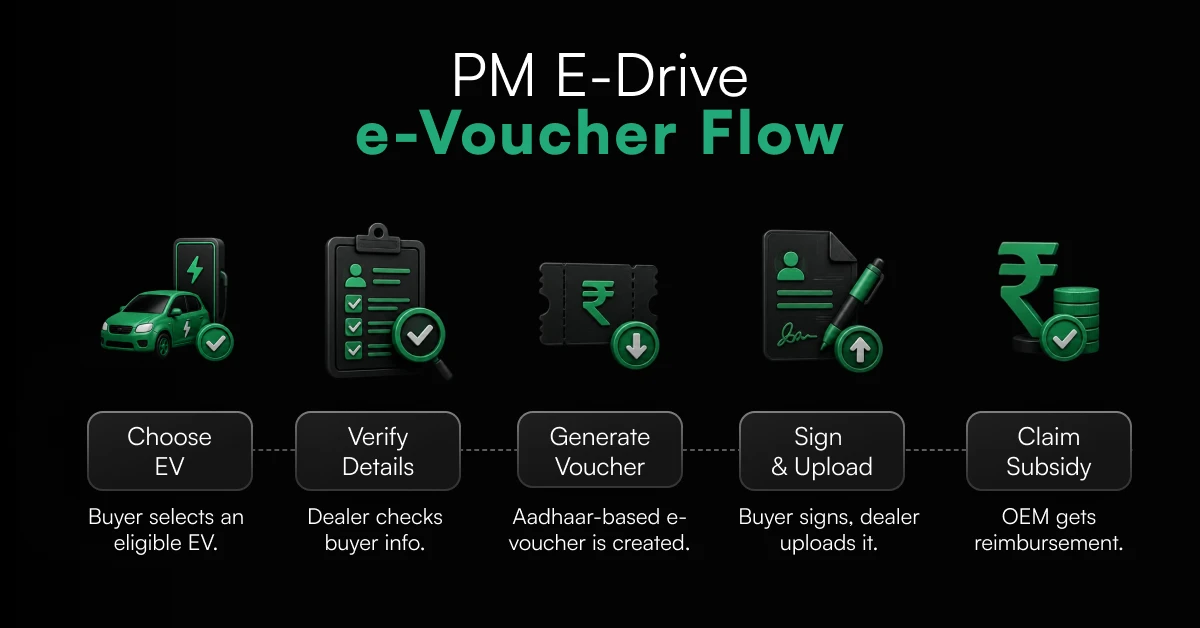
The PM E-DRIVE e-voucher is a digital document that helps buyers receive the EV subsidy benefit at purchase. It is meant to make the process faster, cleaner, and easier to track.
What are the steps in the process?
- Buyer chooses an eligible EV.
- Dealer verifies the buyer details.
- Aadhaar-authenticated e-voucher is generated.
- Buyer signs the e-voucher.
- Dealer uploads it on the PM E-DRIVE portal.
- OEM claims reimbursement from the government.
Why is the e-voucher useful?
It reduces paperwork and makes the subsidy flow more transparent. It also helps the government and OEMs verify claims more efficiently.
How does PM E-DRIVE support charging infrastructure?
Charging infrastructure is one of the most important parts of PM E-DRIVE because EV adoption depends heavily on access to reliable charging. The scheme has already seen significant activity in public charging deployment.
To find EV charging stations already live across these networks, you can use the EV charging stations app — it covers 3,000+ verified stations across 30+ networks in India.
How much money is allocated for charging?
PM E-DRIVE has ₹2,000 crore dedicated to public EV charging infrastructure. That includes public charging stations, battery swapping stations, battery charging stations, and supporting upstream infrastructure.
Where will the chargers be installed?
The scheme supports chargers in government premises, public sector locations, transport hubs, highways, and other public areas. Recent approvals have covered thousands of new public charging stations across the country.
If you want to check which EV charging stations near you are already operational across these locations, download MyMotor on Google Play to see live availability across highways, cities, and public hubs.
What kind of charger rollout is happening now?
Government reporting in 2026 shows approvals for thousands of new public EV charging stations, with large-scale expansion aimed at improving access nationwide. This indicates the scheme is moving from policy into deployment.
Which users benefit most from PM E-DRIVE?
PM E-DRIVE benefits more than just EV buyers. It supports fleet operators, cities, charging businesses, and India’s larger clean mobility goals.
How does it help EV buyers?
It reduces upfront cost, improves charging confidence, and makes EV ownership more practical for daily use.
How does it help fleet operators?
Delivery companies, logistics firms, and mobility services can benefit from lower running costs and better charging access. That makes EV fleets more scalable over time.
How does it help cities?
Electric buses help cities reduce emissions and noise pollution while improving public transport quality. The scheme’s bus allocation is one of its most visible urban benefits.
How does it help charging businesses?
As more EVs enter the market, demand for chargers rises. PM E-DRIVE’s charging focus creates more opportunities for operators and ecosystem players.
What is the latest update on PM E-DRIVE?
The most important current update is that PM E-DRIVE has been extended to 31 March 2028 within the same ₹10,900 crore outlay, while charging infrastructure rollout is actively progressing. Government and media reports in 2026 also show major charger disbursals and a continued push for public charging expansion.
What should readers know about the timeline?
The scheme is not a short pilot anymore. It is being treated as a multi-year national EV support framework, with funding already moving toward chargers, buses, and broader EV deployment.
Why does this matter for buyers?
It means the EV ecosystem is becoming more usable, not just more promotional. For buyers, that often translates into better charging confidence and stronger resale ecosystem development over time.
Why this matters for MyMotor readers
For MyMotor readers, PM E-DRIVE is important because it affects the real cost and convenience of EV ownership in India. It influences what you pay upfront, how easily you can charge, and how practical EVs feel in everyday life. The MyMotor EV charging app already aggregates 30+ charging networks so you can find, check, and pay for a session from a single app — exactly the kind of charging access PM E-DRIVE is trying to build nationwide.
What should buyers watch for?
- Eligibility rules.
- Subsidy caps.
- Dealer-level voucher process.
- Charger access near home and office. You can check EV charger availability near you live before deciding on a charging plan.
- Whether the EV category is supported under the scheme.
Why is this useful for EV shoppers?
Because a good EV purchase is not only about the car. It is also about policy support, charging access, and the infrastructure around the vehicle.