
Riding without a helmet in Uttar Pradesh? That's either a ₹1,000 fine waiting to happen or worse.
With enforcement getting stricter in 2026, it's not just about dodging fines now. It's about whether your helmet actually protects you when it counts and here's the thing, not all helmets do.
Fake ISI stickers, confusing certifications, cheap foam that crumbles on impact it's easy to get fooled.
This blog cuts through the noise and will help you cover the latest helmet rules in UP, explain what certifications like ISI, DOT, and ECE actually mean, and help you find the best helmet for 2026.
Let’s get started
What Are the Latest Helmet Rules in Uttar Pradesh for 2026?
In Uttar Pradesh, wearing ISI-certified helmets is mandatory for all two-wheeler riders and pillion passengers under the Motor Vehicles Act.
If you’re caught without a proper helmet or using a non-ISI one you can be fined ₹1,000, and in some cases, it could even affect your insurance claims.
What the Law Says And Why You’re Getting Fined?
The law doesn’t just say “wear a helmet” it specifically needs ISI-marked motorcycle helmets.
That means those lightweight, stylish, roadside “helmets” without certification? They actually don’t count.
- ISI certification is compulsory for all helmets used on Indian roads
- Wearing a non-ISI helmet is treated the same as not wearing a helmet at all
- Fine: ₹1,000 for riding without a proper helmet
- In case of an accident, insurance claims can be rejected if you weren’t wearing an ISI-certified helmet
So yes, that cheap helmet might save you ₹500 today but it can cost you a lot more in the future.
What Common Helmet Mistakes Do Riders in UP Make?
Well, even regular riders get this wrong. Here are the most common mistakes people make when it comes to helmet rules in UP:
- Wearing non-ISI “fashion helmets”: These look good on Instagram, but offer little to no real protection and they’re illegal.
- Falling for fake ISI stickers: Some sellers put fake ISI marks on low-quality helmets, so always check properly before buying.
- Using half helmets without certification: Not all half helmets are illegal but many sold locally don’t meet ISI standards.
Which ISI-Marked Helmets Are Best for UP Riders in 2026?
For riders in Uttar Pradesh, choosing an ISI mark helmet is both a legal requirement and a smart safety decision.
The best helmet for you depends on your budget but even affordable motorcycle helmets today offer decent protection if they’re properly certified and well made.
What are the best budget helmets under ₹1,500 for daily commuters?
These helmets are ideal if you just want something affordable, legal, and safe for everyday commuting.
1. Studds Raider
- Key features: ISI-certified, lightweight shell, basic ventilation
- Pros: Affordable, widely available, comfortable for short rides
- Cons: Basic padding, limited durability
- Best for: Daily city commute
2. Vega Edge
- Key features: ISI mark helmet, lightweight design, decent airflow
- Pros: Comfortable for traffic riding, budget-friendly
- Cons: Not ideal for long highway rides
- Best for: Short city rides
Which helmets under ₹3,000 offer the best value for money?
This range offers a little upgrade in comfort and usability, perfect for riders who spend more time on the road.
1. Steelbird SBH-17
- Key features: ISI-certified, better cushioning, stylish design
- Pros: Good comfort, attractive looks, improved safety feel
- Cons: Slightly heavier than budget options
- Best for: Daily commute + occasional highway rides
2. Steelbird SBH-25
- Key features: Better ventilation, ISI mark helmet, improved padding
- Pros: Better airflow (great for UP summers), comfortable fit
- Cons: Average build quality compared to premium helmets
- Best for: City + medium-distance rides
Which ISI helmets under ₹5,000 are best for highway and long rides?
If you ride longer distances or want better build quality, this is where you should be looking.
1. Steelbird SBH-57
- Key features: Strong ABS shell, ISI-certified, premium finish
- Pros: Durable, comfortable for long rides, solid build
- Cons: Slightly bulky
- Best for: Highway + long commutes
2. Vega Bolt (Bluetooth Variant)
- Key features: ISI mark helmet, built-in Bluetooth, sun visor
- Pros: Feature-rich, convenient for calls/navigation
- Cons: Battery dependency, slightly expensive
- Best for: Tech-friendly riders, long city rides
How Do ISI, DOT, and ECE Certifications Differ for Indian Riders?
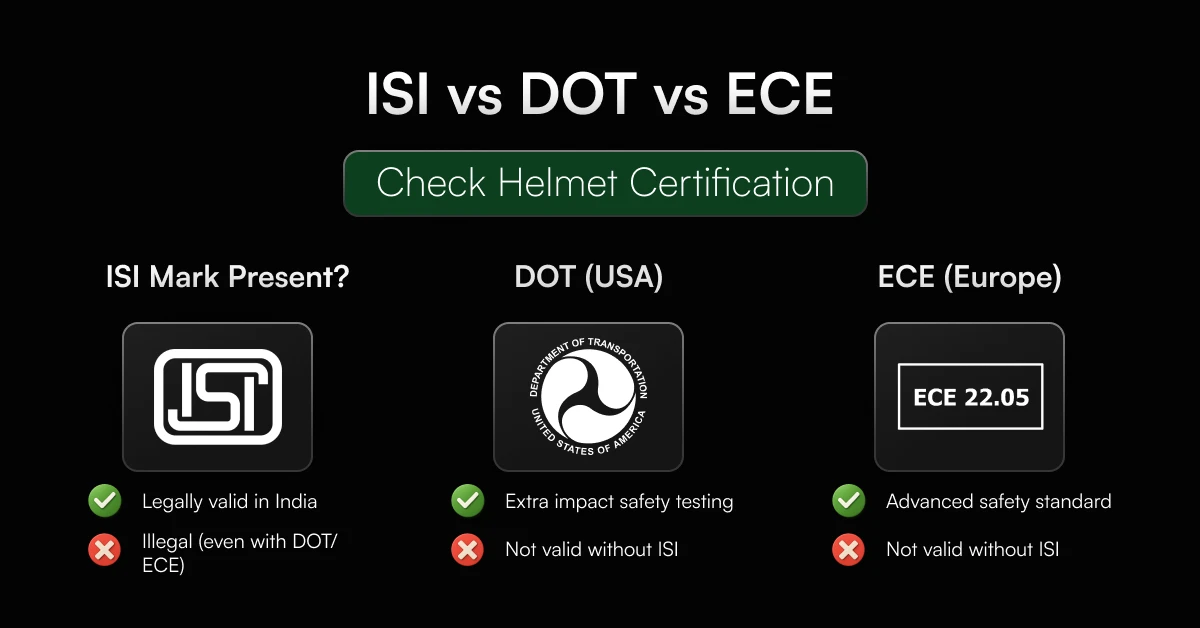
In India, only helmets with an ISI mark are legally valid.
While DOT and ECE certifications indicate higher or additional safety testing, they do not replace ISI certification.
So if your helmet has DOT or ECE but no ISI mark, you can still be fined.
ISI vs International Standards Explained
This is where a lot of riders actually get confused.
You’ll often see motorcycle helmets marketed with global certifications like DOT or ECE and assume they’re better or automatically legal.
That’s not always true in India.
Here’s how it actually works:
1. ISI (Indian Standards Institute)
This is the mandatory certification in India.
It makes sure that your helmet meets basic impact protection standards required under Indian law.
If your helmet doesn’t have an ISI mark, it’s considered invalid, no matter how expensive it is.
2. DOT (Department of Transportation – USA)
DOT-certified helmets are tested for high-speed impact protection. They’re popular globally, but DOT alone is not legally accepted in India.
3. ECE (Economic Commission for Europe)
ECE is one of the most advanced helmet safety standards, with stricter and more detailed testing.
However, just like DOT, ECE without ISI is not valid under Indian helmet rules.
Here’s the actual difference:
| Feature | ISI Mark | DOT | ECE |
|---|---|---|---|
| Legal in India | Yes (mandatory) | No (alone not valid) | No (alone not valid) |
| Safety Level | Basic impact protection | High-speed impact testing | Advanced multi-impact testing |
| Usage | Required for all riders | International standard (USA) | International standard (Europe) |
| Best Approach | Must-have | Optional upgrade | Optional upgrade |
Why Do ISI Helmets Actually Improve Your Safety?
An ISI mark helmet isn’t just about following the Motor Vehicles Act it’s about real protection.
Helmets with a genuine ISI mark are tested to reduce the risk of serious head injuries by up to 60%, making them a critical safety gear for every rider.
How ISI Helmets Protect You
Well, let’s be honest most riders wear helmets to avoid fines. But the real value of an ISI mark helmet shows up in those split seconds during an accident.
Here’s what these helmets are actually designed to do:
- Absorb linear impact: When your head hits a surface (like the road or another vehicle), the helmet’s inner layer absorbs and spreads that force, reducing the direct blow.
- Prevent skull fractures: The hard outer shell acts as a barrier, preventing sharp or blunt objects from directly hitting your skull.
- Reduce severity of head injuries: Studies show that wearing a certified helmet can reduce serious head injury risk by around 60% which is huge when you think about real-world accidents.
How Big Is the Fake Helmet Problem in India and UP?
Now here’s the scary and confusing part, not every helmet you see on the road is actually safe.
Across India, especially in local markets and roadside stalls, you’ll find helmets that:
- Look like branded products
- Have an ISI mark sticker
- Cost super cheap
But in reality? Many of these are non-certified helmets with fake markings.
- They don’t meet safety standards
- They can crack easily on impact
- They’re illegal under the Motor Vehicles Act
That’s why authorities have been increasing crackdowns and seizures of fake helmets in recent years.
What Are State-Wise Helmet Penalties Across India (2026)?
Helmet fines in India are based on the Motor Vehicles Act, but states can tweak the amount slightly.
That’s why you’ll see some difference but overall, most penalties fall between ₹500 and ₹2,000, with stricter action for repeat offences.
State-Wise Helmet Fine Table (2026)
| State / UT | First Offence | Repeat Offence | Additional Notes |
|---|---|---|---|
| Uttar Pradesh | ₹500 | ₹1,000 | Court summons possible |
| Delhi | ₹1,000 | ₹2,000 | Licence suspension possible |
| Maharashtra | ₹500 | ₹1,000 | Strict enforcement in cities |
| Karnataka | ₹500 | ₹1,500 | Pillion rider also fined |
| Tamil Nadu | ₹1,000 | ₹1,500 | Helmet may be seized |
| Gujarat | ₹500 | ₹1,000 | Licence suspension possible |
| Kerala | ₹500 | ₹1,000 | Strict road checks |
| Rajasthan | ₹1,000 | ₹1,000+ | Uniform enforcement |
| Punjab | ₹1,000 | ₹1,000+ | Includes improper helmets |
| Bihar | ₹1,000 | ₹1,000+ | Standard penalty |
| West Bengal | ₹1,000 | ₹1,000+ | Strict enforcement |
| Uttarakhand | ₹1,000 | ₹2,000 | Higher repeat penalty |
Should You Consider MIPS in 2026?
If you ride regularly, MIPS is worth considering but it’s not a replacement for an ISI mark helmet.
ISI vs MIPS: Do You Need Both?
So, a lot of riders think MIPS is some kind of “better version” of ISI but that’s not how it works.
- ISI (Indian Standards Institute): This is your legal requirement. Without an ISI mark, your helmet isn’t valid under Indian law simple as that.
- MIPS (Multi-directional Impact Protection System): This is a technology inside the helmet, not a certification. It’s designed to reduce rotational forces during an angled crash something regular helmets don’t fully address.
How Do I Choose the Right Helmet for My Riding Conditions in UP?
Choosing the right motorcycle helmet comes down to three things, certification, fit, and comfort.
Get these right, and you’ll have a helmet that actually protects you on the road.
1. Check ISI Certification
Always make sure your helmet has a genuine ISI mark with IS:4151 code.
This confirms that it meets Indian safety standards.
Don’t rely on stickers, verify properly using BIS if needed. No ISI certification means the helmet isn’t legal or safe.
2. Get the Right Fit
A good motorcycle helmet should feel snug without being uncomfortable.
Measure your head, check size charts, and make sure that the helmet doesn’t move when you shake your head.
A loose helmet won’t protect you properly in an accident.
3. Consider UP Riding Conditions
Choose a helmet that suits your daily riding.
In UP’s heat and dust, go for good ventilation, and for traffic-heavy rides, pick a lightweight helmet to avoid neck strain.
4. Avoid These Mistakes
Avoid loose helmets, fake duplicates, and buying based only on looks.
Many cheap helmets may seem fine but don’t meet required safety standards so focus on certification and fit, not just design.
What Should I Buy in 2026: Minimum Requirements and Upgrades?
In 2026, the helmet decision really isn't that hard but it does have a few levels depending on your budget.
At the bare minimum, your helmet needs a genuine ISI mark.
No exceptions. It's what makes your helmet both legal and actually safe on Indian roads. Anything without it isn't worth your money, no matter how good it looks.
Once that's sorted, focus on fit and ventilation.
A helmet that fits well and keeps your head cool is one you'll actually wear every day and that consistency is what really keeps you safe in the long run.
And if you have a little more budget to play with? Look for ISI + MIPS.
ISI covers the legal and basic safety side, while MIPS adds an extra layer of protection against rotational impact, the kind that matters most in real-world crashes.
Conclusion
Now you know that choosing the right helmet really comes down to a few simple things, get a genuine ISI-certified helmet, make sure it actually fits your head, and pick one you won't mind strapping on every single day.
Whether you're spending ₹1,500 or ₹5,000+, safe, certified, and reliable is all that matters.
It's tempting to treat a helmet as just another box to tick but it's genuinely the one thing standing between you and a serious injury.
So skip the cheapest option and go for the smartest one instead.