
Buying your own car is exciting, but you need to know that it’s not just about getting your favorite model.
And you would be shocked to know that one of the major factors that affect the final price of a car is taxation, especially the Goods and Services Tax (GST).
Before GST came along in 2017, buying a car in India was just dealing with a bunch of taxes all at once, excise duty, VAT, sales tax, you name it. GST cleaned all of that up.
But since things are still changing, the 2025–2026 updates are actually worth knowing about.
What Is GST on Cars in India?
GST is an indirect tax applied on the sale of goods and services in India. For automobiles, GST replaced multiple earlier taxes, creating a single unified tax system.
Basically, the GST rate on a car depends on some various factors:
- Engine capacity (in cc): Larger engines generally attract higher taxes.
- Vehicle length (in meters): Shorter cars often have lower tax rates.
- Fuel type: Petrol, diesel, electric. EVs have lower GST.
- Vehicle category: Small cars, SUVs, and luxury vehicles are taxed differently.
This tiered system makes sure that taxes are proportional to the size, power, and environmental impact of a car.
What Are the Latest GST Rates on Cars in India (2026)?
Not all cars are actually taxed equally.
Your GST depends on how big the engine is, how long the car is, what fuel it runs on, and if it's an SUV or luxury vehicle. EVs get the lowest rate at 5%, small cars pay less for obvious reasons, and premium or large vehicles pay the most.
New GST Rates on Cars
| Vehicle Category | GST Rate | Compensation Cess | Total Tax |
|---|---|---|---|
| Small petrol car (≤1200cc, ≤4m) | 28% | 1% | 29% |
| Small diesel car (≤1500cc, ≤4m) | 28% | 3% | 31% |
| Mid-size car (>4m) | 28% | 15% | 43% |
| SUV (>1500cc, >4m) | 28% | 22% | 50% |
| Electric vehicles | 5% | 0% | 5% |
*These rates apply to new vehicles purchased from dealerships across India.
How Has GST on Cars Changed: Old vs New Rates?
If you’re planning to buy a car here, getting to know GST (Goods and Services Tax) changes is quite crucial because it directly affects the final on-road price.
The government revised GST rates on cars a few years ago, and learning the differences between the old and new rates can help you make a good and smart decision for yourself.
Let’s break it down in a simple, easy-to-understand way.
GST Rates Overview
GST on cars in India depends mainly on the type of car and engine capacity, here’s a comparison between the old GST rates and the current rates:
| Car Type / Engine | Old GST Rate | New GST Rate | Notes |
|---|---|---|---|
| Small cars (petrol/diesel, < 1200cc) | 12% | 18% | Price increase mostly affects compact hatchbacks. |
| Mid-size cars (petrol/diesel, 1200cc – 1500cc) | 18% | 18% | Rates stayed the same; minimal impact. |
| Luxury cars / SUVs (< 10 lakh ex-showroom) | 28% | 28% | No change; luxury tax included. |
| Luxury cars / SUVs (> 10 lakh ex-showroom) | 30% | 28% | Slight reduction in GST for super-luxury cars. |
| Electric vehicles (EVs) | 12% | 5% | Huge benefit for EV buyers under the new rates. |
Things to note:
- Luxury car buyers benefit slightly: GST for cars priced above ₹10 lakh was reduced from 30% to 28%, making premium cars little cheaper.
- Electric vehicles got a major boost: The govt reduced GST on EVs to just 5% to support green mobility in India.
- Small car buyers see a hike: The cars under 1200cc now attract 18% GST, which is higher than the previous 12%, slightly increasing the cost for budget buyers.
- Mid-size cars remain steady: The GST rate on cars between 1200cc and 1500cc is the same, not affected by the changes.
How to Calculate GST on a Car?
So you've found a car you love and you know the price but that's not what you'll actually end up paying and no it’s not a scam.
In India, the final cost of a car includes GST and a few other charges on top, such as-
Step 1: Know Your Base Price
The base price is what the car manufacturer decides before any taxes or additional charges. For example, let’s say you are buying a 4 wheeler vehicle (like a compact hatchback or sedan) with a base price of:
Base Price = ₹5,00,000
Step 2: Calculate GST
GST is applied to the base price of the car like the rate varies depending on the type of car and engine capacity. For this example, we’ll assume 18% GST.
The formula to calculate GST is quite easy:
GST Amount = Base Price × GST Rate
So, plugging in our numbers we get:
GST Amount = ₹5,00,000 × 18% = ₹90,000
Step 3: Calculate the Car Price Including GST
After that, add the GST amount to the base price to get overall cost of the car before other charges:
Final Price = Base Price + GST Amount = ₹5,00,000 + ₹90,000 = ₹5,90,000
So, the GST-inclusive price of your car is ₹5,90,000.
Step 4: Add Other Costs
It doesn’t end here, the on-road price of a car is usually higher than just the base price plus GST, you can expect charges like:
- Registration Fees: Paid to the local RTO to get the car registered in your name. This varies by state and vehicle type.
- Insurance: Covers damages, accidents, or theft. Comprehensive insurance is recommended for 4 wheeler vehicles.
- Road Tax: A state-specific tax based on the car’s price, engine capacity, and fuel type. It can be a little costly for luxury cars.
- Dealer Charges: Dealers may include handling, logistics, and documentation charges, these are usually a few thousand rupees.
Step 5: Estimating the On-Road Price
If we roughly assume:
- Registration = ₹15,000, Insurance = ₹20,000, Road Tax = ₹25,000, Dealer Charges = ₹10,000
On-Road Price = ₹5,90,000 + ₹15,000 + ₹20,000 + ₹25,000 + ₹10,000 = ₹6,60,000
So, even though the GST-inclusive price is ₹5,90,000, the actual price you pay to drive your 4 wheeler vehicle off the lot is around ₹6,60,000.
What Is the GST on Different Types of Vehicles?
Let's be honest, tax rates aren't exactly the best to read about. But when it comes to buying a car, being aware about GST can actually save you a good amount of money.
The rate depends on the type of car you choose: small hatchback, SUV, luxury car, EV, or hybrid.
1. GST on Small Cars:
Small cars are compact 4 wheelers designed for city driving. In India, the small car length is typically under 4 meters, making them both easy to park and fuel-efficient.
Engine Size Rules:
- Petrol/Diesel engines under 1200cc attract lower GST rates.
- Hatchbacks in this category usually come under 18% GST now (previously 12%).
Examples of Popular Small Cars:
- Maruti Suzuki Swift
- Hyundai i10
- Tata Tiago
These cars are good for city commutes, and the GST is calculated on their ex-showroom price.
2. GST on SUVs and Luxury Cars
There's nothing quite like the feeling of sitting behind the wheel of an SUV or a premium car but they come with a higher tax bill.
Thanks to their larger engines and higher ground clearance, these cars fall into the 28% GST slab. Some also attract an extra cess on top.
Ground Clearance Rule:
Cars with a ground clearance above 170mm often qualify as SUVs in India, pushing them into the higher tax bracket.
Popular Examples:
- Hyundai Creta
- Mahindra XUV700
- Toyota Fortuner
3. GST on Electric Vehicles (EVs)
And you won’t believe that one of the best things to happen to EV users in India is the GST cut.
The government dropped the tax on electric vehicles all the way down to 5%, a big move when you consider that regular petrol and diesel cars are taxed anywhere between 12% and 28%.
Basically, it makes going electric a genuinely smart decision.
Government EV Incentives:
- On top of the lower GST, EV buyers can also benefit from subsidies under FAME India, lower registration fees, and reduced road taxes in some states.
- Popular examples: Tata Nexon EV, MG ZS EV
4. GST on Hybrid Cars
If you're wanting a hybrid, it’s actually good for you as it's a smart and thoughtful choice. But all Hybrids don't get the same GST rate.
It depends on the engine size and fuel type, and some models with larger engines can attract as much as 28% GST, just like SUVs.
Popular Examples for Hybrid:
- Toyota Camry Hybrid
- Honda City Hybri
How Much GST Is Charged on Imported Cars in India?
So yeah, imported cars do look pretty cool, but they'll seriously burn a hole in your pocket when it comes to taxes.
The government slaps heavy duties on them mainly to support local manufacturers and keep the economy in good shape.
Honestly, it's worth knowing charges before you make any decision.
- Assessable Value: So, this is the total value of the car when it arrives in India, including the car price abroad, freight charges, insurance, and other import-related costs. GST and customs duties are calculated based on this assessable value.
- Basic Customs Duty (BCD): A percentage tax levied on imported cars before GST. For most imported cars, the BCD can range from 60% to 100%, depending on the type of car.
- Integrated GST (IGST): IGST is applied on the sum of the assessable value plus customs duty. The IGST rate on imported cars is generally 28%, similar to luxury cars, sometimes with an additional cess.
For Example:
Let’s say you want to import a car with:
- Car price abroad = ₹50,00,000
- Freight & insurance = ₹5,00,000
- Total Assessable Value = ₹55,00,000
Step 1: Calculate Basic Customs Duty (say 60%) BCD = 55,00,000 × 60% = ₹33,00,000
Step 2: Calculate IGST (28%)
IGST = (Assessable Value + BCD) × 28% = (55,00,000 + 33,00,000) × 28% = 88,00,000 × 28% = ₹24,64,000
Step 3: Total Tax Paid
Total Tax = BCD + IGST = 33,00,000 + 24,64,000 = ₹57,64,000
So, the imported car’s tax alone exceeds the original price of the car abroad, which is why imported cars in India are much more expensive and not actually preferred that much.
How Does Make in India Affect Car GST Rates?
India’s Make in India initiative motivates local manufacturing to reduce dependence on imports.
Cars manufactured in India enjoy much lower GST rates (18% for small cars, 28% for luxury cars) without the heavy customs duty, whereas Imported cars, especially luxury and high-end vehicles, are heavily taxed to promote domestic production.
Some car companies even assemble cars locally to take advantage of lower taxation
You might also like: How to Jump Start a Car
What GST Exemptions and Special Cases Apply to Cars?
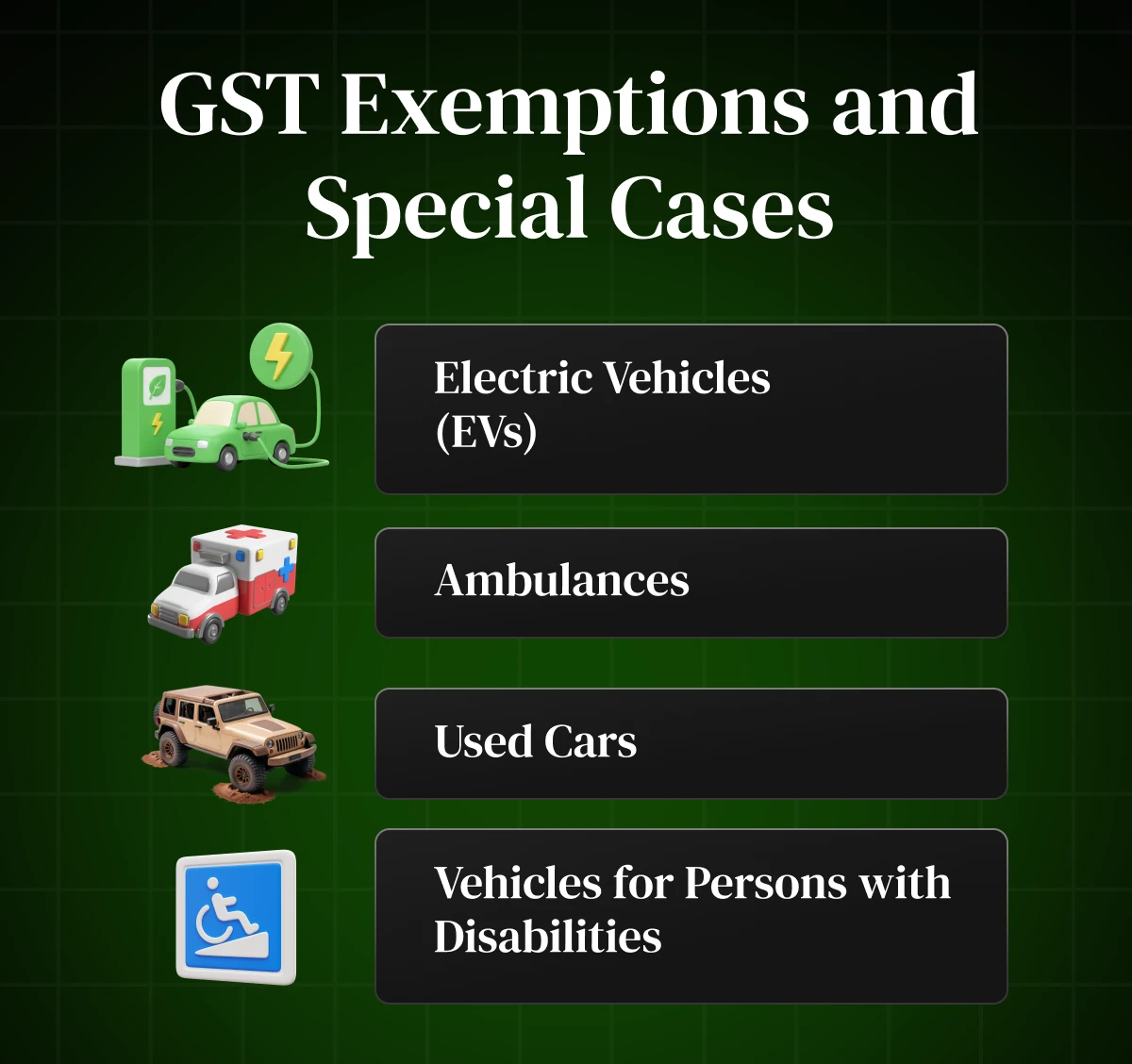
As you know, GST applies to most vehicles in India, there are a few special cases where the rules are different.
1. Electric Vehicles (EVs)
- Since the government wants to spread more green mobility, the GST on EVs is just 5%, much less than regular petrol or diesel cars.
- This lower rate, combined with subsidies under the FAME India scheme, makes EVs more affordable and eco-friendly.
2. Ambulances
- Ambulances are literally life-saving vehicles, so the government keeps the GST rates pretty low on them to make things a little easier for hospitals.
- This makes sure that healthcare services aren’t troubled with high taxes.
3. Used Cars
- You would be happy to know that GST is not applied to the full price of used cars. Instead, it’s charged only on dealer’s margin.
- For example, if a dealer buys a car for ₹3 lakh and sells it for ₹4 lakh, GST is applied on the ₹1 lakh profit, not the full ₹4 lakh.
4. Vehicles for Persons with Disabilities
- Vehicles specially built for people with disabilities are actually fully exempt from GST in a lot of cases, which is honestly a really good move.
What Is Input Tax Credit (ITC) on Cars?
So if you're a business owner looking to buy a car, GST isn't always just an extra expense, it can actually work in your favor through something called Input Tax Credit (ITC).
But here's the catch, not every car qualifies for it, and the rules can get a little confusing.
When Businesses Can Claim ITC
So basically, Input Tax Credit lets businesses balance out the GST they paid on purchases against whatever GST they're collecting on sales.
But when it comes to cars, ITC is only allowed in some specific business situations.
1. Passenger Transport Companies:
If you're running taxis, cabs, or shuttle services, you can totally get ITC on the cars you buy. So like, a cab aggregator expanding their fleet can actually cut down their GST liability using this.
2. Car Rental Businesses:
Rental companies can claim GST credit on the cars they buy for renting out.
So if a company picks up 10 cars for short-term rentals, the GST they paid on those can be adjusted against what they collect from customers. Pretty good, right?
3. Driving Schools:
Since driving schools are buying cars for training purposes, the GST paid on those vehicles are eligible for ITC and it does make sense when you think about it.
4. Demo Cars at Dealerships:
Dealerships usually keep a few cars just for test drives, and since those are being used for business and not personal use, the GST paid on them is eligible for ITC too.
When ITC Is Not Allowed
But yeah, there are some clear no-nos too.
Personal use cars are a straight up no for ITC. Luxury or non-commercial cars without any real business purpose don't make the cut either.
And even if the company is paying the bill, cars used personally by employees won't get you any GST credit.
Which Car Models Became Cheaper After GST Reforms?
When India rolled out the GST reforms for automobiles, a bunch of cars actually got cheaper, especially the compact and mid-size ones.
The whole reform basically cleaned up the tax slabs and took some of the tax pressure off certain models, which means you're genuinely getting a lot more value for every rupee you spend now.
1. Tata Cars GST Savings
So basically, when GST came in, Tata Motors got a pretty sweet deal on a bunch of their popular cars.
The Nexon, which is already a solid pick if you're shopping under 10 lakhs, got a bit cheaper making it an even harder deal to pass.
The Punch also benefited quite a bit, since it's a small car that fits under the 4-meter mark, it falls into a lower tax bracket, so buyers ended up saving more money there.
And then there's the Altroz Tata's answer to cars like the Baleno and i20.
2. Maruti Cars GST Savings
Maruti, which honestly needs no introduction when it comes to Indian people, also had some good news for buyers after GST kicked in.
- The Swift, a car that pretty much every Indian family has either owned or thought of, got more affordable. Since it's under 4 meters, it falls in a friendlier tax bracket, so that's a win.
- Same story with the WagonR, it's already a go-to for city folks who just want something practical and easy to park.
- And the Brezza, known as Maruti's compact SUV was already doing really well, but a better price helped it pull in buyers who wanted that SUV feel without spending way too much.
3. Mahindra Cars GST Savings
Mahindra's SUVs also benefited from GST, though the more expensive models still pay higher taxes.
- The Thar, which is a favourite among off-road lovers, got a small price cut thanks to GST. It was already a popular choice, and this just made it even more popular among people.
- The Scorpio, a well-known name in India, also saw a slight drop in its taxes, which is enough to get potential buyers interested.
- And the XUV700, which was a major hit when it launched, also got a modest price benefit on certain trims.
How Do GST Changes Affect Car Loan EMI?
Did you know that a small change in GST can actually bring down your monthly car loan EMI?
Yep, tax changes don't just affect the price of a car, they also impact how much you borrow and how much you pay every month.
Lower GST = Lower Loan Amount
When GST drops, the price of the car comes down too. And when the price comes down, you need a smaller loan, it's as simple as that.
For example:
- Old GST of 28% on a ₹10 lakh car adds ₹2.8 lakh - so you're paying ₹12.8 lakh total
- New GST of 18% on the same car adds ₹1.8 lakh - so now it's ₹11.8 lakh total
That's a whole ₹1 lakh less on your loan, which means your EMI goes down too.
Conclusion
So the next time a car catches your eye at the showroom, look beyond the price and check what GST is doing to it.
For budget buyers and big spenders alike, knowing taxes can lead to some serious savings.
And with EVs enjoying lower GST rates, going electric might just be the smartest financial decision you make.