
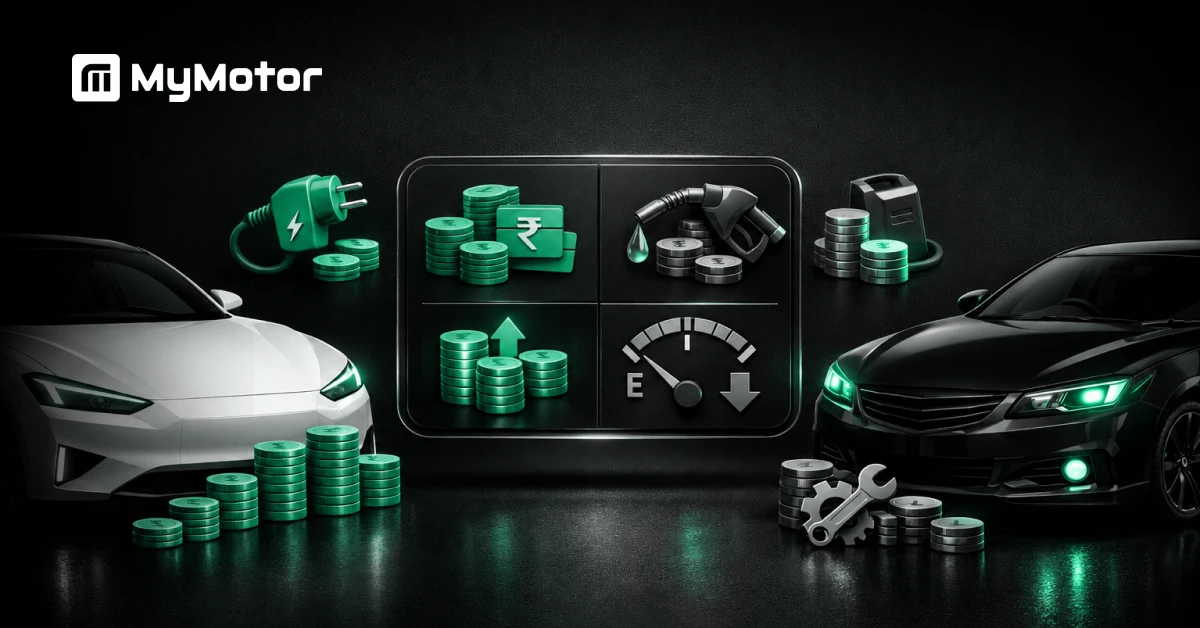
We don’t just buy cars. We calculate them.
EMI, resale, insurance, service costs, we run the numbers, ask a few neighbours, two cousins, and that one uncle who “knows about these things.”
And even after all that, the decision still somehow feels uncertain. Because the answer to “Should I switch?” isn’t a simple yes or no.
It depends.
On your city, your building’s charging setup and how many kilometres you actually drive each month.
Let’s dig more.
What Are the Total Ownership Costs for EVs vs Petrol Cars?
EVs usually cost more to buy upfront, but they’re actually much cheaper to run and maintain over time compared to petrol cars.
So the question isn’t just “Which car is cheaper?” but it’s “Which one costs less to own over the years?”
How Do Purchase Prices and Government Incentives Change the Upfront Cost?
Let’s be real for a moment, electric cars are usually pricier at the time of purchase because of battery costs.
But depending on your state, government incentives can help reduce that gap through:
- Lower or zero road tax
- Reduced registration fees
- State EV subsidies
- Lower GST on EVs
So yes, petrol cars are usually easier on your wallet upfront, but the difference may not be as big as it first looks.
How Do Running Costs per Km Compare for EVs and Petrol Cars?
Now, this is where EVs usually pull ahead.
EV
- Electricity cost: ₹8/unit
- Efficiency: 6 km/unit
- Running cost: ~₹1.3/km
Petrol car
- Petrol price: ₹100/litre (approx)
- Mileage: 15 km/litre
- Running cost: ~₹6.7/km
If you see that’s actually a huge difference.
Even with public fast charging being costlier, electric vehicles are usually much cheaper to drive than petrol cars.
What Are the Typical Break-Even Periods for EV Ownership?
If an EV costs ₹3 lakh more upfront but saves around ₹5/km in running costs:
Break-even = ~60,000 km (approx)
So if you drive:
- 10,000 km/year → ~6 years
- 15,000 km/year → ~4 years
- 20,000 km/year → ~3 years
And since electric cars also have lower maintenance, the break-even can actually happen even sooner.
Now, which one makes more sense?
If you drive less and want lower upfront costs, petrol may still make sense.
But if you drive regularly and plan to keep the car for a few years, EVs are a better fit since they are cheaper to maintain than petrol vehicles.
How Do Fuel and Charging Costs Compare in Real Indian Scenarios?
Well, in most real Indian driving scenarios, EVs are cheaper to run than petrol cars but exactly how much cheaper depends a lot on where and how you charge.
What Difference Does Home Charging VS Public Fast Charging Make?
Now, this is where the cost difference really shows up.
If you charge your EV at home, it’s usually the most affordable option. With average residential electricity rates, running an EV can cost roughly ₹1–₹2 per km, depending on your car’s efficiency and local tariff.
But if you rely mostly on a public EV charging station, especially fast chargers, the amount goes up. Use the MyMotor app on Google Play to find stations near you and compare prices before charging.
Public EV chargers are built for convenience and speed, but that convenience comes at a premium.
In some cases, your running cost can move up to ₹3–₹5 per km.
Petrol, on the other hand, doesn’t really give you this flexibility.
It doesn't matter if you fuel up in Mumbai or Bengaluru, you’re still paying more per kilometre compared to home charging an EV.
In easy terms-
Home charging = maximum savings.
Public fast charging = still cheaper than petrol in many cases, but the gap gets smaller.
How Do Regional Electricity Tariffs and Petrol Prices Affect Cost Per Km?
India doesn’t have one standard cost for electricity or fuel, which means it depends on your city.
Electricity tariffs can vary by state, and petrol prices also differ across cities because of taxes and local pricing.
So if you live in a city with lower electricity rates and mostly charge at home, owning an EV becomes even more economical and easy.
And if you rely on frequent public charging in high-demand locations, your savings might reduce but EVs can still remain competitive depending on usage.
Whereas, petrol cars are more predictable, but expensive also.
That’s why the real comparison isn’t just EV vs petrol, it’s your charging habits vs your driving habits.
How Do Maintenance, Servicing, and Reliability Costs Differ?
One of the biggest long-term benefits of electric vehicles is easy maintenance.
Since electric cars have fewer moving parts than petrol cars, there’s simply less that can wear out, leak, or need regular replacement.
Which Components Drive Lower Maintenance for EVs?
Now, think about what a petrol car has to deal with engine oil, filters, spark plugs, clutch wear, exhaust systems, and a lot of moving mechanical parts working together.
An EV skips most of that, sounds cool right?
Since electric vehicles run on electric motors instead of internal combustion engines, you probably don’t have to worry about:
- Engine oil changes
- Spark plug replacements
- Clutch repairs (in most EVs)
- Exhaust-related issues
- Regular engine servicing
Even brake wear can be lower, thanks to regenerative braking, which helps slow the car while recovering energy.
That doesn’t mean that EVs are completely maintenance-free.
Tyres, brake pads, suspension, coolant (in some models), and general check-ups still exist.
But overall, the list is much shorter and lighter on your wallet.
What Are Typical Service Items and Annual Costs for Petrol Cars?
Petrol cars come with a more familiar service routine but also more recurring costs.
Your typical annual maintenance might include:
- Engine oil changes
- Oil and air filter replacement
- Spark plug checks or replacements
- Brake servicing
- Coolant top-ups
- Battery replacement over time
- Clutch wear (depending on usage)
So, for a daily used petrol car, annual service and maintenance costs can vary mostly based on the model and age of the vehicle, but they’re higher than electric cars, especially as the car gets older.
How Do Insurance, Road Tax, and Incentives Affect Ownership Cost?
When comparing owning costs, it’s not just fuel or maintenance that matters.
Insurance, road tax, and government incentives can make quite a difference especially if you’re considering getting an EV.
How Do EV Insurance Premiums and Tax Breaks Compare to Petrol Cars?
Well, at first glance, insurance for electric vehicles can sometimes look slightly higher than petrol cars, mainly because EV parts like batteries are expensive to repair or replace.
But ownership costs don’t just stop at insurance.
Many states in India offer reduced or even zero road tax for EVs, along with lower registration charges.
That means while you might pay a bit more in insurance in some cases, you could save significantly on upfront government charges.
Petrol cars, on the other hand, usually come with standard road tax and registration costs, which can add quite an amount to your total purchase bill.
What State-Level Incentives in India Materially Lower EV Ownership Cost?
This is the part where location matters a lot.
India’s EV incentives aren’t the same everywhere. Depending on your state, buying an EV may come with benefits such as:
- Road tax exemption
- Registration fee waivers
- Direct purchase subsidies (where available)
- Special local EV adoption incentives
These benefits can reduce the upfront cost of electric vehicles, specifically in EV-friendly states.
That said, policies can change over time, so incentives available today may not look the same a year from now.
How Does Depreciation and Resale Value Affect Lifetime Cost?
Depreciation can also affect ownership cost, especially at resale.
Since India’s used electric vehicle market is still growing, EV resale values can be less predictable than petrol cars.
Do EVs Depreciate Faster or Slower than Petrol Cars in India?
Well, right now, many electric cars can depreciate faster than comparable petrol cars, mainly because the used EV market is still maturing.
Buyers often have questions around battery life, charging convenience, and how future friendly the technology feels.
Since EV tech is improving fast, some older models might feel outdated faster than petrol cars.
That said, this isn’t true for every EV.
Well-known models with good reliability, practical range, and strong brand trust tend to have better value.
Petrol cars still have a more defined resale market in India, which makes pricing more predictable.
Hybrid cars often sit somewhere in between, offering better fuel efficiency than petrol cars while avoiding some of the range anxiety concerns that buyers may have with EVs.
What Resale Factors (Battery Health, Range, Model) Matter Most?
When it comes to second hand electric vehicles, a few things matter more than usual such as:
1. Battery health: Most likely the biggest factor. A healthy battery means better confidence for the next buyer.
2. Real-world range: Practical usable range matters more than brochure numbers.
3. Brand and model trust: Popular, proven models usually resell better.
4. Charging ecosystem compatibility: Cars that work easily with accessible charging networks may feel more appealing.
5. Vehicle age and warranty coverage: Remaining battery warranty can be a strong resale advantage.
And for petrol cars, resale is usually influenced by more familiar factors like mileage, service history, accident record, and brand demand.
How Do Usage Patterns and Lifecycle Affect Which Option is Cheaper?
The cheaper option really depends on how you use your car.
For daily drivers, especially in the city, an EV often makes better financial sense.
But for occasional users or people who do regular long highway trips, the equation can look different.
When Does High-Mileage Ownership Favour EVs?
Basically, the more you drive, the more an electric vehicle starts to make sense.
Why? Because EVs have much lower running costs compared to petrol cars. So if you’re covering a lot of kilometres every month, daily office commutes, frequent city driving, ride-sharing, or business use the savings add up much faster.
Over time, those lower charging and maintenance costs can offset the higher upfront price.
How Do Occasional Long-Distance Users Compare Costs with Frequent City Drivers?
If you mostly drive within the city and can charge at home or access nearby EV chargers, an EV is usually the more cost-effective choice.
But if your driving is occasional and mostly long-distance, petrol cars may still feel more practical for you.
Frequent highway users may rely more on public charging, where costs are higher and charging stops need planning.
What Are Hidden and Situational Costs to Consider?
While EVs are cheaper to run, hidden costs like charging convenience, time, and long-term battery considerations can actually affect your ownership experience.
How Do Charging Infrastructure and Range Anxiety Translate Into Cost or Time Penalties?
This depends a lot on how and where you drive.
If you mostly charge at your home or have reliable access to a car charger, owning an EV feels much smoother and cheaper.
But if you depend mostly on public EV chargers, things can be less predictable.
You may end up spending:
- More on fast charging compared to home charging
- Extra time waiting for an available EV charger
- Time planning routes around charging stops
And then there’s range anxiety, the very real concern of running low on charge without a convenient charging option nearby.
It might not show up as a line item in your bill, but time, inconvenience, and occasional charging detours are there too.
What Are the Costs of Battery Replacement or Warranty Extensions?
Battery replacement is often the biggest long-term cost people worry about with EVs but for most buyers, it’s not an instant concern.
Most modern EVs come with battery warranties that usually cover several years, which helps reduce your risk.
That said, battery replacement can be expensive if needed outside warranty, since the battery is one of the most costly parts in an electric vehicle.
Some people may also choose extended warranty plans for peace of mind, which adds to overall cost but can improve predictability.
How to Model Your Personal Cost Comparison Step-By-Step?
The best way to compare an EV and a petrol car is to use your own driving pattern.
Your monthly kilometres, fuel price, electricity tariff, and vehicle efficiency will tell you which option is cheaper for you.
Which Inputs Are Essential?
So, start with these basic numbers:
- Km driven per month
- Petrol price per litre
- Petrol car mileage
- Electricity cost per unit
- EV efficiency
- Price difference between EV and petrol car
- Expected maintenance cost
- Insurance, road tax, and incentives
Once you have these, the comparison becomes much clearer.
For petrol cars, calculate:
Petrol cost per km = Petrol price ÷ Mileage
For EVs, calculate:
EV cost per km = Electricity tariff ÷ Km driven per unit
Then compare the monthly running cost for both.
What Sample Calculation Templates Should I Use to Estimate Payback?
Monthly petrol cost = Monthly km × Petrol cost per km
Monthly EV charging cost = Monthly km × EV cost per km
Monthly savings = Monthly petrol cost − Monthly EV charging cost
Payback period = Extra EV purchase cost ÷ Monthly savings
For Example:
If your petrol car costs ₹7/km and your EV costs ₹2/km, your saving is ₹5/km.
If you drive 1,000 km/month:
Monthly savings = 1,000 × ₹5 = ₹5,000
So, if your EV costs ₹3 lakh more upfront:
Payback period = ₹3,00,000 ÷ ₹5,000 = 60 months, or 5 years
So the more you drive, the faster the EV pays back.
Which EV and Petrol Car Segments Show the Biggest Cost Differences?
Well, the cost difference between EVs and petrol cars varies by segment.
In some cases, electric cars offer quicker savings, while in others, the payback takes longer.
Do Compact Hatchbacks, SUVs, and Luxury Segments Differ in ROI?
Yes.
In compact hatchbacks, the upfront price gap is usually smaller, so EV savings can show up faster for regular drivers.
In SUVs, EVs may cost more upfront, but higher fuel costs for petrol SUVs can make long-term savings.
In the luxury segment, EV savings can be significant, but the higher purchase price often means a longer payback period.
How Do Used EVs Compare to Used Petrol Cars on Cost Metrics?
Used EVs can look appealing because the upfront price is lower, but buyers usually pay closer attention to battery health, remaining warranty, and real-world range.
And a used petrol car is often easier to evaluate because buyers are more familiar with service history, mileage, and maintenance expectations.
On pure running costs, used EVs can still be cheaper especially if you have easy access to home charging or nearby car chargers.
But if the battery condition is shaky, that can change the cost equation real fast.
What Future Trends Will Change the EV vs Petrol Cost Equation?
The EV vs petrol cost comparison isn’t actually fixed, it's changing fast.
As technology improves and market conditions shift, the cost advantage of an EV could become stronger over time.
How Will Battery Price Declines and EV Adoption Affect Total Cost?
In most cases, battery costs are one of the biggest reasons why EV prices are still higher than petrol cars.
As battery technology improves and EV adoption grows, those costs are expected to come down.
That could mean lower buying prices, better range, and improved affordability for future EV buyers.
How Could Fuel Price Volatility and Policy Shifts Change the Comparison?
Petrol prices can be unpredictable, and any sharp increase directly affects running costs for petrol car owners.
Electricity costs can change too, but EV owners usually have more flexibility, especially with home charging options.
Policy changes will matter as well. Future incentives, tax benefits, or changes in EV support could make whole ownership cheaper or might change it entirely.
What Practical Checklist Should Readers Use Before Choosing?
Here, the right choice isn’t about what’s cheaper on paper, it's about how you drive, what your budget looks like, and whether an EV charging station fits naturally into your routine or not.
Which 10 Checks Should I Run on My Driving Profile and Finances?
Before you decide, just ask yourself these easy questions once:
1. How much do I actually drive every month? The more you drive, the more an EV can save you.
2. Is most of my driving in the city? EVs usually make more sense for daily city commutes.
3. Can I charge at home? This is a big one. Home charging makes EV charging much cheaper and easier.
4. Are there reliable EV chargers around me? If public charging is your main option, convenience may vary.
5. Do I take frequent long road trips? Petrol still feels easier for spontaneous long-distance travel.
6. What’s the actual upfront price difference? Compare the exact models you’re considering and not just usual assumptions about EV price.
7. What are fuel and electricity costs in my city? Your local rates can change the math quite a bit for you.
8. How long am I planning to keep the car? EV savings usually make more sense over longer ownership.
9. Am I okay with slightly different ownership habits? Charging needs a bit more planning than refuelling.
10. What matters more to me, convenience today or savings over time? That answer might decide everything for you also.
How Do I Prioritize Comfort, Convenience and Long-Term Savings?
If you want something familiar, flexible, and easy for any kind of trip, petrol will probably feel more comfortable.
But if your routine is mostly city driving, and charging fits into your lifestyle, an EV can actually save you a lot over time.
Petrol is about convenience today. EVs are often about savings tomorrow.
The Five Year Total Cost of Ownership (TCO) Matrix
| If you value... | EV | Petrol Car |
|---|---|---|
| Lower running costs | Strong advantage | Higher ongoing cost |
| Lower upfront cost | Higher purchase price | Strong advantage |
| Easy long-distance travel | Depends on charging access | More convenient |
| Lower maintenance | Lower servicing costs | Higher servicing costs |
| Familiar ownership experience | Slight learning curve | More familiar |
| Better for daily city driving | Well suited | Less cost-efficient |
Final Thoughts
There is no winner here, just the right fit for your life.
City driving, home charging, long-term ownership, EVs make a compelling case.
But infrequent use, long highway trips, or just wanting simple petrol is still a smart choice.
So, the cheapest car isn't always the one with the lower price tag. It's the one that actually fits how you drive. If you switch to an EV, the MyMotor EV charging app helps you plan your charging across 3,000+ stations and 30+ networks in India.