
Electric Vehicle Subsidy in India 2026: State & Central Incentives You Can Claim Now
Everyone's talking about EVs but nobody's talking about the money you could save.
Between central schemes, state incentives, and registration waivers, the final price can be lakhs lower than the sticker.
The catch? Nobody hands it to you and you need to know where to look.
That's exactly what this blog is for.
What Is the Central EV Subsidy in India for 2026?
The central EV subsidy in India for 2026 is majorly offered under the PM E-DRIVE scheme.
It gives eligible buyers an upfront benefit on selected EV categories, especially electric two-wheelers and some electric three-wheelers.
This subsidy is usually adjusted at the dealership, so buyers do not have to claim it separately in most cases.
How Much Subsidy Do Electric Two-Wheelers Get Under PM E-DRIVE?
Eligible electric two-wheelers can get a subsidy of ₹2,500 per kWh, capped at ₹5,000 per vehicle.
This benefit is available for registered e-2Ws until 31 July 2026, subject to scheme rules and fund availability.
In easy words, if your electric scooter or bike qualifies, the subsidy can reduce your upfront purchase cost. Just make sure that your EV model is approved under PM E-DRIVE before booking.
What Is the Subsidy for Electric Three-Wheelers in 2026?
For registered e-rickshaws and e-carts, the subsidy is ₹2,500 per kWh, capped at ₹12,500 per vehicle. This support is currently extended until 31 March 2028.
However, not all electric three-wheelers get the same benefit.
The PM E-DRIVE portal notes that the e-3W L5 category closed on 26 December 2025, so buyers need to check the exact vehicle category before assuming subsidy eligibility.
Do Electric Four-Wheelers Get Central Subsidy in 2026?
For regular private electric cars, there is no direct central buyer subsidy like electric two-wheelers get under PM E-DRIVE.
The scheme is more focused on categories like e-2Ws, e-3Ws, e-buses, e-trucks, e-ambulances, and charging infrastructure.
That said, electric car buyers may still save through state-level EV benefits such as road tax waivers, registration fee exemptions, or local incentives.
So, before getting an electric car, check your state’s current EV policy too.
Which States Offer the Best EV Subsidies in 2026?
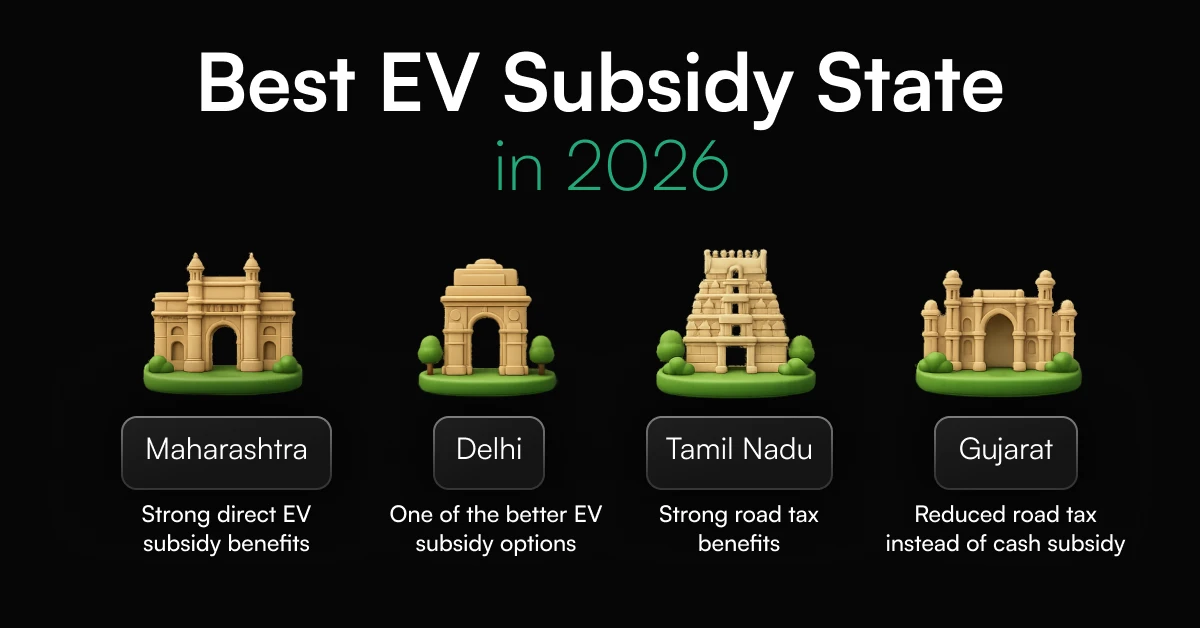
In 2026, Maharashtra and Delhi offer some of the strongest EV subsidies.
Tamil Nadu gives strong road tax benefits, while Gujarat offers reduced road tax instead of direct cash subsidy.
What Is the Maharashtra EV Subsidy for 2-Wheelers, 3-Wheelers & Cars?
Maharashtra is one of the stronger states for EV buyers in 2026.
Under the Maharashtra EV Policy 2026, the state offers benefits across multiple EV categories.
For buyers, the main benefits are:
- Electric 2-wheelers: up to ₹10,000 subsidy
- Electric 3-wheelers: up to ₹30,000 subsidy
- Electric 4-wheeler cars: around ₹1.5 lakh to ₹2 lakh subsidy, depending on the category
- All EVs: exemption from motor vehicle tax and registration fees
- Passenger EVs: 100% toll exemption on key expressways
Maharashtra is also pushing EV charger access by planning charging stations every 25 km on highways and fast chargers at fuel stations and MSRTC depots.
So, it is not just about giving EV subsidies, it is also trying to make EV ownership more practical.
How Much Subsidy Does Delhi Offer on EVs in 2026?
Delhi proposes strong EV benefits, especially for two-wheelers, e-autos, and goods vehicles.
These benefits include:
- Electric 2-wheelers: ₹10,000 per kWh, up to ₹30,000 in Year 1
- Electric 3-wheeler auto-rickshaws: ₹50,000 in Year 1
- Electric N1 goods vehicles: ₹1,00,000 in Year 1
- Electric cars up to ₹30 lakh: 100% road tax and registration fee exemption till 31 March 2030
- Old vehicle scrapping benefit: up to ₹1 lakh for eligible electric car buyers who scrap an old Delhi-registered BS-IV or older car
Well, Delhi is trying to make the switch to EVs more rewarding, especially if you are shifting from an older petrol, diesel, or CNG vehicle.
What Are Gujarat's EV Subsidy Rates for 2026?
Under the Gujarat EV Policy 2021, the state offered ₹10,000 per kWh for electric 2-wheelers, 3-wheelers, and 4-wheelers, with subsidy limits based on battery capacity and vehicle category.
But for 2026, Gujarat’s direct purchase subsidies have largely ended, and the major active benefit is road tax relief.
The state has kept EV registration tax at 1% instead of the usual 6%, and reports say this RTO-linked benefit has been extended till 31 March 2027.
So, Gujarat might not give the same direct EV subsidy as before, but people can still save money through lower road tax at registration.
Does Tamil Nadu Still Give EV Subsidies in 2026?
Yes, Tamil Nadu still supports EV buyers in 2026, but mainly through road tax exemption, not a big direct cash subsidy for every private buyer.
Tamil Nadu has extended 100% motor vehicle tax exemption for battery-operated vehicles till 31 December 2027.
This applies to both transport and non-transport EVs, which means electric two-wheelers, autos, commercial EVs, and private electric cars can benefit.
Who Is Eligible for EV Subsidy in India in 2026?
Well, you can claim an EV subsidy in India in 2026 only if the EV model, vehicle category, price, registration, and policy rules match the active central or state subsidy scheme.
What Is the Maximum Ex-Showroom Price to Claim Central Subsidy?
For the central EV subsidy under PM E-DRIVE, the official rule uses ex-factory price, which is close to what buyers usually understand as the base vehicle price before taxes and extra charges.
- For eligible electric two-wheelers, the maximum ex-factory price is ₹1.5 lakh.
- For eligible e-rickshaws and e-carts, the maximum ex-factory price is ₹2.5 lakh.
The subsidy is also capped at either the fixed limit or 15% of the ex-factory price, whichever is lower.
Do I Need to Be a Resident of the State to Get State Subsidy?
Mostly, yes. State EV subsidies are usually linked to where the EV is bought, registered, and claimed.
Some states may also ask for local address proof, Aadhaar, bank details, or other documents.
For example, Maharashtra’s incentive is for Battery Electric Vehicles sold in Maharashtra for the first time, while Delhi’s draft EV Policy 2026 mentions that buyers must be Delhi residents and the vehicle must be registered in Delhi.
So, simply you cannot buy an EV in one state and casually claim subsidy from another state. The registration state matters.
Can I Claim Subsidy on Used or Replacement EVs?
For central subsidy, used EVs generally do not qualify.
PM E-DRIVE is made for eligible EVs that are manufactured, certified, and registered within the scheme rules, with the benefit given as an upfront reduction in purchase price.
But if you are replacing an old petrol or diesel vehicle with a new EV, you may get extra benefits in some states through scrapping incentives.
e-AMRIT lists scrapping incentives as one of the EV benefit types, and Delhi’s draft policy also provides extra support if an old Delhi-registered vehicle is scrapped before buying a new EV.
How to Apply for EV Subsidy in India in 2026?
For central EV subsidy, the dealer usually processes it through the PM E-DRIVE e-voucher system and adjusts the benefit in your invoice.
For state EV subsidy, the process actually depends on your state’s policy.
What Documents Are Required to Claim EV Subsidy?
The exact documents can vary from state to state, but in most cases, you should keep these ready with you:
- Aadhaar card and Aadhaar-linked mobile number
- Vehicle invoice
- RC or registration details
- Address proof, especially for state subsidy
- Bank details or cancelled cheque, if the subsidy is paid directly
- PAN/GST details, if the EV is bought by a company or business
For PM E-DRIVE, the subsidy process uses Aadhaar-based face e-KYC and an e-voucher generated at the time of purchase.
The signed e-voucher is then uploaded by the dealer for the subsidy claim.
How Long Does It Take to Get Subsidy in Your Bank Account?
For central subsidy under PM E-DRIVE, buyers usually don’t wait for money in their bank account.
The benefit is adjusted upfront in the vehicle price, and the manufacturer later claims reimbursement.
For state EV subsidies, the timeline can vary.
Some states transfer the amount after document verification, while others give the benefit through road tax or registration fee exemptions.
So, you just have to ask your dealer whether the subsidy is an instant invoice discount or a later bank transfer.
Can the Dealer Process Subsidy on My Behalf?
Yes, in most cases, your EV dealer plays a major role in the subsidy process.
For PM E-DRIVE, your dealer helps complete your Aadhaar e-KYC, generate the e-voucher, get it signed, and upload it on the official portal.
After that, the subsidy is adjusted in your purchase process.
But don’t leave everything blindly to your dealer.
Before paying, confirm that your electric vehicle is eligible, the subsidy is shown clearly on the invoice, and you have a copy of the signed e-voucher or claim acknowledgement.
Road Tax, Registration & Toll Benefits for EVs in 2026
In 2026, many EV buyers can save through lower road tax, registration fee waivers, toll benefits, and lower GST, but the benefit usually depends on the state where the EV is registered.
Which States Offer 100% Road Tax Exemption on EVs?
Different states still give strong road tax benefits for EV buyers, but the rules are not the same everywhere.
| State | Key EV Benefit in 2026 | Important Note |
|---|---|---|
| Maharashtra | 100% road tax exemption | Passenger EVs also get toll exemption on select major routes. |
| Tamil Nadu | 100% road tax exemption | Active till 31 Dec 2027 for eligible battery-operated vehicles. |
| Telangana | 100% road tax + registration fee exemption | Active till 31 Dec 2026 for eligible EVs. |
| Delhi | Proposed 100% road tax + registration fee exemption | Draft policy; check final rules before buying. |
Does Maharashtra Give Toll Exemption for EVs?
Yes. Under the Maharashtra EV Policy 2025, passenger EVs get 100% toll tax exemption on key routes such as the Mumbai–Pune Expressway, Mumbai–Nagpur Samruddhi Mahamarg, and Atal Setu.
The policy also states EV charging facilities every 25 km along state and national highways, which makes long-distance EV travel easier and more practical.
Is GST on EVs Lower Than Petrol Vehicles in 2026?
Yes. GST on EVs is lower than petrol and diesel vehicles.
Electric vehicles are taxed at 5% GST, and EV chargers or charging stations are also taxed at 5% GST.
This is one reason EVs are becoming affordable over time.
The upfront price may still feel a little high, but lower GST, road tax benefits, registration waivers, and cheaper running costs can improve the overall value of having an EV.
Total Savings: Central + State Subsidy + Tax Benefits
Your total EV savings depend on your vehicle, state, subsidy eligibility, road tax benefits, and how much you usually ride.
In some cases, the real saving is not just at purchase, it builds up over years of lower running cost.
How Much Can You Save on an Electric Scooter in Maharashtra?
If you buy an eligible electric scooter in Maharashtra, your savings can come from three places:
| Benefit Type | Possible Saving |
|---|---|
| Central PM E-DRIVE subsidy | Up to ₹5,000 |
| Maharashtra state subsidy | Up to ₹10,000 |
| Road tax / registration benefit | Can reduce on-road cost further |
So, in easy terms, an eligible electric scooter buyer in Maharashtra may save up to ₹15,000 through direct subsidies, plus extra savings through tax and registration benefits.
The final amount depends on the chosen EV model, price, battery capacity, and whether the subsidy is still available at the time of purchase. Once you buy your EV, use the MyMotor EV charging app to find nearby chargers across 30+ networks — available free on Google Play.
What Is the Real On-Road Price After All EV Incentives?
Well, the real on-road price is not just the ex-showroom price minus EV subsidies. It usually has:
- Ex-showroom price
- minus central subsidy
- minus state subsidy
- minus road tax/registration benefits
- plus insurance, accessories, handling charges, and other fees.
So, two people buying the same EV in different states may end up paying different final prices.
Once your EV is ready, finding a EV charging station near you is easy — the MyMotor app covers 3,000+ verified chargers across India on one map.
That is why it is always better to ask your dealer for the final on-road price after subsidy, not just the brochure price.
How Much Do EV Owners Save Over 3–5 Years?
This is where owning an EV starts feeling more practical.
EVs usually cost less to run than petrol vehicles because charging is cheaper than fuel, and EVs have fewer moving parts, which can reduce maintenance needs.
e-AMRIT also highlights lower operational cost as one of the key benefits of EVs.
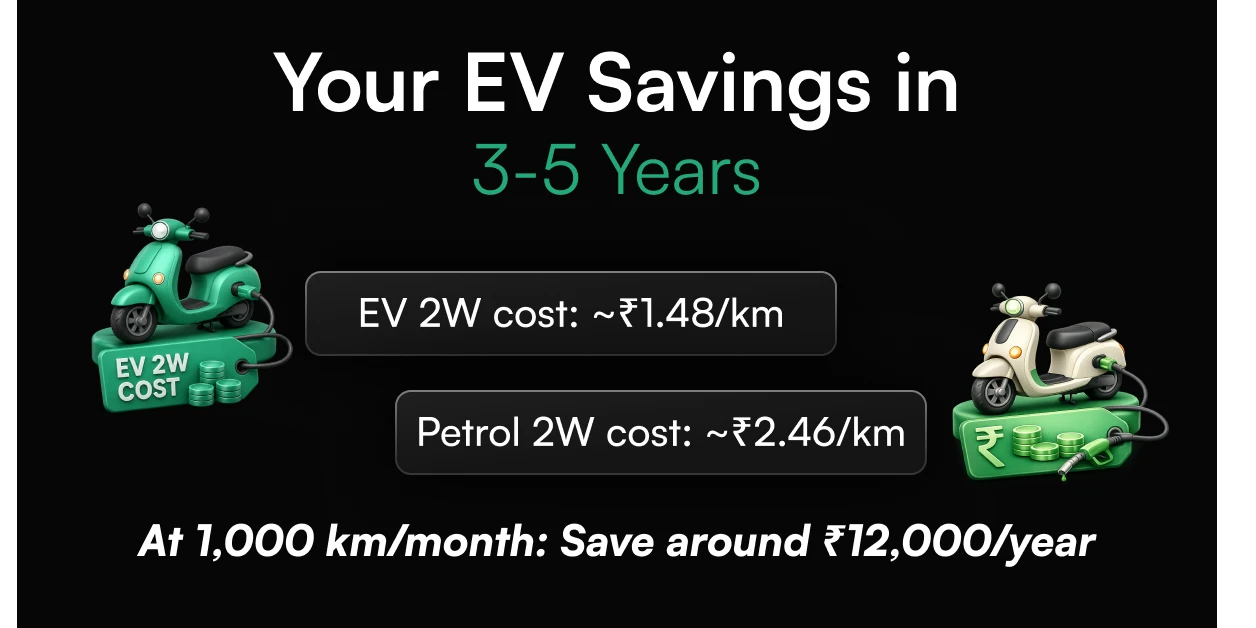
For example, a reported CEEW comparison found electric two-wheelers at around ₹1.48/km, compared to petrol two-wheelers at around ₹2.46/km.
That means if you ride around 1,000 km a month, you could save roughly ₹12,000 a year, or around ₹35,000–₹60,000 over 3–5 years, just on running costs.
* Subsidy lowers your buying cost. Lower charging cost lowers your ownership cost.