
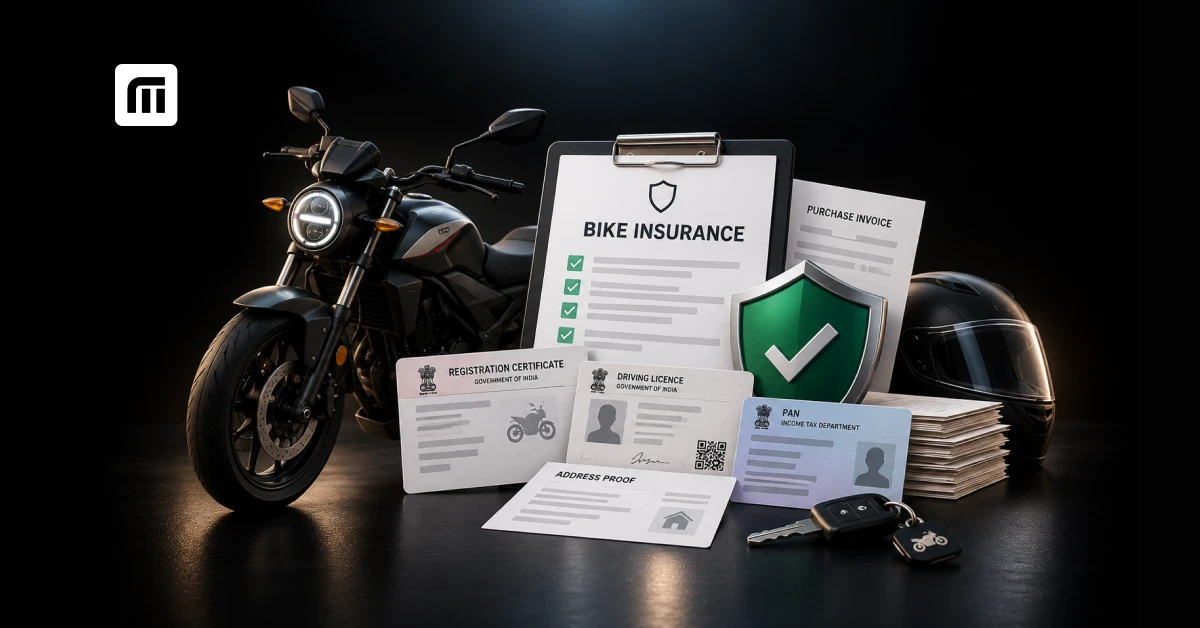
For a new bike insurance policy, you need your bike's RC or registration details, ID and address proof, PAN or Form 60 where applicable, a passport-size photo, and the purchase invoice. For renewal, you usually need only your registration number, previous policy number, and a valid PUC where applicable.
Bike insurance used to mean endless paperwork. Online, it is much easier: you just need a few important documents ready. Here is a quick guide to the documents needed for new, renewed, lapsed, and second-hand bike insurance. You can also check your policy status and compare plans directly on MyMotor's bike insurance page. New to MyMotor? See what the platform covers for every vehicle owner.
What Documents Are Required to Buy Bike Insurance Online in India?
The documents you need depend on whether you are insuring a new bike, renewing an existing policy, or buying cover for a used vehicle. In every case, the insurer needs to know two things: who is buying the policy, and which vehicle is being insured.
What Is the Basic Bike Insurance Documents List?
Your bike insurance documents online may include:
- KYC or identity details
- Address details
- Bike registration number
- RC details
- Make, model and variant of the bike
- Engine and chassis details, where needed
- Previous insurance details, if applicable
- Driving licence details, where requested
- Contact details such as mobile number and email address
Do You Have to Upload Every Document?
Not always. You may or may not be asked to upload a scanned copy of each item. Many details can be fetched or verified digitally from your registration number.
Which Documents Do You Need for a Brand-New Bike Insurance Policy?
A new bike does not have an old policy or a finished RC yet, and that is perfectly normal. Insurers can usually work from your KYC, the engine and chassis numbers, and the dealer's invoice details. Showrooms often arrange insurance with your registration, so most of this information may already be there digitally.
For a new bike, you may need:
- Your name and contact information
- KYC details
- Bike make and model
- Engine number and chassis number
- Registration details, once available
- Invoice or dealer-provided vehicle details, if needed
Is a Registration Certificate (RC) Mandatory for Bike Insurance?
For an already registered bike, the RC is one of the most important records because it connects the vehicle to its registered owner. Insurers usually need the registration details to issue or renew a policy.
That does not always mean you must upload a photo or PDF of your physical RC. If the vehicle information can be verified digitally, entering your registration number and confirming the details may be enough. For a brand-new bike whose permanent registration is still being completed, insurers may use the chassis, engine, invoice or temporary registration details instead.
The key point: the information on your insurance policy must match the vehicle registration records.
Can You Buy Bike Insurance Without a Driving Licence?
A driving licence and an insurance policy serve different purposes. Insurance covers the insured vehicle as per the policy terms, while a licence proves that a person is allowed to drive that class of vehicle. A licence is not the main document used to show ownership of the bike, although your insurer may ask for licence details as part of its proposal or verification process.
More importantly, the person riding the bike must hold a valid driving licence. Riding without one can create legal problems and may affect a claim, depending on the situation and policy terms.
What Documents Are Needed to Renew Bike Insurance?
Renewal is the easiest case, because most of your vehicle data is already on file. In most cases, your registration number and previous policy details are enough, and the insurer can fetch the rest.
Common bike insurance renewal documents or details include:
- Bike registration number
- Existing or previous policy number
- Previous insurer details
- Policy expiry date
- KYC details, where verification or updating is needed
- Details of claims made during the previous policy period
- NCB information, if applicable
- Valid PUC information, where applicable
The phrase "documents for two wheeler insurance renewal" does not mean you will upload several PDFs every year. When you renew online, the insurer can often fetch many details on its own.
Do You Need Your Old Policy Number to Renew Bike Insurance?
It is useful, but losing the policy copy does not mean you can never renew. If you renew with the same insurer, they can often locate your policy using your registration number, registered mobile number or other customer details.
If you are switching insurers, your previous policy information matters more, especially if you want to carry forward your No Claim Bonus (NCB). IRDAI states that when changing insurers, proof of NCB may be established through a renewal notice from the existing insurer, or through the expiring policy along with suitable confirmation about previous claims.
If you cannot find your old PDF, do not panic. First try retrieving the policy digitally, or contact your insurer.
Is a PUC Certificate Required to Renew Bike Insurance?
Keep your Pollution Under Control (PUC) certificate valid at all times. IRDAI's published guidance states that a valid PUC certificate should be held on the date of renewal of a motor insurance policy.
There is an important distinction, though. IRDAI has also stated that not holding a valid PUC at the time of an accident is not, by itself, a valid reason to reject a motor insurance claim.
The sensible approach is to renew your PUC on time instead of waiting for the insurance renewal screen to remind you. Not sure when your PUC expires? You can check your vehicle details on MyMotor.
For electric two-wheelers, tailpipe-emission PUC requirements do not apply in the same way, because there are no exhaust emissions.
Can You Renew Bike Insurance Without an RC Copy?
You may not need to upload a scanned RC during a normal online renewal, but the registration information itself remains crucial. If your insurer can verify your bike's details online using the registration number, a separate RC upload may not be needed.
If there is a mismatch in ownership, registration or vehicle details, you may be asked to provide the RC or supporting proof before the policy can be issued correctly.
What Documents Are Required for Bike Insurance Premium Payment?
Paying the premium is just the last step of buying or renewing, so you do not need new documents for it. Any verification happens earlier, during policy issuance. People often prepare far more paperwork than they actually need at this stage.
Do You Need to Upload Documents Just to Pay the Premium?
Usually, no. Any document or KYC check the insurer needs is part of issuing the policy. It is not required by your UPI, card or other payment method. If you are searching for bike insurance premium payment documents, what you really need is the information that identifies your vehicle and policy.
What Details Should You Keep Ready Before Paying?
For a smoother payment, keep these handy:
- Registration number
- Existing policy number, for renewals
- Registered mobile number
- Email address
- Chosen payment method
- Vehicle and KYC details, if they still need verification
If you are renewing, also check your current coverage, IDV, selected add-ons and NCB before paying. Do not rush the payment screen. A few minutes of checking can save you from buying the wrong cover for another year.
Which KYC Documents Are Accepted for Bike Insurance?
KYC confirms who is buying the policy. Many insurers now complete it online, and you usually choose from a list of accepted documents instead of submitting physical copies. Insurers must follow applicable KYC and anti-money-laundering rules, so the exact flow can vary between insurers.
Common identity or address documents include:
- Passport
- Voter ID
- Driving licence
- Aadhaar, where voluntarily used under the permitted process
- Other officially accepted identity or address records
Is Aadhaar Mandatory for Bike Insurance?
No. Aadhaar is not the only way to complete your KYC. IRDAI has stated that insurers should not mandatorily seek Aadhaar as part of KYC, although it can be accepted as an identity or address document, subject to applicable rules and your consent. If you prefer not to use Aadhaar, check the alternative KYC options your insurer offers.
What Is Form 60, and When Do You Need It Instead of PAN?
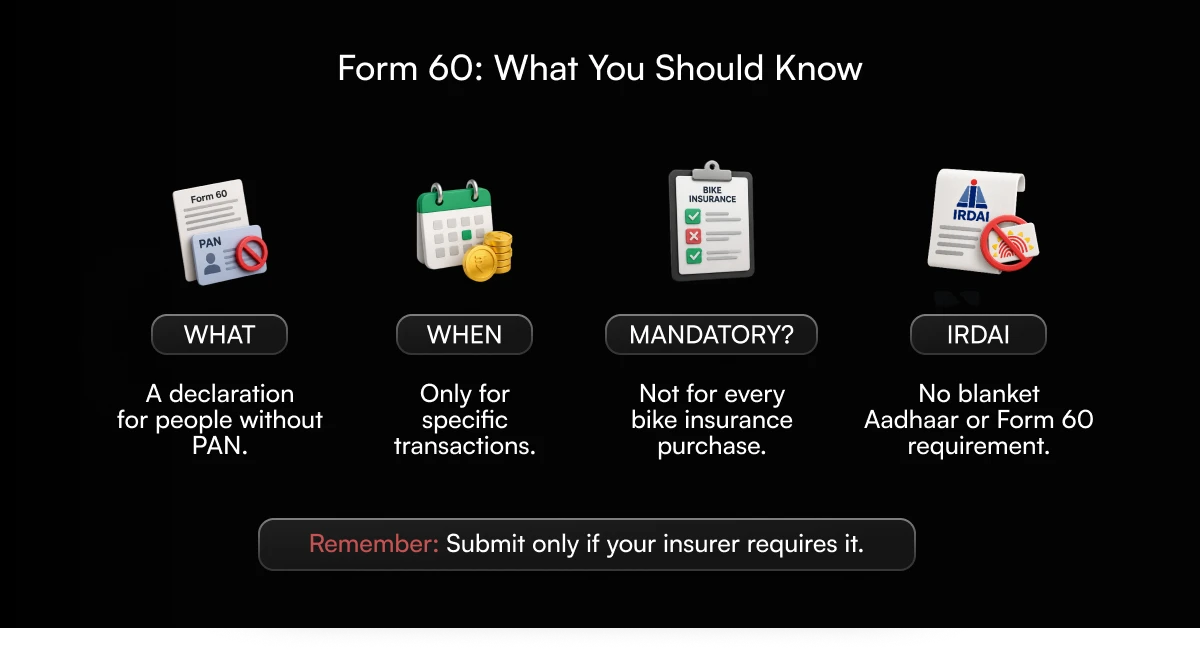
Form 60 is a declaration used in specific transactions by people who do not have a PAN, subject to applicable tax rules. Not every bike insurance buyer has to submit a PAN card or Form 60. IRDAI has previously stated that insurers should not demand Aadhaar and Form 60 as a blanket KYC requirement. Where PAN or Form 60 is needed for a particular transaction, the insurer will tell you.
Which Address Proof Documents Are Accepted?
The options shown during KYC differ depending on the verification method. A passport, voter ID, driving licence and other officially accepted documents are commonly used, and Aadhaar may be used where the process allows it. The easiest rule is to follow the options your insurer displays instead of uploading a document just because you assume it will work.
What Documents Do You Need for Different Types of Bike Insurance?
The core documents are almost the same for every policy type. What changes is how much underwriting or inspection the insurer needs, especially for comprehensive cover. You might be buying:
- Third-party insurance
- Comprehensive insurance
- Standalone own-damage cover
- A long-term policy for a new vehicle
Third-Party vs Comprehensive Bike Insurance: Are the Documents Different?
The basic customer and vehicle information is usually the same for both. The difference is in the coverage. Third-party insurance covers your legal liability toward third parties as defined by the policy and law. Comprehensive (package) insurance also protects your own bike, subject to its terms and exclusions.
Because comprehensive cover includes damage to your own bike, the insurer may run extra checks in cases such as a break in coverage or an unusual vehicle condition. The biggest difference is often not the number of documents, but how much underwriting or inspection is needed.
What Documents Are Needed for a Long-Term Bike Policy for a New Bike?
For a long-term policy on a new bike, keep these ready:
- Owner's KYC details
- Vehicle invoice and details
- Engine number
- Chassis number
- Registration or temporary registration information
- Contact details
The exact structure and duration of cover depend on the product and the applicable motor insurance rules.
What Documents Do You Need to Insure an Electric Bike or Scooter?
An electric two-wheeler needs the same basic information to identify the owner and vehicle:
- KYC details
- Registration details
- Chassis number
- Vehicle make and model
- Previous policy information, for renewals
The main practical difference is that an electric two-wheeler has no conventional internal-combustion engine. Official vehicle forms recognise a motor number for battery-operated vehicles. Because an EV has no tailpipe emissions, a conventional PUC certificate does not apply in the same way as it does for a petrol bike or scooter.
Own an electric two-wheeler? Our guide to finding EV charging stations in India covers the other half of EV ownership.
What Documents Are Required to Renew an Expired or Lapsed Bike Insurance Policy?
An expired policy needs a little more care than a normal renewal. IRDAI's consumer guidance says motor policies should be renewed before their due date, and notes that insurers do not offer a general grace period for a standard annual motor premium. Do not assume your old cover continues after expiry.
For an expired bike insurance renewal, keep these ready:
- Registration details
- Previous policy information
- KYC details
- NCB information, where applicable
- Vehicle details
- Any information or images requested for inspection
Do You Need a Bike Inspection After the Policy Lapses?
Often, yes. A break in insurance can trigger a vehicle inspection, especially when own-damage cover is being issued again. IRDAI's consumer information states that even a lapse in motor insurance can require the vehicle to be inspected.
The method depends on your insurer. It may be a physical inspection, or a digital self-inspection using photographs or video. The insurer wants to know the bike's existing condition before agreeing to cover future damage. So if you have a bike insurance break in policy, expect one extra step.
Renewing is also a good moment to clear pending traffic fines. Here is how to check your e-challan online.
Will You Lose Your No Claim Bonus (NCB) if You Don't Have the Old Policy Documents?
Losing the physical policy document is not the same as losing your NCB. What matters is whether you can establish your NCB entitlement and renew within the applicable period.
IRDAI states that NCB belongs to the insured person, not the vehicle, and can be carried to another insurer when supported by the needed proof. It also notes that accumulated NCB can be lost if a comprehensive policy stays lapsed for more than 90 days. If your policy has expired, delaying renewal can cost you more than misplacing the PDF.
What Documents Are Needed to Transfer Bike Insurance After Buying a Second-Hand Bike?
When you buy a used bike, the RC and the insurance must both move into your name. These are two separate processes, and missing either one can cause problems at claim time. IRDAI says insurance can be transferred to the purchaser, and the registration and insurance records should carry the same name and address. Do not leave the policy in the seller's name indefinitely.
Which Documents Are Needed for Ownership Transfer?
For a normal vehicle ownership transfer, the important records can include:
- Form 29 (Notice of Transfer of Ownership)
- Form 30 (Application/report for Transfer of Ownership)
- Registration Certificate
- Insurance certificate
- PUC certificate, where applicable
- PAN or Form 60, where applicable
- Address proof
- Other supporting documents required by the registering authority
An NOC may also be relevant in certain interstate or jurisdictional situations. Parivahan lists Form 29 and Form 30 for a normal ownership transfer and specifies additional documents depending on the circumstances and state requirements.
Do not confuse the RTO ownership-transfer process with the insurance-transfer process. They are connected, but they are not the same application. For the RTO side, read our step-by-step guide to RC ownership transfer.
Before you transfer a used bike, also check for pending challans so you do not inherit someone else's fines.
Can You Keep the Seller's NCB?
No. The seller's No Claim Bonus belongs to the seller, not the bike. When a vehicle is sold, the insurance may be transferred to the new owner, but the previous owner's NCB does not go with it. The seller can keep their NCB for another eligible vehicle.
So if someone tells you a used bike comes with the previous owner's 50% NCB, that is not how NCB works.
How Do You Retrieve Missing Bike Insurance Documents?
Losing a PDF or your RC is not the end of the road. Policies can be re-downloaded or duplicated by the insurer, and a lost RC can be replaced through the transport authority. A lot of vehicle and insurance information is now available online or can be reissued.
How Can You Download Your Policy If You've Lost the Copy?
Start with the easiest places:
- Search your email for the insurer's name or policy number.
- Check the insurer's website or app.
- Try your registered mobile number and vehicle registration number.
- Contact the insurer if you still cannot retrieve it.
IRDAI also states that a policyholder who has lost a motor insurance policy can approach the issuing insurer for a duplicate. Losing the PDF does not erase the policy itself.
What If Your RC Is Lost or Damaged?
If your RC is lost, damaged or destroyed, you can apply for a duplicate Registration Certificate through the relevant transport authority. Parivahan lists Form 26 as the application for a duplicate Certificate of Registration when the original is lost or destroyed. You can look up your RC details online before applying, and check whether your digital vehicle records are available while the duplicate is processed.
How Do You Check Your Bike Insurance Status Before Renewing?
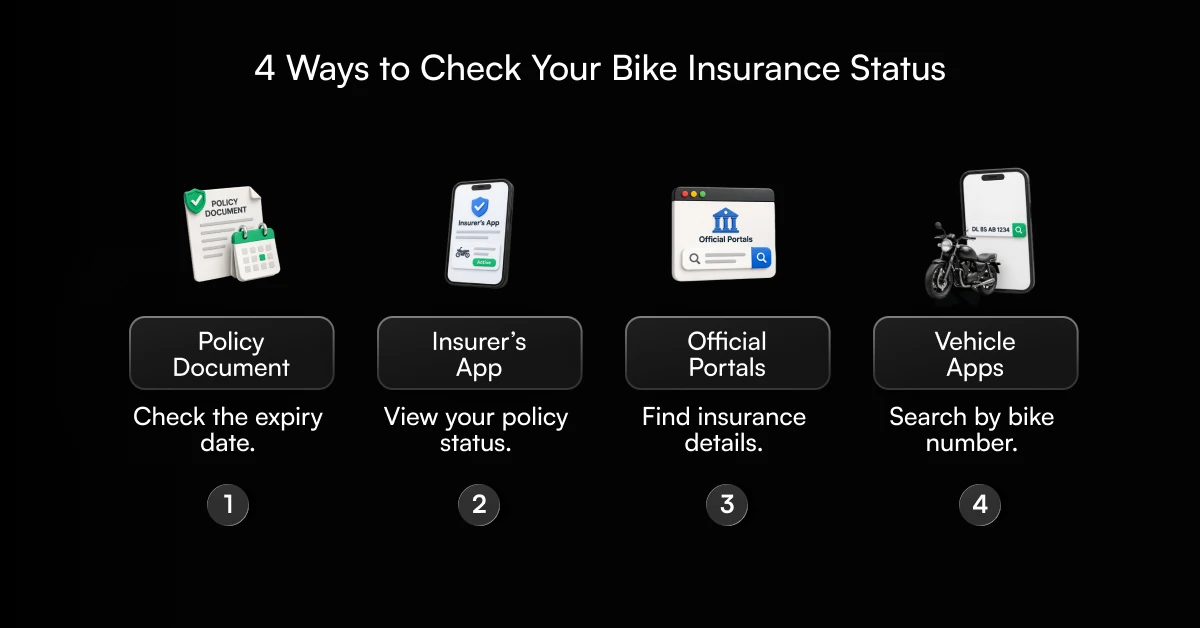
Before paying for a renewal, confirm exactly when your current policy expires, even if you think you remember the date. Your bike insurance status may be available through:
- Your existing policy document
- Your insurer's website or app
- Official vehicle-information services
- Insurance or vehicle-management platforms that retrieve policy details from your registration number
MyMotor lets you check your insurance status and expiry date using just your registration number. During a bike insurance expiry date check, confirm:
- Current insurer
- Policy expiry date
- Policy type
- Whether own-damage cover is active
- NCB eligibility, where relevant
Checking beforehand is much easier than discovering after the expiry date that your policy has already lapsed.
What Are the Common Mistakes to Avoid While Submitting Bike Insurance Documents?
Most rejections come from small mismatches, not major errors. A wrong digit or a different spelling of your name can delay your policy, so check these seven things first.
1. Your name does not match
If your RC says one version of your name and the policy says another, get it corrected. Owner details must be consistent across the policy and registration records.
2. The registration number is entered incorrectly
One wrong letter or digit can link your policy to the wrong vehicle. Double-check your number before making any payment.
3. The engine or chassis details are wrong
If these fields are requested, copy them carefully from your official vehicle records instead of typing from memory.
4. Your KYC document is expired or invalid
Where the verification document must be current, check its validity before you start.
5. The uploaded document is unreadable
If your insurer asks for an image, make sure that:
- All four corners are visible
- The text is readable
- There is no glare
- Nothing important is cropped
- You have uploaded the correct side or page
6. You enter the wrong NCB
Do not select an NCB percentage just to lower your premium. Your insurer can verify previous insurance and claim information, and an incorrect declaration can create problems later.
7. You ignore an ownership mismatch
This matters most with second-hand bikes. IRDAI states that registration and insurance should have the same name and address after transfer. Fix your ownership records instead of renewing a policy year after year in somebody else's name.
How Do You Buy or Renew Bike Insurance on MyMotor?
You should not need a folder full of paperwork to deal with your bike insurance. With MyMotor, you start with your vehicle details and check the available insurance information or renewal options in one place.
- Open MyMotor Bike insurance page.
- Enter or select your vehicle.
- Check the available insurance details or renewal options.
- Review your policy information, coverage and premium.
- Provide any additional details or verification needed.
- Complete your premium payment online.
- Keep your updated policy accessible once it is issued.
Before paying, look beyond the final premium. Check the coverage, IDV, deductibles, add-ons and policy period. The cheapest figure on your screen is not always the policy that gives you the cover you need.
Keeping your insurance, RC details and other vehicle information in one place also makes the next renewal much easier. Renew or buy your bike insurance on MyMotor now. Also own a car? See what is needed for car insurance too. And get renewal reminders on the MyMotor app.