
Getting a traffic challan is already frustrating.
But the real confusion begins when you are not sure whether it can be paid online or needs a court process.
Sometimes, it is a regular e-challan that you can check and pay for online.
Other times, it might be a court challan that needs action through virtual court or a physical visit to the traffic court.
So, before you rush to pay or ignore the notice, go through this blog to learn more about it.
What Is an E-Challan and How Is It Issued?
An e-challan is a digital traffic fine issued for a traffic rule violation.
It can be generated through traffic cameras, ANPR systems, speed detection devices, or handheld devices used by traffic police.
Since the process is digital, the challan details are usually linked to your vehicle number, driving licence number, or challan number.
This makes it quite easier to check challan status online and complete your payment through an official or trusted platform.
Which Traffic Violations Usually Get an E-Challan?
E-challans are usually issued for common traffic violations such as:
- Riding without a helmet
- Jumping a red light
- Overspeeding
- Wrong parking
- Driving without a seatbelt
- Using a mobile phone while driving
- Breaking lane or traffic rules
These are regular traffic violations where the fine can often be checked and paid online easily at your convenience.
How Is an E-Challan Linked to Your Vehicle Number, DL, or Challan Number?
Well, an e-challan is usually connected to one or more of these details:
- Vehicle registration number
- Driving licence number
- Challan number
- Mobile number, in some cases
For example, if a traffic camera captures your vehicle overspeeding or jumping a signal, the system may link the offence to your vehicle number.
If traffic police issue the challan manually using a handheld device, it may also be linked to your DL number.
That is why you can just check your pending challan by entering your vehicle number, DL number, or challan number on the e-challan or Parivahan portal anytime you need.
What Is a Court Challan and Why Does It Need Legal Review?
A court challan is a traffic challan that needs court involvement or legal review.
This happens when the offence is serious, challan has remained unpaid for a long time, the violation is repeated, or the case needs a magistrate or traffic court decision.
Unlike a normal e-challan, a court challan may not always show a direct “Pay Now” option.
In some cases, you may be able to pay it through the virtual court portal and in other cases, you may need to visit the mentioned traffic court.
Which Offences Are Typically Sent Straight to Court?
Some traffic offences may be sent directly to court because they are considered more serious. These mostly include:
- Drunk driving
- Dangerous or rash driving
- Driving without a valid licence
- Accident-linked traffic offences
- Repeated traffic violations
- Serious violations that need legal review
In such cases, the final fine or next step may be decided through court proceedings.
What Is a Virtual Court Challan, and How Is It Different From a Regular Court Challan?
A virtual court challan is a court challan that can be handled online through the Virtual Courts portal.
So, instead of visiting a physical court immediately, you may be able to check the case, pay your fine, or contest the challan online if you wish to.
On the Virtual Courts portal, users can usually search using details such as mobile number, CNR number, party name, challan number, or vehicle number.
A regular court challan, on the other hand, might need you to visit the mentioned traffic court on the given date with the required documents.
Court Challan vs E-Challan: Side-by-Side Comparison Table
Both e-challan and court challan are traffic fines, but the process, payment method, and level of court involvement are different.
| Point | E-Challan | Court Challan |
|---|---|---|
| Meaning | A digital traffic fine issued online | A traffic challan that needs court or legal review |
| Issued for | Regular traffic violations | Serious, repeated, unpaid, or court-referred violations |
| Common examples | Helmet violation, signal jumping, overspeeding, wrong parking, seatbelt violation, mobile use while driving | Drunk driving, dangerous driving, driving without a valid licence, accident-linked offences |
| Issuing authority | Traffic police, traffic cameras, ANPR systems, or digital enforcement systems | Traffic court, magistrate, or court-referred traffic authority |
| Where to check | eChallan/Parivahan portal or trusted challan platforms | Virtual Court portal or the mentioned traffic court |
| Payment method | Usually paid online | Paid through Virtual Court or at the traffic court, depending on the case |
| Court visit needed? | Usually not needed | May be needed in some cases |
| Best action | Check challan status and pay online | Check Virtual Court status or follow the court instructions |
Difference in Issuing Authority, Payment Method, and Need for a Court Visit
The main difference is the level of legal involvement.
An e-challan is usually issued digitally for common traffic violations and can often be paid online.
A court challan is more serious or has been escalated, so it may need Virtual Court action or a physical court visit.
*If your challan shows “Sent to Court,” “Pending in Court,” or does not show a direct pay option, you should check the Virtual Court portal or follow the court details mentioned in your challan.
How Do You Check and Pay an E-Challan Online?
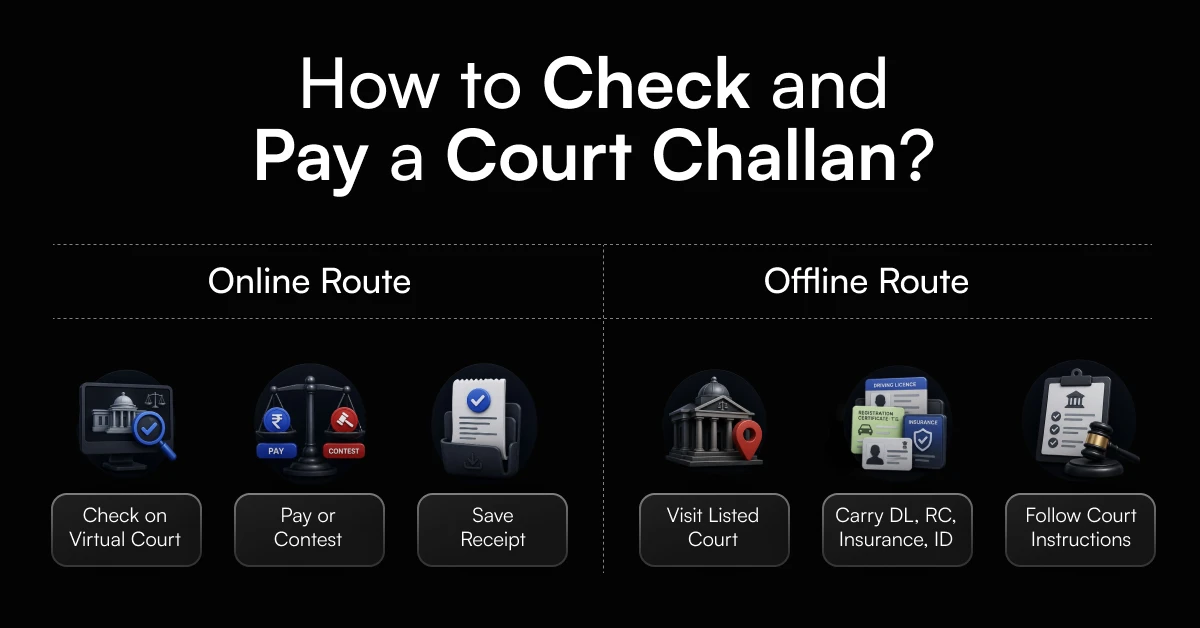
You can pull up full echallan details - violation type, location, fine amount and issuing authority using only your vehicle number. Here are the steps to check and pay an e-challan online:
- Visit the official e-challan/Parivahan portal or a trusted challan platform.
- Enter your challan number, vehicle number, or driving licence number.
- Complete captcha or OTP verification, if needed.
- Check your pending challan details, including offence, date, location, and fine amount.
- Select the challan you want to pay.
- Choose the available online payment option.
- Complete the payment.
- Download or save the receipt for future reference.
- Recheck the payment status after some time to make sure the challan is marked as paid.
Always save your receipt because it works as payment proof if the status takes time to update.
How Do You Check and Pay a Court Challan?
A court challan can be handled in two ways: through Virtual Court or by visiting the physical traffic court.
If It Is a Virtual Court Challan
Follow these steps:
- Visit the Virtual Courts portal.
- Select your state and department.
- Search using mobile number, CNR number, party name, challan number, or vehicle number.
- Open the case details.
- Check the offence, fine amount, and available action.
- Choose “Pay Fine” if you want to pay the challan.
- Choose “Request to Contest” if you want to challenge the challan.
- Complete OTP verification, if needed.
- Pay through the available ePay option.
- Download and save your receipt.
If you choose to contest your challan, the portal may show the physical court name and case date for the next step.
If a Physical Court Visit Is Needed
Follow these steps:
- Check the court name and date mentioned in your challan.
- Carry your challan copy, driving licence, RC, insurance, and ID proof.
- Visit the mentioned traffic court on the given date.
- Follow the court’s instructions.
- Pay the fine or complete the required legal process.
- Collect the receipt and keep it safely.
And do not ignore the date or instructions mentioned in a court challan, even if the fine amount looks small. Pulling up full bike challan details - offense, location and officer ID, helps you decide quickly whether the fine is a routine e-challan or needs a court visit.
Can an E-Challan Turn Into a Court Challan?
Yes, an e-challan can turn into a court challan in a few cases.
This usually happens when:
- The challan remains unpaid for too long
- The offence is serious
- There are repeated violations
- The traffic department transfers the case to court
- The challan requires legal review
Once the challan is escalated, it may show a status like “Sent to Court” or may no longer show a normal online payment option on the e-challan portal.
In such cases, you should check the virtual court portal first.
If the challan is available there, you may be able to pay the fine online or contest it.
If it is not available for online payment then you may need to visit the mentioned traffic court.
How Do You Know Which Challan You have Received?
Since most routine violations are logged as e-challans, an e challan check by vehicle number is usually the fastest way to confirm which category your fine falls under.
Here are some points through which you can identify which one you have received:
- If your challan has a direct “Pay Now” option, it is likely a normal e-challan.
- If it says “Sent to Court,” it may be a court challan.
- If it appears on the Virtual Court portal, it may be payable or contestable online.
- If a court name and date are mentioned, a physical court visit may be needed.
- If the offence is serious, such as drunk driving or dangerous driving, it may need legal review.
- If the challan is old and unpaid, it may have been escalated.
- If you are not sure, check both the e-challan/Parivahan portal and the virtual court portal.
An online e challan check is usually enough to tell you which category - e-challan or court challan - your violation falls into before you decide where to pay.
Final Thoughts
An e-challan is usually easier to check and pay online.
A court challan needs more attention because it may involve virtual court or a physical court visit.
The safest step here is to check your challan status early, pay only through an official or trusted platform, and save your receipt.
Also, avoid clicking on random payment links sent through SMS or WhatsApp. If you receive a challan message, verify it first before making any payment.