
Sent to court. Two words you never want to see on your traffic challan.
First thought? Panic. Second thought? More panic but okay, what do I actually do now?
I know that it sounds scarier than it is.
UP's virtual court system lets you deal with this entirely online, no courthouse visits, no confusing paperwork, no chai-paani for anyone.
Just you, your phone, and about 10 minutes.
Let's break it down, step by step.
What Does "Challan Sent to Court" Mean?
It means your unpaid e challan has been moved from the regular payment system to a virtual court, where it’s now handled by a digital magistrate, you’ll need to either pay it there or contest it online.
Usually, this happens when a challan stays unpaid for around 60–90 days.
Until that point, you can easily clear it through platforms like e challan UP, mParivahan, or other e challan payment portals. But once it crosses that window, things change.
Your case is no longer just a “pending fine.” It officially becomes a court case handled through a virtual court instead of a physical one.
- You can’t pay it on regular portals anymore (like e challan UP or mParivahan)
- The challan gets transferred to a digital magistrate system
- So, now you have only two options:
Pay the fine via virtual court (basically accepting the offence)
Contest it legally online if you think it’s wrong
Well the good news is that you don’t need to visit any actual court.
Everything from checking details to making payment or even contesting can be done online in just a few steps.
How do UP Virtual Courts work for traffic challans?
Well, UP Virtual Courts exist to make handling traffic challans quicker, simpler, and completely online so you don’t have to deal with physical court visits for minor offences.
And let’s be real, nobody wants to take a day off just to stand in a courtroom for something like a traffic challan.
That’s exactly the problem virtual court systems are trying to solve. Instead of the old-school process, everything is now designed to happen online.
So whether you’re checking your challan on e challan UP, tracking it via mParivahan, or doing a quick challan check, the next step resolving it is also digital.
- No physical court visits required: You don’t have to show up anywhere. No waiting, no paperwork, no back-and-forth.
- Available 24/7: Unlike traditional courts, virtual courts don’t run on fixed hours, now you can settle your challan anytime that works for you.
- Faster resolution for minor offences: Simple cases get cleared quickly without dragging on for weeks or months.
What immediate risks if you ignore a court challan?
Honestly, ignoring a court challan can actually lead to bigger problems like blocked services, higher fines, and even legal action.
It might feel tempting to just ignore a traffic challan, especially when it’s already been sent to court.
Out of sight, out of mind right? But not really. Once your challan reaches this stage, the system just gets stricter.
Here’s what can actually happen if you keep ignoring it:
1. RC transfer gets blocked: Planning to sell your vehicle? Well, you won’t be able to complete the RC transfer until all pending dues are cleared since your challan details stay linked to your vehicle.
2. Driving licence renewal may stop: When it’s time to renew your licence, unpaid RTO challans can cause delays or even rejection.
3. Fine may increase over time: The longer you wait, the worse it can get. Additional penalties or late fees may be added.
4. Case can escalate legally: At this point, it’s not just a pending payment, it’s a legal matter under the Motor Vehicles Act. Ignoring it further could lead to more strict consequences.
How to check clearance and update records after payment?
Once you pay a UP virtual-court challan, the portal issues an immediate digital receipt and updates the case status to “Paid” or “Case Closed.” Keep the receipt and verify the status on the same virtual-court page and on Parivahan/mParivahan before you attempt RC transfer or licence renewal.
- Payment on virtual court gives instant digital receipt; download and save it.
- Re‑check the same case on UP Virtual Court - status should show “Paid” or “Closed”.
- Allow 24-72 hours for the system to sync with Parivahan/RTO databases.
- Verify on Parivahan / mParivahan that no pending challan appears for your vehicle.
- Before RC transfer or licence renewal, if the portal still shows dues, show the payment receipt at the RTO and request manual update.
Where to get official help and further guidance?
- Use the UP Virtual Court portal and national Virtual Courts / eCourts site for FAQs, process and contact details.
- Check Parivahan / mParivahan for vehicle and licence status plus listed helplines.
- Note the virtual-court helpdesk email/phone and mention your challan/case number.
- Contact local traffic police or RTO enquiry desk if the portal directs you there.
- Consult a lawyer if the offence is serious, penalties are high, or summons for physical appearance are issued.
- For low‑cost help, explore state legal‑aid clinics or citizen helplines mentioned on court/Parivahan pages.
5 Steps to Settle a Court Challan Online via UP Virtual Court
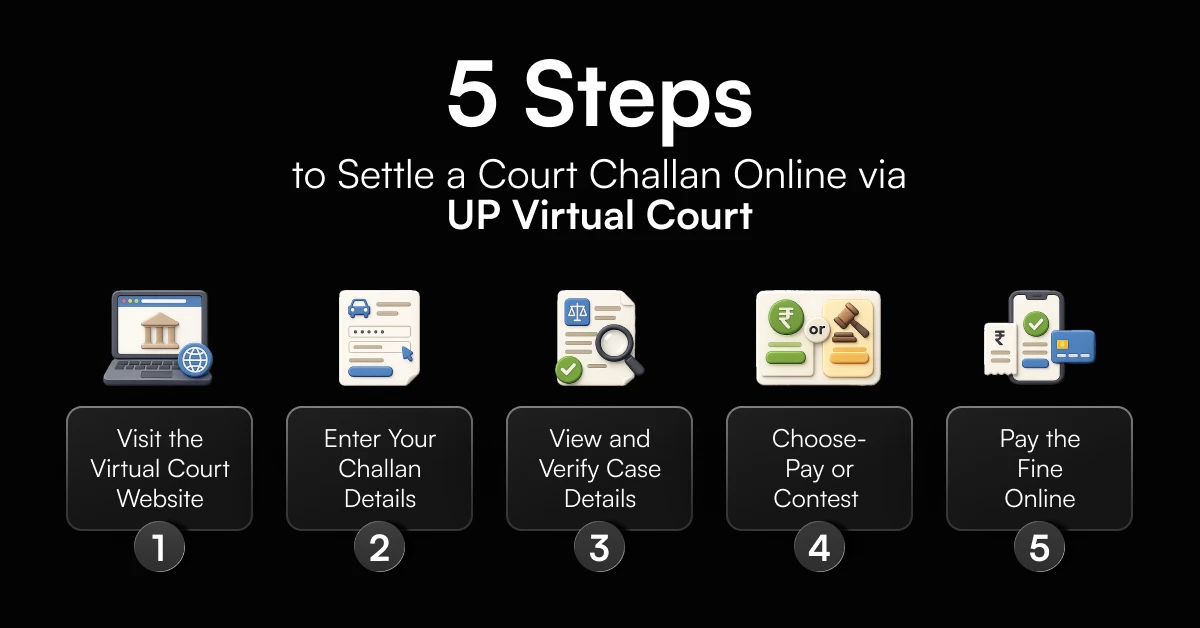
Now, you can settle a court challan online in UP by visiting the virtual court portal, checking your challan details, and then choosing to either pay the fine or contest it all in just a few simple steps.
Here’s how to do it step by step:
Step 1: Visit the Virtual Court Website
Start by opening the official virtual court portal (the government-authorized site). Once you land on the homepage, select Uttar Pradesh as your state so you’re directed to the correct database.
Step 2: Enter Your Challan Details
Next, you’ll need to retrieve your challan.
You can search for it using:
- Your challan number, or
- Your vehicle registration number
After entering the details, you’ll be asked to complete a captcha or OTP verification. This step makes sure that only you can access your challan information.
Step 3: View and Verify Case Details
Once your challan appears, don’t rush and take a minute to carefully review everything.
Check for:
- The type of violation (e.g., no helmet, overspeeding)
- The total fine amount
- The case status (pending, sent to court, etc.)
This step is important because it helps you confirm that the challan actually belongs to you and that there are no incorrect charges or duplicate entries.
Step 4: Choose- Pay or Contest
Now comes the main decision point.
- Option 1: Plead Guilty (Pay the Fine): If you agree with the violation, you can accept it and proceed with the e challan payment directly through the virtual court platform. This is the quickest way to close the case.
- Option 2: Contest the Challan: If you believe the challan was issued wrongly, you can also choose to contest it.
You’ll then receive a digital summons along with a hearing date, where you can present your side online or as instructed.
Step 5: Pay the Fine Online (If Applicable)
If you decide to pay, the process is smooth and flexible. You can make your payment using:
- UPI
- Net banking
- Debit/Credit card
Once the payment is successful, you’ll get an instant digital receipt and your case will be marked as closed in the system.
Can You Reduce Your Fine in Virtual Court?
Yes, in some cases, the fine on a traffic challan can be reduced in a virtual court, depending on your situation.
Now, this isn’t guaranteed but it can happen.
When your RTO challan reaches the virtual court, it’s reviewed by a magistrate, and they do have the authority to revise the penalty.
This is more common in minor offences, where the violation isn’t very serious or there are reasonable grounds for leniency.
That said, the final decision really depends on a couple of things.
- First is the severity of the violation. A small offence like a documentation issue might be looked at more leniently than something like dangerous driving.
- Second is the evidence linked to your challan details. If the proof is unclear, incomplete, or there’s a genuine mistake, the chances of getting some relief improve.
So yes, while you shouldn’t rely on it completely, there is a possibility that your fine could be reduced, especially if your case is simple and you have a valid reason and proof to back it up.
When Do You Still Need to Visit Court Physically?
Here, you'll only need to visit a physical court in certain situations mainly when the case is serious, disputed, or the court actually asks you to appear.
For most everyday cases, the whole e challan process from checking your challan to completing the e challan payment can be handled online through the virtual system.
But there are a few exceptions where things can’t be completely online.
If the offence is serious, for example, dangerous driving or repeat violations, the case may require closer examination, and the court might ask you to show up in person.
Similarly, if you’ve raised a strong dispute like claiming the challan is incorrect or the evidence is unclear the court may want a proper hearing where you can present your side more properly.
And sometimes, it’s simply procedural.
If the court specifically issues a notice for physical appearance, you don’t really have a choice, you’ll need to attend on the given date.
What common mistakes should you avoid while handling a court challan?
Well, most issues with a court e challan don’t come from the process itself, they come from small, avoidable mistakes that can easily be fixed with a bit of attention, such as:
1. Ignoring SMS notifications
Those messages aren’t just reminders, they’re important, time-sensitive updates about your e challan.
So, if you miss them, you might not even realise when your case moves to the virtual court stage.
2. Waiting too long to act
Delaying things is one of the biggest reasons people land in trouble.
What could’ve been a simple payment can quickly turn into a court case if you keep putting it off.
3. Entering incorrect challan details
Even a small typo or mistake in your vehicle number or challan number can create confusion or stop you from finding your case altogether.
Always double-check your details before submitting.
4. Paying on fake or unofficial websites
Scam websites are becoming more common and can actually look very convincing.
So, always make sure that you’re using the official virtual court or government portal before making any payment.
5. Not saving your payment receipt
Once you’ve paid, that receipt is your only proof that the challan is cleared.
If you don’t save it, you might run into issues later when verifying your challan details.
Conclusion
So that's really all there is to it.
A challan in court doesn't mean that you're in some big trouble, it just means you handle it through the virtual court system instead of the usual place.
Slightly different path but same destination.
Whether you want to pay the fine or push back and contest it, the whole thing happens online.
No trips anywhere, no waiting around, no unnecessary stress.
The one thing you don't want to do is sit on it.
A small challan that gets ignored has a funny way of becoming a much bigger problem down the line.
But you've already done the hard part, figuring out what to do. Now the rest is just following the steps. For the fastest way to check your UP challan status, download the MyMotor app and track all your vehicle fines in one place.