
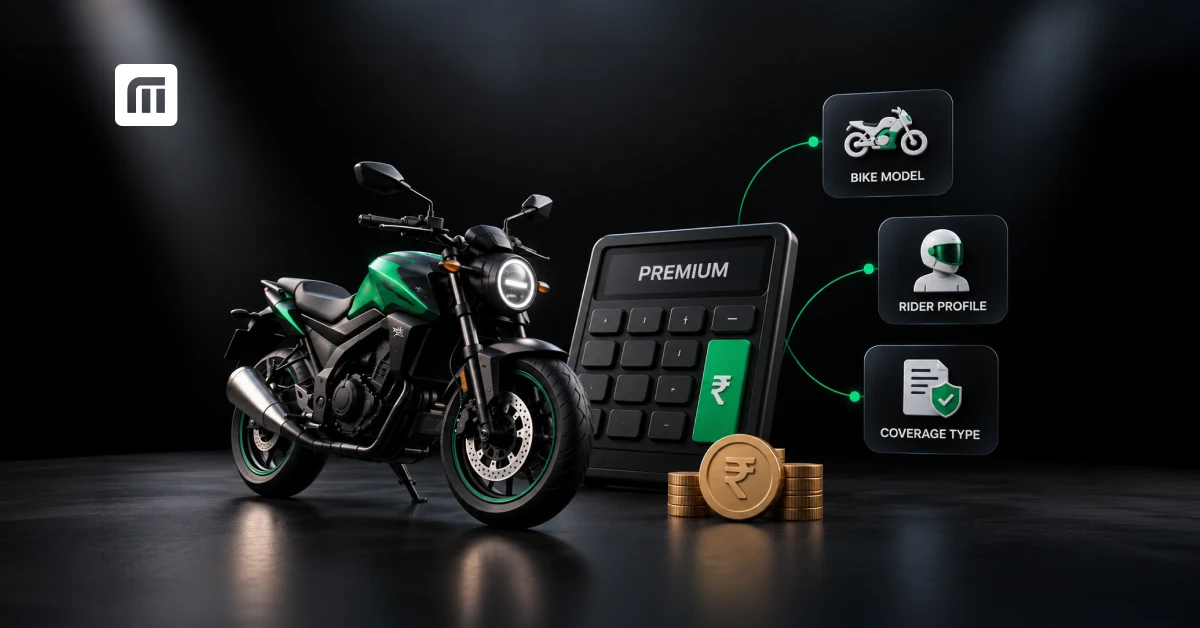
Your bike insurance premium is the sum of your third-party premium (fixed by engine capacity), your own-damage premium (based on IDV, bike age, location, claims and NCB), any add-ons you choose, and applicable taxes.
Why Do Bike Insurance Quotes Vary So Much?
Your bike insurance premium depends on factors like engine capacity, IDV, bike age, location, claims, coverage and add-ons. Knowing exactly what affects your two wheeler insurance premium helps you get the right cover at the right price.
If you'd rather skip the theory, you can get a bike insurance quote on MyMotor in a couple of minutes. Otherwise, read on.
In this guide:
- What goes into your premium
- 1st, 2nd and 3rd party insurance
- Third-party vs own-damage premium
- Factors that affect your premium
- How much bike insurance costs in India
- Third-party vs comprehensive
- How to calculate your premium
- How to reduce your premium
- Common mistakes that make people overpay
What Exactly Goes Into Your Bike Insurance Premium?
Your bike insurance premium is mainly made up of two components: third-party premium and own-damage premium. If you choose add-ons or other optional covers, their cost is added to the final premium.
Third-party pricing follows prescribed rates, while the own-damage portion is priced by individual insurers based on the risk associated with your bike.
In simple terms:
- Third-party premium: Covers your legal liability towards other people or their property.
- Own-damage premium: Covers damage to or loss of your own bike.
- Add-on premium: Extra amount for optional covers such as zero depreciation, roadside assistance or engine protection.
- Taxes and other selected covers: Added to arrive at your final payable amount.
What Is 1st, 2nd, and 3rd Party Insurance?
In bike insurance, the first party is you, the bike owner and policyholder. The second party is the insurance company, and the third party is any other person or property affected by an accident involving your bike.
There isn't a separate product called "second-party bike insurance." The term usually refers to the insurer.
When people talk about first-party insurance, they usually mean cover for damage to their own bike, also known as own-damage insurance. Third-party bike insurance covers your legal liability if your bike causes injury, death or property damage to somebody else.
Valid third-party motor insurance is mandatory for vehicles used on public roads in India. A comprehensive bike insurance policy combines third-party liability with own-damage protection.
Third-Party Premium vs Own-Damage Premium: What's the Difference?
The biggest difference is who decides the price and what the premium protects.
| FactorThird-Party PremiumOwn-Damage Premium | ||
| Protects | Other people/property | Your own bike |
| Mandatory? | Yes | No |
| Pricing | Based on prescribed rates | Set by individual insurers |
| Major pricing factors | Engine capacity | IDV, bike age, model, location, claims, discounts |
| NCB applies? | No | Yes |
| Add-ons available? | Generally no | Yes |
If two insurers quote the same bike differently, the variation usually comes from the own-damage component, IDV, discounts, deductibles and add-ons, not the statutory third-party base premium.
What Factors Actually Affect Your Bike Insurance Premium?
The biggest factors are your bike's engine capacity, IDV, age, registration location, claim history, NCB and the type of coverage you select. Not every factor affects every part of the premium in the same way. Here's how each one works.
1. Engine CC and Its Impact on Premium
Engine capacity matters a lot for the third-party portion of your premium. For regular private two-wheelers, the current third-party premium structure uses four engine-capacity bands:
| Engine CapacityAnnual Third-Party Base Premium | |
| Up to 75cc | ₹538 |
| Above 75cc up to 150cc | ₹714 |
| Above 150cc up to 350cc | ₹1,366 |
| Above 350cc | ₹2,804 |
These base rates remain in use for FY 2026-27 at the time of writing. A 400cc motorcycle therefore gets a higher third-party base premium than a 125cc commuter bike.
For comprehensive insurance, engine size may also correlate with the bike's model, repair costs and value, but the own-damage premium is not determined by CC alone.
2. IDV (Insured Declared Value) and How It Changes Your Premium
IDV (Insured Declared Value) is the insured value assigned to your bike. It is the maximum basis for compensation in situations such as theft or total loss, subject to the policy terms.
A higher IDV usually means a higher own-damage premium, because the insurer takes on a larger potential liability. A lower IDV can reduce the premium, but choosing an unrealistically low IDV just to save money can leave you underinsured if your bike is stolen or declared a total loss.
For bikes up to five years old, depreciation is commonly used to arrive at the IDV. The standard age-based schedule looks like this:
| Age of BikeDepreciation for IDV | |
| Up to 6 months | 5% |
| 6 months to 1 year | 15% |
| 1 to 2 years | 20% |
| 2 to 3 years | 30% |
| 3 to 4 years | 40% |
| 4 to 5 years | 50% |
For older bikes, the IDV may be agreed between the insurer and the policyholder based on the bike's condition and market value.
Your IDV changes every year, so it's worth checking it when you renew your bike insurance online.
Related reading: What is IDV in bike insurance and how is it calculated?
3. Bike Age and Its Effect on Premium
As your bike gets older, its market value and therefore its IDV usually decrease. That can reduce the basic own-damage premium, but an older bike is not automatically cheaper to insure. Age can also affect:
- Eligibility for certain add-ons
- Depreciation during claims
- Availability and cost of spare parts
- Insurer underwriting
- Inspection requirements in some cases
For example, zero-depreciation cover may only be offered up to a certain vehicle age, depending on the insurer. So while depreciation may bring the base own-damage premium down, the protection available to an older bike can also change.
Related reading: How to buy second-hand bike insurance
4. No Claim Bonus (NCB) and How Much It Can Reduce Your Premium
A No Claim Bonus rewards you for completing policy years without making an own-damage claim. The discount applies to the own-damage premium, not the third-party premium. The standard NCB progression is:
| Consecutive Claim-Free PeriodNCB on Own-Damage Premium | |
| 1 year | 20% |
| 2 years | 25% |
| 3 years | 35% |
| 4 years | 45% |
| 5 years | 50% |
After five consecutive claim-free years, NCB can reduce your own-damage premium by as much as 50%. This is why filing a claim for every tiny scratch may not make financial sense. For a small repair, compare the claim benefit with the deductible and the NCB you could lose at renewal.
Remember that NCB belongs to the policyholder, not the bike. If you sell your bike and buy another eligible vehicle, the accumulated NCB can usually be transferred through the applicable process. If you're switching insurers, make sure your NCB is carried over when you buy a new two wheeler insurance policy.
Related reading: No Claim Bonus in bike insurance: how it works
5. City and RTO Location as a Premium Factor
Yes, your registration location can affect your bike insurance cost, particularly the own-damage portion. Insurers may consider geographical risk factors such as:
- Accident frequency
- Traffic density
- Theft exposure
- Repair and labour costs
- Historical claims in that location
This means the same bike may receive slightly different comprehensive quotes depending on where it is registered. The prescribed third-party base premium, however, is determined by the vehicle category and engine-capacity band, not by your city.
6. Traffic Challans and Past Claims - Impact on Premium
Past insurance claims can affect your premium. Traffic challans are more nuanced.
Making an own-damage claim can affect your accumulated NCB, and insurers may also consider your claim history when pricing future own-damage cover.
Traffic challans do not currently have a universal nationwide surcharge table where, for example, one challan automatically adds a fixed percentage to every bike insurance policy. Linking insurance pricing more closely with challan history and driving behaviour has been discussed and proposed in India, but it is not yet a standard, uniform premium mechanism comparable to the engine-CC-based third-party rates.
Pending violations won't add a fixed surcharge, but it's still smart to check your e-challans and see the photo evidence of a challan before they pile up.
7. Add-Ons Like Zero Depreciation and Their Cost Impact
Add-ons improve your bike insurance coverage, but every add-on you select increases the premium. A popular example is zero depreciation cover.
Without zero depreciation, depreciation on eligible bike parts may be deducted when settling an accidental-damage claim. With the add-on, the insurer waives specified depreciation deductions according to the policy terms, reducing your out-of-pocket share.
That extra protection costs extra. The exact amount varies by insurer, bike and policy. As a broad indication, zero-depreciation cover may add roughly 10-20% of the base own-damage premium in some products, although actual quotes can differ a lot.
Don't choose an add-on simply because it sounds useful. Ask yourself whether the likely benefit justifies what you're paying for it. You can compare zero depreciation bike insurance prices across insurers before deciding.
Related reading: Zero depreciation bike insurance: is it worth it?
How Much Does Bike Insurance Actually Cost in India?
There is no single bike insurance cost for every rider. Third-party insurance has prescribed base rates, while comprehensive insurance varies with your bike's IDV, model, age, location, NCB, claims, deductible and selected add-ons.
For regular private bikes, the annual third-party base premium currently ranges from ₹538 for bikes up to 75cc to ₹2,804 for bikes above 350cc. Your actual comprehensive premium can be considerably higher, because it includes own-damage protection and any additional covers you choose. To see actual comprehensive prices for your bike, check bike insurance prices on MyMotor.
1-Year vs 5-Year Bike Insurance Cost Comparison
When searching for a 1 year or 5 year bike insurance price, there's an important detail to understand: for a new two-wheeler, five-year third-party insurance is required. A one-year third-party policy is not an alternative you can choose instead when buying a new bike.
Here are the prescribed base premiums for regular private two-wheelers:
| Engine Capacity | 1-Year Third-Party Base Premium | 5-Year Third-Party Premium for a New Bike |
| Up to 75cc | ₹538 | ₹2,901 |
| Above 75cc up to 150cc | ₹714 | ₹3,851 |
| Above 150cc up to 350cc | ₹1,366 | ₹7,365 |
| Above 350cc | ₹2,804 | ₹15,117 |
The five-year figure is a single premium for the mandatory long-term third-party cover on a new two-wheeler. It should not be confused with five years of comprehensive own-damage coverage.
What Does It Cost to Insure a New Bike in the First Year?
Your new bike insurance price is usually higher upfront because a new two-wheeler needs long-term third-party cover. A basic new-bike policy may include:
5-year third-party cover + 1-year own-damage cover + selected add-ons/other covers + applicable taxes
For example, a new private bike between 75cc and 150cc currently has a five-year third-party base premium of ₹3,851. But ₹3,851 is not the complete insurance price of your bike. If you buy comprehensive protection, the first-year own-damage premium, optional add-ons and other applicable components are added on top.
That is why two new 125cc bikes can have different final insurance bills even though they fall in the same third-party CC bracket. Buying a new bike? You can insure your new bike with 5-year third-party and 1-year own-damage cover in one go.
Related reading: New bike insurance: what to know before you buy
Why Do Renewal Cost and First-Year Premium Differ?
Your renewal cost can look very different from what you paid when your bike was new. One major reason is the long-term third-party structure. If your new bike was insured with five years of third-party cover and one year of own-damage cover, the five-year third-party component is already active. At the first renewal, you mainly need to renew your own-damage portion if you want to keep that protection.
Other things also change over time:
- Your bike's IDV usually falls
- You may earn NCB
- Your claim history may change
- Add-ons may be added or removed
- Insurer pricing may change
- Your bike may become ineligible for certain add-ons
So don't compare your renewal amount with your first-year premium without first checking what each amount actually covers. If you're unsure when your policy expires, you can check and renew your bike insurance using your vehicle number. Want a reminder before your policy expires? Download the MyMotor app to track your bike insurance expiry date.
Related reading: How to renew bike insurance online
Third-Party vs Comprehensive Bike Insurance: Which Costs More?
Comprehensive bike insurance usually costs more than third-party insurance because it covers both third-party liabilities and damage to your own bike. Third-party insurance provides the minimum legally required liability protection, while comprehensive insurance gives much broader financial protection.
| Coverage | Starting Price | Best For |
| Third-Party Bike Insurance | Annual base premium starts at ₹538 for regular bikes up to 75cc | Riders who need basic legal compliance and are willing to bear damage to their own bike |
| Comprehensive Bike Insurance | No universal fixed starting price; includes TP + insurer-priced own-damage premium | New, valuable or regularly used bikes where own-damage protection matters |
The cheapest policy is not automatically the best policy. If your bike is stolen under a third-party-only plan, for example, your own bike isn't protected, even though you have valid insurance.
Related reading: Third-party vs comprehensive bike insurance: key differences
Which Two Wheeler Bike Insurance Is Best for You?
For most owners of a new, valuable or regularly used bike, comprehensive insurance offers stronger protection because it covers both third-party liability and your own bike against covered risks.
Third-party-only insurance might make more sense when:
- You only want the legally required minimum cover
- The bike is old and has a very low current value
- You're comfortable paying for damage to your own bike yourself
Comprehensive insurance is worth considering when:
- The bike is new or expensive
- You ride frequently
- Major repair bills would be difficult to absorb
- You want protection against theft and covered accidental damage
- You want useful add-ons
If you already have a valid long-term third-party policy, you may also be able to buy standalone own-damage cover instead of buying third-party protection again.
Own a car too? The same logic applies to car insurance.
How Can You Calculate Your Bike Insurance Premium Before Buying?
The easiest way is to use a bike insurance premium calculator and enter accurate details about your bike and existing policy. The calculator uses those details to estimate the premium for the coverage you select. You can also run the same estimate on the MyMotor app.
When comparing quotes, don't look at the final number alone. Compare:
premium + IDV + coverage + deductible + add-ons + exclusions
A ₹100 cheaper policy isn't really cheaper if it gives you a much lower IDV or removes cover you actually need.
What Details Do You Need for an Accurate Premium Estimate?
Keep these details ready:
- Bike registration number
- Make and model
- Variant
- Registration year
- Engine capacity
- RTO/registration location
- Current IDV
- Existing policy details
- Previous claim history
- Applicable NCB
- Policy expiry date
- Chosen add-ons
- Voluntary deductible, if any
For a new bike, details such as the model, variant, ex-showroom value, engine capacity and location are enough to generate the initial quote.
Related reading: Documents required to buy bike insurance online
How Can You Reduce Your Bike Insurance Premium in 6 Steps Without Losing Cover?
You can lower your premium without cutting important coverage by making a few smarter choices.
- Protect your No Claim Bonus (NCB). Avoid small claims when the repair cost is manageable, as a claim can reduce your NCB at renewal.
- Compare policies with the same coverage. Compare quotes using a similar IDV, deductible and set of add-ons to see which policy actually offers better value.
- Choose only the add-ons you need. Skip add-ons that don't match your bike's age, value or everyday usage.
- Pick a sensible voluntary deductible. A higher voluntary deductible can reduce your premium, but choose an amount you can comfortably pay during a claim.
- Renew your policy on time. Timely renewal helps you avoid a policy lapse and keep benefits such as your accumulated NCB.
- Compare insurers before renewal. Own-damage premiums vary between insurers, so check whether you can get similar coverage at a better price.
Is a Higher Voluntary Deductible Worth It?
It can be, but only if you understand the trade-off. A voluntary deductible is an amount you agree to pay from your own pocket during an own-damage claim, over and above the compulsory deductible. A higher voluntary deductible can reduce your own-damage premium.
But imagine saving ₹400 on your annual premium and then having to contribute several thousand rupees extra when you make a claim. That saving may not feel like saving anymore.
A voluntary deductible makes more sense when:
- You're comfortable carrying more claim risk yourself
- You have a good riding history
- You don't usually make small claims
- The deductible won't strain your finances after an accident
Don't simply choose the highest deductible available because it gives the lowest quote.
Should You Skip Add-Ons You Don't Actually Need?
Yes. Add-ons should solve a real problem for you. Zero depreciation, for example, may be valuable for a relatively new or expensive bike where replacement parts are costly. On an older, low-value bike, paying for several add-ons every year may give less value, and some add-ons may not be available after a certain age. Before selecting any add-on, think about whether you would realistically use it.
What Mistakes Make People Overpay on Bike Insurance?
Most people don't overpay because insurance itself is expensive. They overpay because they compare the wrong things. Common mistakes to avoid:
- Choosing the lowest quote without comparing coverage: A cheaper plan may have a lower IDV, higher deductible or fewer benefits.
- Setting an unnecessarily high IDV: A higher IDV increases the own-damage premium. Choose an appropriate value rather than automatically selecting the highest option.
- Setting IDV too low just to reduce premium: This saves money today but reduces protection in theft or total-loss situations.
- Buying every add-on available: More cover isn't automatically better if you'll never realistically use half of it.
- Forgetting to apply your NCB: If you're eligible for a No Claim Bonus, make sure it is correctly shown when renewing or switching insurers.
- Making very small claims without checking the maths: A small claim can cost you through deductibles and a lower NCB at renewal.
- Comparing premiums with different deductibles or IDVs: Always compare like with like.
- Letting the policy lapse: Apart from leaving you unprotected, a long lapse can affect NCB and may need additional steps before cover is restored. Not sure if your policy is still active? Check your bike insurance status before you ride. You can also check it on the MyMotor app.
The goal isn't simply cheap bike insurance. It is paying the lowest sensible price for the protection you actually need.
Related reading: Expired bike insurance: what happens and how to fix it
Get Your Bike Insurance Quote
Want an accurate premium estimate for your bike? Get a bike insurance quote on MyMotor
Prefer your phone? Download the MyMotor app on Google Play to manage bike insurance, challans and more in one place.
Related insurance reading:
- Buy bike insurance online on MyMotor
- No Claim Bonus in bike insurance: how it works
- Third-party vs comprehensive bike insurance
- What is IDV in bike insurance?
- How to renew bike insurance online
- Zero depreciation bike insurance: is it worth it?
- Challan check with photo: how to see the evidence image