
When you buy car insurance, you see terms like Own Damage, Third-Party, IDV, and NCB. It can feel like a lot to take in. But here's the thing:
One part of your insurance actually pays for repairs to your own car when something goes wrong. That part is called Own Damage Premium.
Most people focus only on the total premium amount. They don't realise what this specific piece covers and why it matters. Then when an accident happens, they find out the hard way that their policy doesn't pay for their own car's repairs.
This blog breaks down everything about Own Damage premium. What it means, how it's calculated, what affects the price, and how to claim without mistakes.
By the end, you'll know exactly what you're paying for and whether you're getting it right.
What is Own Damage Premium?
Own Damage premium is the portion of your car insurance that covers repair costs for your own vehicle.
When you pay for car insurance, part of that money goes towards OD cover, which handles damage to your car from accidents, theft, or natural disasters.
The other part goes towards third-party cover, which handles damage you cause to others.
In short: Third party covers others while Own Damage covers you.
How Is Own Damage Different from Third-Party Cover?
As mentioned above the most primary difference between the two is that Third-party cover pays for damage you do to others while Own Damage pays for damage done to your own car.
Say you're driving and accidentally hit a parked car. Your front bumper cracks, and the other car's door gets damaged.
- Third-party cover pays to fix the other person's door
- Own Damage cover pays to fix your bumper
| Feature | Own Damage | Third-Party |
|---|---|---|
| What it covers | Your car | Other people's car/property |
| Is it compulsory? | No | Yes (by law) |
| Theft cover | Yes | No |
| Natural disaster cover | Yes | No |
| Can you customize? | Yes (add-ons available) | No |
Why Is OD Premium Optional Yet Essential?
The law only requires you to buy third-party insurance. You can legally drive with just that. OD cover is optional because the Motor Vehicles Act doesn't require you to insure your own car, only to cover damage you might cause to others.
But here's the thing.
Car repairs are expensive. A bumper replacement can cost ₹15,000-25,000. If your car gets stolen, you lose the entire value. One flood and your car could be completely damaged. A small accident could cost you lakhs.
Your third-party insurance pays for damage you do to others, but your own car's repair bill comes entirely from your savings.
Your car is probably one of the costliest things you own. So while OD premium is optional on paper, not getting one basically means you're ready to pay for every scratch, dent, or total loss from your own pocket.
For most people, that risk just isn't worth taking.
How Is Own Damage Premium Calculated?
Insurance companies use a formula to figure out your OD premium. They look at your car's current value, apply a fixed rate, then add or subtract based on your driving history and the extra covers you choose.
The basic formula looks like this:
(IDV × Premium Rate) + Add-on Costs – (NCB + Other Discounts) = Your OD Premium
Insurance companies tweak this slightly, but this is the general structure they all follow.
What Role Does Insured Declared Value Play?
IDV is simply the current market value of your car. It's the maximum amount the insurer will pay if your car is stolen or damaged beyond repair.
Higher IDV means higher premium and lower IDV simply means lower premium.
How IDV works:
- New cars have higher IDV, so their premium is more.
- Every year, your car's value drops due to normal wear and tear.
- Insurance companies apply fixed depreciation rates based on your car's age.
- Your IDV gets updated at every renewal to match this lower value.
Some people try to save money by declaring a lower IDV than their car's actual worth. This brings down the premium. But if your car gets stolen or completely damaged, the insurer pays only that lower amount.
You end up losing more than you saved. Always set IDV close to your car's real market value.
How Do NCB and Add-Ons Affect OD Premium?
No Claim Bonus or NCB is basically a reward for not making claims. Every year you go without filing a claim, you earn a discount on your OD premium when you renew.
Read our detailed guide on No Claim Bonus in Car Insurance, to see exactly how much you can save.
This discount can add up to serious savings over time. But there’s a catch: make one claim and your NCB resets to zero. You have to start building it all over again.
Add-ons work the opposite way, however.
They increase your premium but give you extra protection. Some common ones are:
- Zero Depreciation Cover: Insurer pays full part replacement cost without cutting for depreciation
- Engine Protect: Covers engine damage from water entering during floods
- NCB Protection: Lets you make one claim without losing your accumulated NCB
- Roadside Assistance: Help if your car breaks down somewhere
- Return to Invoice: Pays the original showroom price if car is stolen or totally damaged
Each add-on adds to your premium. Choose only the ones you actually need based on where you live and how you drive. For instance, someone in a flood prone area might want Engine Protect. Someone with 50% NCB might want NCB Protection.
Pick whatever makes sense for your situation.
What Factors Influence Own Damage Premium?
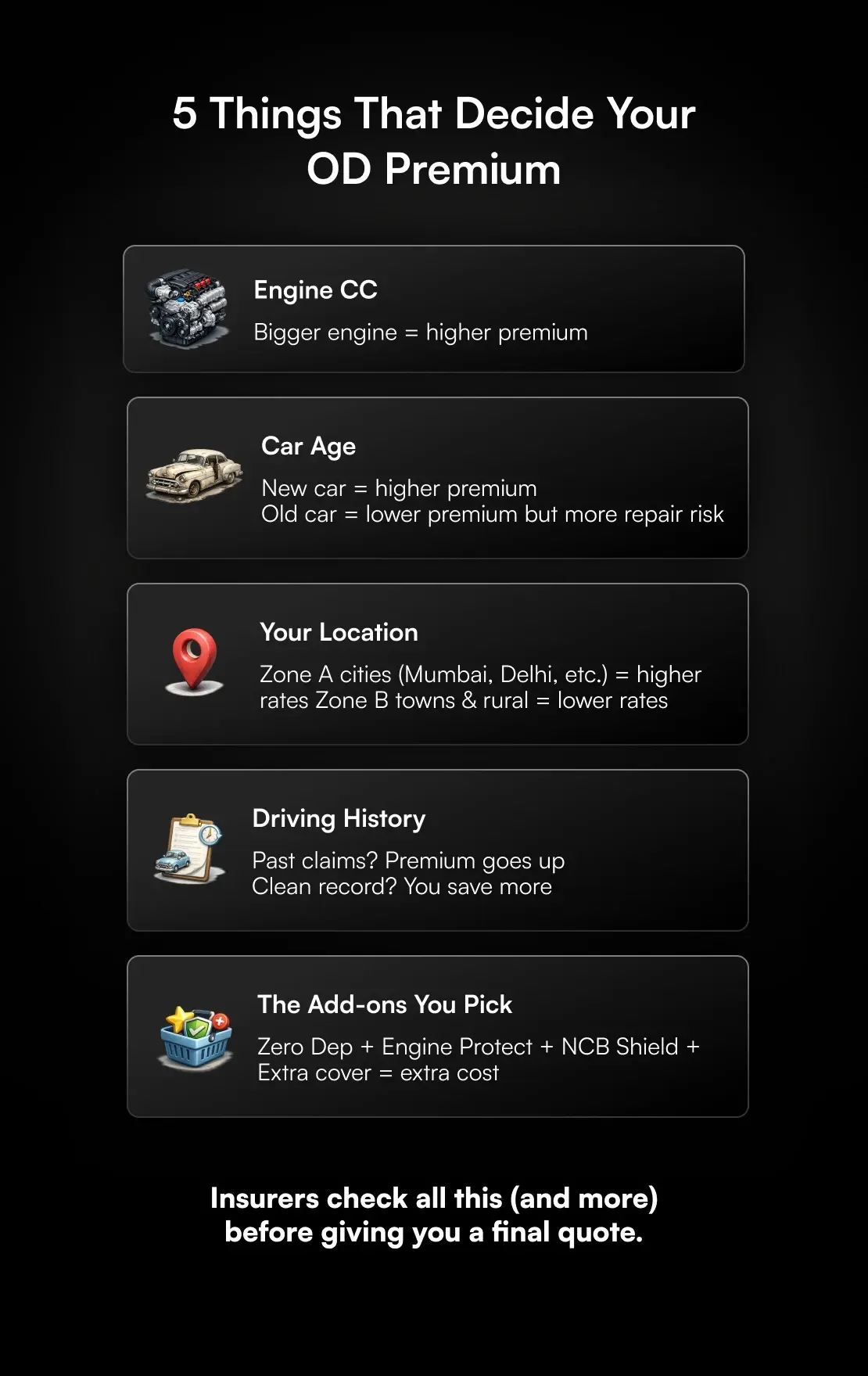
Insurance companies don't pick your OD premium through random thought. They consider a variety of things about your car and where you drive it. The main ones are your car's engine size, how old it is, and which city you live in. Your driving history and the add-ons you choose also play a part.
1. Engine capacity or CC: Is It impact OD Rates?
Yes, engine capacity directly affects your OD premium. Engine capacity or CC, is simply how much power your engine can produce.
Bigger CC means more power and more power means higher risk according to insurers.
- Cars with smaller engines (less than 1000 CC) have lower premiums.
- Mid size engines (1000 CC to 1500 CC) fall in the middle range.
- Large engines (above 1500 CC) attract the highest premiums.
Bigger engines cost more to repair. They also tend to be in luxury or performance cars that are expensive to fix. If something breaks on a high-CC car, the replacement parts and labour cost much more.
Insurers factor this into your premium.
2. Vehicle Age: Vehicle age and your premium
Your car loses value every year. This is called depreciation. As the value drops, your OD premium also comes down.
So an 8-year-old car will have a much lower premium than a brand new one. But there's a catch:
Older cars break down more often and some insurers may charge higher rates for very old vehicles because repair costs can be unpredictable.
3. Location (Zone A cities higher): Location and your premium
Where you drive matters because some places have more traffic, more accidents, and higher theft rates.
India is divided into two zones:
- Zone A - Big cities like Mumbai, Delhi, Kolkata, Chennai, Bengaluru, Hyderabad, Ahmedabad, Pune. These have higher premiums because of heavy traffic and more accidents.
- Zone B - All other towns and rural areas. Premiums are lower here.
If you live in a city with bad traffic and park on the street every night, your risk is higher than someone in a small town with a secure garage.
Insurers definitely take this into account, and charge you accordingly.
Own Damage vs Comprehensive Car Insurance?
Own Damage cover only protects your own vehicle against accidents, theft, fire, and natural disasters. Whereas, comprehensive insurance bundles OD cover with third-party cover into one single policy.
So comprehensive gives you both, protection for your car and protection against claims from others.
https://storage.googleapis.com/mymotor_blogs/Own-Damage-vs-Comprehensive-Car-Insurance.png
When Should You Buy a Standalone OD Policy?
You should buy a standalone OD policy only if you already have an active third-party insurance cover. Since third-party is mandatory by law, you cannot drive without it. But if you already have that base covered, adding a standalone OD policy makes good sense.
Who this works for:
- People who bought a new car after September 2018 and already have a long term third-party policy (3 years).
- Anyone with an existing TP cover who wants to add protection for their own vehicle without buying a whole new comprehensive policy.
- Those who want to save on premiums compared to a comprehensive plan.
What standalone OD covers:
- Accident damage to your car
- Theft of your vehicle
- Damage from natural disasters like floods, earthquakes, cyclones
- Damage from man-made events like riots, vandalism, terrorist attacks
- Fire or explosion damage
What it does NOT cover:
- Third-party liabilities (injuries or property damage you cause to others)
- Depreciation of parts
- Mechanical or electrical breakdowns
- Driving without valid license or under alcohol influence
The main advantage is flexibility. You can buy OD cover from any insurance company, not necessarily the one that gave you TP cover. You can also customise it with add-ons based on what you need.
What Are Benefits of Bundling OD with TP?
Bundling your Own Damage Cover with your Third Part Cover means buying a comprehensive policy that includes both covers together. This is what most car owners in India do.
Main benefits of bundling:
1. Complete protection under one roof
You don't have to manage two different policies. One comprehensive plan covers your car's damages and also handles third-party claims if you accidentally hit someone or their property.
2. Legally compliant from day one
Since TP cover is mandatory, a comprehensive policy automatically meets the legal requirement. You can drive without worrying about fines or penalties.
3. Cost-effective compared to buying separately
Buying OD and TP as a bundle often works out cheaper than purchasing them as separate policies from different insurers.
4. Easy to customise with add-ons
Comprehensive policies let you add covers like Zero Depreciation, Engine Protection, Roadside Assistance, and NCB Protection. These enhance your coverage without needing separate paperwork.
5. Cashless claim access
With a comprehensive policy, you can use the insurer's network garages for cashless repairs. This works for both your car's damages and third-party claims.
6. Theft and total loss coverage
If your car gets stolen or damaged beyond repair, comprehensive insurance pays you the IDV amount. Standalone TP cover gives you nothing in such cases.
What is the Claim Process for Own Damage Premium?
When your car gets damaged, you need to file a claim with your insurance company to get it fixed. There are two ways to do this: cashless or reimbursement.
Which one you choose depends on where you get the car repaired and how much cash you have handy at that moment.
The first rule of any claim is to inform your insurer immediately after the accident. Delay can cause problems. Take pictures of the damage, note down details, and call your insurance provider right away.
What Is Cashless vs Reimbursement OD Claim?
When your car gets damaged, you can file a claim in two ways. Cashless means you get repairs at a garage tied to your insurer and they pay directly. Reimbursement means you pay first at any garage and the insurer sends the money back to you later.
https://storage.googleapis.com/mymotor_blogs/Cashless-vs-Reimbursement0-OD-Claim.png
How to Maximize OD Claims with Zero Dep?
Zero Depreciation is an add-on cover that removes depreciation from your claim calculation. Normally, insurers deduct 20-50% from part costs based on age. With Zero Dep, you get the full amount without these cuts.
For a complete breakdown of how this works and whether it's worth the cost, check out one of our detailed guides that go into All about Zero Depreciation.
What Zero Dep covers:
- Plastic, rubber and fibre parts like bumpers and mirrors
- Glass parts like windshields
- Paint work
What still gets deducted:
- Nothing. That's the point. You get the complete cost of replacing damaged parts.
So to maximize your claim, buy Zero Dep cover when you purchase your policy. When you file a claim later, every replaced part gets paid in full.
The extra premium you paid for this add-on comes back to you many times over when your car needs repairs.
What are the Common Mistakes with Own Damage Premium?
https://storage.googleapis.com/mymotor_blogs/5-things-that-decide-od-premium.webp
People make simple errors with their OD cover that cost them money when claims come. Most of these happen at the time of buying or renewing the policy.
Knowing these mistakes beforehand can save you from paying extra later.
Mistake 1: Picking policy only based on lowest premium
Cheapest is not always best. A very low premium usually means lower coverage. When you need to claim, you realise the policy doesn't cover enough. Look at what the policy offers, not just the price tag.
Mistake 2: Hiding details about driver or car usage
Some people hide information to keep premium low. Like not telling about young drivers in the family or modified parts. If insurer finds out later, they can reject your claim completely. Be honest from the start.
Mistake 3: Choosing lower deductibles without thinking
Lower deductible means higher premium. Many go for low deductible without realising they are paying more every year. A higher deductible reduces your premium and still works fine if you don't claim often.
Mistake 4: Setting IDV too low to save money
This is the biggest and most common mistake. People reduce IDV to bring down premium. But when car gets stolen or totally damaged, they get much less money than what the car was worth.
Mistake 5: Not buying online
Buying offline through agents adds extra cost. Agents take commission, which gets built into your premium. Online purchase cuts out the middleman and saves money.
Why You Should Avoid Under-Insuring Your Car IDV?
IDV or Insured Declared Value is the maximum amount your insurer pays if your car is stolen or completely damaged. Under-insuring means setting this value lower than your car's actual worth.
What happens when you underinsure:
You save a little on premium today. Maybe ₹500 or ₹1000 less. But if your car gets stolen, the insurer pays only that lower IDV amount. Not what the car was really worth.
For instance, a car worth ₹8 lakh with IDV set at ₹6 lakh means you lose ₹2 lakh completely.
How to Renew OD Policy Without Losing NCB?
No Claim Bonus or NCB is the discount you earn for every claim-free year. It starts at 20% and goes up to 50% after five years. When you renew, you want this discount to carry forward. Here's how to make sure it does.
- Check your NCB amount in the renewal notice: Your insurer will show the NCB discount in the premium breakdown. Verify it matches your claim-free years.
- Don't make small claims just before renewal: If you claim for minor damage, your NCB resets. Compare the claim amount vs the NCB discount you will lose. Sometimes paying for small repairs yourself is smarter.
- Renew on time without gaps: If policy lapses, you may lose accumulated NCB. Renew before expiry date.
- When switching insurers, carry your NCB: You can transfer NCB when you change companies. Ask your old insurer for an NCB certificate or renewal notice showing the bonus. Show this to the new insurer to get the same discount.
- Consider NCB Protection add-on: Some insurers offer this. It lets you make one or two claims without losing your full NCB. Premium is slightly higher but protects your hard-earned discount.
Conclusion
So here's the thing about Own Damage premium. It's the part of your car insurance that actually protects your money when your car gets damaged. Without it, you're paying for every repair yourself.
Keep your IDV accurate. Don't make small claims and lose your NCB. Add Zero Dep if your car is new or expensive. Renew on time.
Your car costs you a lot. OD cover makes sure one accident doesn't cost you even more.