
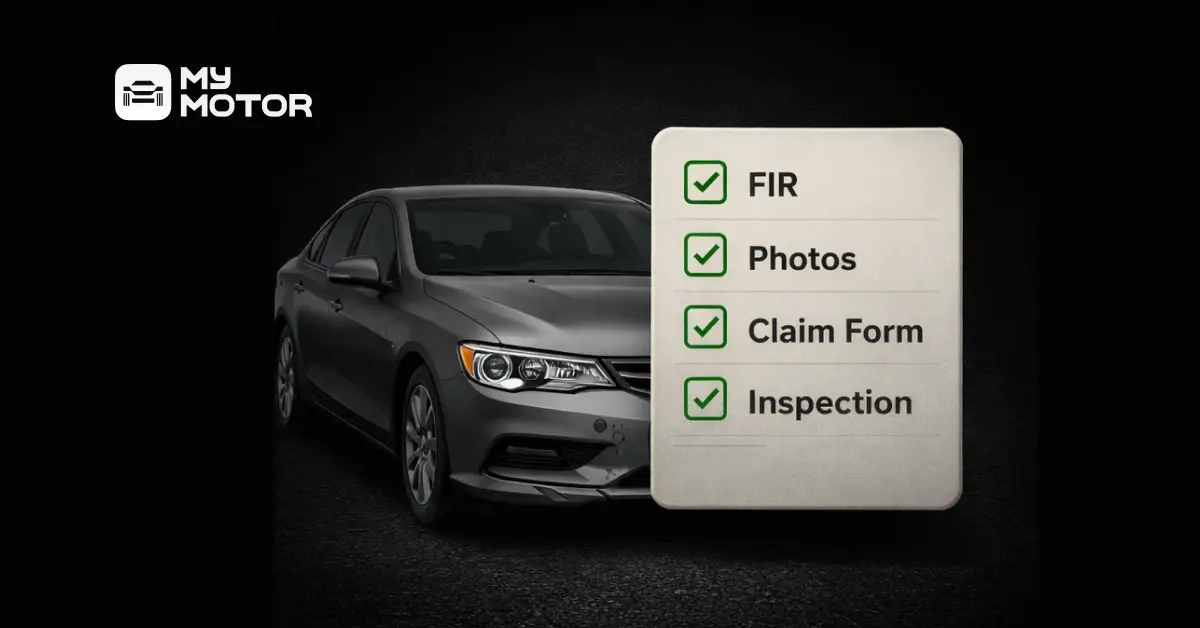
People pay for motor insurance every year. But when something actually happens to their car or bike, most of them freeze. They don't know who to call, what papers to get, or how to even start the process.
This guide is for that moment.
It covers everything from what counts as a claim to what to do if the insurer says no. Just a simple step-by-step of how this works in India.
What Is a Motor Insurance Claim?
A motor insurance claim is when you ask your insurance company to pay for vehicle damage or losses after something goes wrong, like an accident, theft, or something else that's unfortunate.
You pay premiums every year to keep your policy active, and the whole point of doing this is so that when the time comes and something unfortunate happens to your vehicle, you don't have to pay for expensive repairs from your own pocket.
Instead, the insurance company steps in and handles it, based on what your policy covers.
Why Do You Need to File a Motor Insurance Claim?
You file a claim because fixing a car or paying for someone else's damage can cost a lot of money. The kind of money that most of us don't have lying around like that.
And when you don't file a claim when you should, what happens is:1. You pay for everything yourself. A simple bumper replacement could set you back ₹15,000-20,000. And let's suppose it's a major engine damage. In that case, we're talking lakhs.
2. You could get into legal trouble. If you hurt someone or damage their property and don't have insurance coverage, they can take you to court. But if you did have the necessary insurer coverage, and you made the decision to claim, the insurer will handle all that legal hassle for you, on your behalf.
3. You lose what you already paid for. Your insurance premiums are meant for exactly these situations. Not claiming when you need to essentially means you gave away that money for nothing.
What are the Common Scenarios for Motor Claims in India?
Most people in India file claims after accidents, but theft and damage from nature are also pretty common.
Here are some of the typical situations where it would be wise for you to make a claim:
1. Road accidents
This is the most common one. You hit someone, someone hits you, or you crash into a divider. Your insurer pays for repairs or damage to others and your own.
2. Vehicle theft
If your car or bike gets stolen, you file a theft claim. The insurer pays you the insured value of the vehicle (minus depreciation). Speaking of theft, god forbid if your vehicle ever gets stolen, you'll need to know exactly what paperwork to file. Check out our guide on How to Get a Duplicate RC Online and Offline, because you'll need that RC copy for your claim.
3. Damage from natural disasters
Floods, cyclones, and earthquakes all count. With the kind of weather we get in India, this happens more than you'd think.
4. Fire or explosion
Short circuits in the wiring, fire in the parking lot, even riots or terrorist attacks are covered if you have a comprehensive policy.
5. Vandalism
Someone scratched your car with a key? Broke the window to steal your bag? That is covered as well.
6. Third-party injury or death
If you hit a pedestrian or another driver and they get hurt, the third-party part of your policy pays their medical bills or gives compensation to their family.
The key thing to remember is that you need a comprehensive policy for your own vehicle damage. If you only bought third party insurance, the insurer only pays for the damage you do to others and your own car's repairs would have to come from your pocket.
Read our breakdown of Third-Party vs Comprehensive Car Insurance for a better understanding of the differences between the two.
What Are the Types of Motor Insurance Claims?
There are two main ways to claim: cashless and reimbursement. Which one you get depends on where you get your vehicle repaired and what your policy says.
But before we get into that, you need to understand that all claims fall into two categories, based on whether it's your own vehicle that got damaged or someone else's. More on that in a bit.
What Is Cashless Claim and When to Use It?
A cashless claim is when you get your vehicle repaired at a garage that has a tie-up with your insurance company, and you don't pay anything from your pocket. The insurer pays the garage directly.
Basically, you take your car to what's called a network garage. These are workshops authorised by your insurer. They assess the damage, fix the vehicle, and send the bill to your insurance company. Thereafter, the insurance company will take care of the bill.
You just have to worry about driving in and driving out. There is no monetary transaction between you and said garage
When should you use this? Whenever you can, basically. It's pretty much the easiest option, because:
- Repair bills can run into lakhs and with cashless, you don't need to worry about arranging that money.
- Less paperwork for you to deal with. The garage and insurer talk directly.
- You don't have to wait for anybody to return your money. In reimbursement claims, you pay first and then wait for the insurer to pay you back. You are naturally going to be frustrated until you get that money back. Here, that is not the case because you don't pay from your pocket, in the first place. Their money, their headache.
The only catch is that you have to use a garage from your insurer's network list.
You can find this list on their website or by calling their helpline. Most insurers have decent coverage across cities, but if you're in a remote area, there might not be a network garage nearby.
In that case, you go with the other option: Reimbursement Claim.
What Is Reimbursement Claim and Its Process?
A reimbursement claim is when you pay for the repairs yourself first, and then the insurance company gives that money back to you later.
This is what you do when you can't use a cashless garage. Maybe there's no network garage in your area. Maybe you have a mechanic you really trust and he's not on their list. Or maybe, you just didn't want to wait and got the repairs done immediately.
Here's the step-by-step of how it works:
Step 1: Inform your insurer immediately. Even if you're not using a network garage, you still need to tell them about the accident within the time limit they specify, usually 48 to 72 hours. If you don't do this, your claim could get rejected.
Step 2: File an FIR if needed. For serious accidents, theft, or anything involving major damage or injury, you need to register an FIR at the nearest police station. Keep a copy.
Step 3: Take your vehicle to any garage you choose. Get them to assess the damage and give you an estimate. You can go ahead with the repairs right away. No need to wait for a surveyor if you don't want to.
Step 4: Pay the bill and collect everything. Once repairs are done, you pay the garage directly. Make sure you take the original detailed bill, payment receipt, and any estimate papers they gave earlier.
Step 5: Submit your claim. Go to your insurer's website or app, or call their customer care. File the reimbursement claim and upload all documents like the claim form, repair bills, FIR copy if applicable, your policy copy, RC, driving licence, and whatever else it is that they ask for.
Step 6: Get your money back. The insurer verifies everything, deducts applicable depreciation and excess amount, and transfers the eligible amount to your bank account.
Own Damage vs Third-Party Claim: Key Differences
The biggest difference is simple: own damage covers your vehicle, third-party covers damage you do to someone else’s vehicle.
Here's a table that breaks it all down:
https://storage.googleapis.com/mymotor_blogs/own-damage-vs-third-party-claim.png
The main thing to understand is that third-party is the legal minimum, whereas own damage is the actual protection for your vehicle.
If you can afford it, go for a comprehensive policy that includes both. That way, whether your car gets damaged or you damage someone else's, you're covered.
What Is the Step-by-Step Motor Insurance Claim Process?
The motor insurance claim process follows a simple pattern: inform your insurer, get the vehicle inspected, submit documents, and then get it repaired either through cashless or reimbursement. Before you start, check how motor insurance claims work in India in detail.
But the exact steps depend on what happened. Accident, theft, or damage to someone else's vehicle all work a little differently.
Let's break it down step by step so you know exactly what to do when something happens.
How to Report an Accident Immediately After One?
First thing first, make sure everyone is safe. Then, call your insurance company right away and tell them what happened.
Most insurers have a 24/7 toll-free number. If you need to compare this with claim rules, read our guide on motor insurance claim process. You can also report through their app, website, or even WhatsApp these days.
When you call, they'll ask for:
- Your policy number
- Date, time, and place of the accident
- Basic details of what happened
- Information about other vehicles or people involved
Don't move your vehicle from the spot until you get permission. If it's blocking traffic or in a dangerous position, take pictures first, then move it carefully. But ideally, let the police or insurer tell you when you can shift it.
The key thing is to inform them fast.
Most insurers want to know within 48 to 72 hours. If you inform them late, they might start asking uncomfortable questions about why you waited.
Do You Always Need an FIR for Motor Claims?
No, you don't always need an FIR. While it's mandatory in some cases, in others it's just nice to have.
For instance, if it's a case of vehicle theft, your claim won't even be entertained without an FIR. Also, in accident cases, especially serious ones with major injury or death involving a third party, an FIR is a must.
Hit and run cases are another one where FIR is indispensable for obvious reasons.
However, for minor accidents where only your vehicle is damaged and no one else is involved an FIR is not necessary.
Basically, minor stuff like scratches or dents, where you wouldn’t be claiming insurance (which you shouldn't for small stuff anyway), you don't need an FIR.
But even if it's not mandatory, filing an FIR can help. It's an official record.
If the insurer has questions later, that FIR is proof that something actually happened and you reported it to the authorities.
For third-party claims, FIR is basically non-negotiable. If you damage someone else's vehicle or property, or god forbid injure someone, you need to file one. To understand the legal side better, read Third-Party vs Comprehensive Car Insurance.
How to Contact Insurer and Register Claims Online?
These days,with how everything is digital, registering a claim is as easy as can be. You can do it through the app, website, a phone call, or even WhatsApp.
Here are the different ways you can reach your insurer:
- Call their toll-free number: The number is on your policy document and their website.
- Use their mobile app: Most insurers have apps where you can file a claim by uploading photos and filling a form. Some even do video surveys through the app itself.
- Visit their website: Go to the claims section, fill the form, upload documents.
- Email: Write to their customer support with all details and attachments.
- WhatsApp: Many insurers now have WhatsApp bots where you can send a "Hi" and start the claim process.
- Physical approach: Walk into a branch, the old school way.
When you register, have the following details ready:
- Policy number
- Vehicle registration number
- Date and time of incident
- Location
- Brief description of what happened
*Take photos and videos right after the accident, through multiple angles. This helps a lot when you're registering the claim, especially if you're doing it online and they ask for evidence right away.
What Documents Are Required for Motor Claim?
The documents you need depend on what kind of claim you're filing. But some papers are common across all claim types.
Here's a breakdown of what you'll need for each situation:
1. Claim Type: All Claims (Common Documents)
Documents Required -
• Duly filled claim form (from insurer's website or app)
• Copy of your insurance policy or the card they gave you
• RC
• Driving licence of the person who was driving
• Photos of the damage from different angles
• FIR copy (if applicable based on what we discussed)
If you’re missing vehicle papers, check mandatory driving documents to carry in India.
2. Claim Type: Reimbursement Claims (in addition to common docs)
Documents Required -
• Original repair bills from the garage
• Payment receipts showing you paid the garage
3. Claim Type: Theft Claims
Documents Required -
• FIR copy
• Non-traceable report from police (after they've searched and can't find your vehicle)
• Original RC
• Original keys (both sets usually)
• Letter of Subrogation (insurer will give you the format)
• Indemnity on stamp paper
4. Claim Type: Third-Party Claims (when you're at fault)
Documents Required -
• FIR copy
• Driving licence
• RC
• Policy copy
• Any legal notices you received from the third party or court
5. Claim Type: Injury Claims
Documents Required -
• Medical reports
• Hospital bills
• Doctor's certificates
What Happens During Vehicle Survey and Inspection?
Once you inform the insurer, they send someone called a surveyor to look at your vehicle and assess the damage. This person decides how much the repair should cost and whether your claim is valid.
The surveyor comes to where your vehicle is, which could be the accident spot, your home, or the garage. They inspect the damage thoroughly, take photos, note down which parts need replacement and which can be repaired. They also check if the damage matches what you told the insurer.
Then, they prepare a report with:
- Estimated repair cost
- Which parts are damaged
- Whether it's a total loss or repairable
- Any red flags (like damage that looks older or doesn't match the accident story)
This report goes to the insurance company. The insurer refers to it and decides how much to pay.
Now, here’s what you should do during a survey:
- Be there when the surveyor comes
- Show them everything they ask for
- Don't start repairs before the survey. If you do, the insurer might reject your claim because they couldn't see the original damage.
The survey usually happens within a few hours to a couple of days after you report the claim.
How Long Does Motor Claim Settlement Take?
Cashless claims are faster, usually 3 to 7 days. Reimbursement claims can take 2 to 4 weeks, sometimes more.
The actual time depends on a few things like how fast you report, the surveyors availability (surveys in remote areas might take longer than in urban areas), how quickly the mechanic repairs your vehicle and sends the invoice, how fast the paperwork is completed, etc…
1. For cashless claims at network garages:
The insurer pays the garage directly after repairs. You are not caught in the middle and the only delay you have to worry about is in getting the car repaired at the garage. Once the garage finishes, you drive out.
2. For reimbursement claims:
You pay first, submit bills, then wait for the insurer to verify and transfer money to your account.
This verification takes time because they check if the repair costs are reasonable, if depreciation was applied correctly, etc.
If your claim is stuck, you can track it on the insurer's app or website. Most have a claim tracking feature where you can see status, survey done, documents received, approved, payment initiated, etc.
Cashless Repair: Network Garages Explained
https://storage.googleapis.com/mymotor_blogs/network-garages.webp
Network garages are workshops that have a tie-up with your insurance company. If you take your vehicle there, you don't pay anything. The insurer pays them directly.
How to find network garages?
- Check your insurer's website. They have a list you can search by city or area.
- Call their toll-free number and ask for the nearest network garage.
- Look at your policy documents. Sometimes they print the list.
- Use the insurer's app. Most have a "find garage" feature.
What are the Benefits of network garages?
- You don't need to arrange cash for the repairs.
- Insurers only tie up with garages that meet their standards. So, you can expect quality assurance.
- Hassle-free. You just coordinate delivery and pickup. The garage and the insurance company deal with each other.
- Warranty on repairs.
However, even in cashless claims, you're not off the hook completely. You still need to pay:
- Compulsory deductible, which is a fixed amount mentioned in your policy. Usually ₹1,000 to ₹2,500 depending on your engine size. You pay this and the insurer pays the rest.
- Voluntary deductible. If you choose a higher deductible to lower your premium, that amount also comes from your pocket.
- Depreciation. For plastic and rubber parts especially, insurers don't pay full price. They deduct depreciation. The depreciated amount is your responsibility.
- Non-covered items. If you damaged something not covered by your policy, you pay for that.
What if there's no network garage near you?
Then you go the reimbursement route. Get it repaired at any garage, pay yourself, submit bills, get money back. It takes longer, but it's dependable.
What Is the Documents Checklist for Different Claims?
Every claim type needs different papers. What works for a car accident won't work for bike theft, and third-party injury claims have their own list entirely.
We've covered some of this already, but let's put it all in one place so you know exactly what to gather depending on your situation.
what Essential Papers Needed for Own Damage Claim?
For own damage claims, you need papers that prove the accident happened, show you own the vehicle, and establish who was driving.
https://storage.googleapis.com/mymotor_blogs/imp-papers-own-damange-claim.png
What Documents Needed for Bike Theft Insurance Claim?
Bike theft claims, and theft claims in general need more paperwork because the insurer needs to ensure that the bike has actually been stolen and you're not trying to scam them.
Here's the complete list:
https://storage.googleapis.com/mymotor_blogs/documents-needed-for-bike-theft-insurance-claim.png
*If your bike was financed, the insurer might pay the loan provider first. Whatever's left comes to you. So keep your loan documents handy too.
Third-Party Injury Claims: What to Prepare?
Third-party injury claims are different because you're either the victim asking for compensation, or you're the one at fault whose insurer will pay.
Here are the documents you need regardless of what side you find yourself on:
- FIR copy
- Your driving licence
- RC
- Insurance policy copy
- Photographs of accident scene
- Witness statements if available
- Claim form (filed with insurer and/or Motor Accident Claims Tribunal)
Now, if you're the victim, you also need:
- Insurance details of the person at fault (their policy number and insurer name)
- Medical reports from the hospital
- Hospital bills and receipts
- Doctor's certificates with injury details
And If you're the one at fault, you will also need:
- Any legal notices received from the victim or their lawyer
- Forward these to your insurer immediately
What Are Common Mistakes to Avoid in Claims?
Most claim rejections happen not because the accident wasn't covered, but because people make simple mistakes in how they file the claim.
Little things like delaying the FIR, not talking to the surveyor properly, or hiding information can cost you lakhs.
Let's go through the common ones so you don't make the same errors.
https://storage.googleapis.com/mymotor_blogs/mistakes-to-avoid-in-insurance-claims.webp
Why Delaying FIR Hurts Your Motor Insurance Claim?
Filing FIR late doesn't automatically kill your claim, but it gives the insurance company a reason to doubt you. And if there's other evidence that doesn't match your story, you're in trouble.
Here's the thing about FIR delay.
The Supreme Court has clearly said that delay alone cannot be grounds to reject a genuine claim. People have genuine reasons to delay sometimes. They could be severely injured, in shock, dealing with hospital visits, whatever. So the SC has made it clear that insurers can't just say blame everything on a late FIR submission, reject the claim and be done with it.
But here's where it gets tricky.
When you delay the FIR, and on top of that there are other things that don't add up, like medical records, your narrative, or the police closing the case saying no accident happened, then the delay becomes a big problem.
So what does this mean for you?
- File FIR as soon as you can. Within 24-48 hours is ideal.
- If you delay, have a genuine reason, and remember to keep proof of said genuine reason
- Make sure your story matches all evidence.
The bottom line: delay alone won't sink your claim. But delay plus other contradiction will.
How to Handle Surveyor Visit Effectively?
The surveyor has to be the most important person in your claim process. How you handle this visit can make the difference between full settlement and reduced payment or rejection.
The surveyor is supposed to be neutral. They are neither on your side, or on the side of the insurance company. Their job is to look at the damage, figure out what happened, and tell the insurer how much it should cost to fix.
Here's how to handle the visit like a pro:
1. Don't start repairs before the survey
This is the biggest mistake people make. You get excited, take the car to your mechanic, and get it fixed. Then the surveyor comes and… there's nothing to see. How will they assess damage they can't see?
Wait for the surveyor to come and see the damage in its original condition. Only after their inspection should you start repairs.
2. Don't move the vehicle from the spot without permission
If the accident just happened and the surveyor is coming to the spot, leave the car where it is. If it's blocking traffic or in a dangerous position, take photos first from every angle, then move it carefully. But ideally, ask the insurer or police if you can shift it.
3. Be there when they come
Don't leave the surveyor alone with the vehicle. Be present. Show them what happened. Point out the damages. Answer their questions.
4. Be completely honest
If there was old damage on the car before this accident, tell them. Don't try to pass off old dents as new ones. Surveyors are trained professionals. They can tell the difference between fresh damage and old wear and tear. If they catch you lying, your whole claim becomes suspect.
5. Have all documents ready
Keep your policy, RC, driving licence, and FIR copy handy. The surveyor might ask to see them.
6. Take your own photos and videos
Before the surveyor comes, take clear photos and videos of the damage, the accident spot, the other vehicle if involved, and any injuries. This is your evidence if something gets disputed later.
7. Get a copy of the survey report
Once the surveyor submits their report to the insurer, ask for a copy. It's your right. This tells you what they've said about the damage and estimated repair costs.
8. Cooperate, don't argue
If the surveyor says something you don't agree with, don't argue with them. Note down your concern and take it up with the insurer later.
Remember, the surveyor's report is what the insurer bases their payment on. So make sure they see everything, and be honest about everything.
How to Speed Up Claim Approval - Tips
Want your claim settled fast? It's simple. Give the insurer everything they need, when they need it, and don't give them reasons to doubt you.
Here are practical tips that actually work:
1. Inform the insurer immediately: Don't wait. Call them within hours, not days. Most insurers want to know within 48-72 hours.
2. Take photos and videos right away: Before you move anything, before you go to the hospital, before anything, take pictures. Multiple angles. Close-ups of damage. Wide shots of the scene. Number plates of other vehicles. Injuries if any. This evidence is gold.
3. Collect witness information: If people saw the accident, get their names and numbers. Witness statements can speed things up when there's dispute about who was at fault.
4. Exchange details with the other party: If another vehicle is involved, get their name, number, insurance company, policy number, and vehicle registration.
5. File FIR when needed: For theft, third-party injury, or serious accidents, file FIR immediately.
6. Submit complete documents in one go: Don't send documents one by one. Gather everything: claim form, policy copy, RC, driving licence, FIR, photos, repair estimates, medical bills, everything and submit them together.
7. Fill the claim form accurately: Double check everything before submitting. Wrong policy number, incorrect date, misspelled name mistakes cause delays.
8. Be honest and consistent: Don't change your story. Don't hide facts. Insurers have seen every trick in the book. If they catch you lying, they'll slow down the process, investigate more, and possibly reject the claim.
9. Respond quickly to queries: If the insurer or surveyor asks for more information, give it immediately.
10. Use online claim tracking: Most insurers have apps or websites where you can track your claim status. If it's stuck somewhere, you'll know and can follow up.
11. For cashless claims, go to network garages: If you use a network garage, the insurer and garage talk directly. No waiting for you to pay and then claim reimbursement. Much faster.
12. For reimbursement claims, keep original bills: If you're paying yourself and claiming later, keep every single bill and receipt.
13. Don't make small claims: This one's different. For minor scratches and dents, paying from your own pocket is actually faster than claiming insurance. Plus you save your No Claim Bonus.
If you want to understand exactly how much you save, you should check out our other guide on No Claim Bonus in Car Insurance: NCB Slabs, Transfer & Savings.
This might sound strange but it's true that insurers actually want to settle genuine claims quickly. It's good for their reputation and keeps customers happy. So, if your claim is genuine and your paperwork is in order, it will move fast.
Your only job is to not create reasons for them to slow it down.
How to Track Motor Insurance Claim Status Updates?
Once you've filed your claim, you don't have to sit around wondering what's happening. There are multiple ways to check where your claim is in the process.
Most insurers these days give you regular updates through WhatsApp, SMS, or email. But if you want to check yourself, here's how.
How to Check Your Motor Insurance Claim Status Online?
You can check your claim status through the insurer's app, their website, or even government portals. Takes two minutes and saves you from calling customer care and waiting on hold.
Here are the different ways:
1. Through your insurer's mobile app
Almost every insurance company has an app these days. Download it, log in with your policy number or registered mobile number, and look for "Track Claim" or "Claim Status" option. That's where you will see what you are looking for.
2. Through the insurer's website
Go to their official website. Look for the claims section. Usually there's a "Track Claim Status" option where you enter your claim number or policy number and get the latest update.
3. Through WhatsApp
Many insurers now have WhatsApp bots.
4. Through email or SMS
When you file a claim, the insurer sends you a claim number and updates via email and SMS. Check your inbox and messages.
5. Through IIB Portal (Insurance Information Bureau)
This is a government portal maintained by IRDAI. Here's how to use it:
- Go to the IIB website
- Enter your vehicle registration number
- Enter your mobile number and email
- Complete the captcha
- The portal shows your insurance details including claim status
6. Through VAHAN e-Services portal
This is another government option:
- Go to Vahan e-services website
- Click on "Know Your Vehicle Details"
- Enter your registration number
- Complete captcha
- The portal shows your vehicle details including insurance status
7. Through Parivahan Sewa website
Same idea. Go to parivahan.gov.in, click on "Know Your Vehicle Details" under Information Services, enter your registration number, and check.
8. Through mParivahan app
Download the app, log in with your mobile number, enter your vehicle number, and you can see insurance validity and related info.
9. Just call them
If all else fails, call their toll-free number. Keep your claim number or policy number handy. They'll tell you the status.
The easiest way is definitely the insurer's app. You can check anytime, anywhere, and often get more detail than anywhere else. If you want to know what happens before this stage, read motor insurance claim process.
What If Your Claim Gets Rejected?
Claim rejection doesn't always mean the end of the road. Sometimes you can fix the issue and get it approved. Other times, you can challenge it.
Let's understand why claims get rejected and what to do about it.
Common reasons for claim rejection:
https://storage.googleapis.com/mymotor_blogs/reasons-for-claim-rejection.png
What to do if your claim is rejected:
Step 1: Understand why
Read the rejection letter carefully. It should mention the specific reason. If it's not clear, call the insurer and ask. You need to know exactly what went wrong.
Step 2: Check if you can fix it
Some rejections can be fixed. Missing documents? Submit them. Late filing but you have a genuine reason? Explain with proof. Policy lapsed? Some insurers allow renewal with late fee.
Step 3: Talk to the insurer
Sometimes a conversation can clear up misunderstandings. Be polite, explain your side, provide whatever proof you have.
Step 4: Escalate within the company
If the first person says no, ask to speak to a senior. Insurance companies have internal grievance redressal mechanisms. Look for the Grievance Redressal Officer's contact on their website. Send a written complaint with all documents.
Step 5: Approach IRDAI
If the insurer still doesn't budge, go to the regulator. IRDAI has a portal called Bima Bharosa. Register your complaint there. You can also email complaints@irdai.gov.in or call 155255 (toll-free).
When registering with IRDAI, you'll need:
- Policy details
- Claim number
- Rejection letter
- All supporting documents
- Your side of the story
IRDAI will take up the matter with the insurer and try to resolve it.
Step 6: Go to consumer court or tribunal
For motor accident claims, you can approach the Motor Accident Claims Tribunal also called MACT. For other insurance disputes, consumer court is an option. But this takes time and might need a lawyer. Try the other steps first.
Cashless vs Reimbursement: Which to Choose?
Cashless is almost always the better option if you have a network garage nearby. But reimbursement has its place, especially when cashless isn't available or practical.
In cashless claims, you don't pay anything and the insurer pays the garage directly. However, in reimbursement, you pay first from your pocket, then the insurer gives you the money back later.
From this brief distinction between the two, it is clear that cashless claims sound like the better deal.
So then why would anyone choose reimbursement? Let's break it down.
What are the Pros and Cons of Cashless Garages?
Cashless garages are network workshops tied to your insurer. They're convenient, but they come with their own set of trade-offs.
https://storage.googleapis.com/mymotor_blogs/pros-cons-cashless-garages.png
The biggest advantage of cashless is obvious: you don't need money at the moment of crisis.
The biggest disadvantage is the limited garage choice.
When Should You Opt for a Reimbursement Claim?
Reimbursement makes sense when cashless isn't an option, or when you have strong reasons to use a garage outside the insurer's network.
Here are situations where reimbursement is the right choice:
Scenario 1: You're in a location with zero network garages
Maybe you live in a small town or say you met with an accident in a remote area. Whatever the reason, if there's no network garage within reasonable distance, you don't have a choice. Get it repaired locally, pay the bill, and claim reimbursement.
Scenario 2: You have a mechanic you trust completely
If you have a mechanic in your contacts who you completely trust with your vehicle and who knows your vehicle better than anyone, but he's not in the insurer's network, reimbursement lets you keep going to him instead of taking a chance with some unknown network garage.
Scenario 3: You want genuine parts
Network garages often use parts approved by the insurer. Sometimes that means aftermarket parts, not the original company ones. With reimbursement, you tell the mechanic to fit only genuine parts and you pay for them. Later, the insurer reimburses you as per policy terms.
Scenario 4: You can't wait for approvals
Cashless claims need the insurer to say yes before repairs start. If you need the vehicle back on the road immediately, just get it fixed and deal with the claim later.
Scenario 5: You've had a bad experience with their network garages
Maybe, for some reason, you were not satisfied with the work they did on your vehicle last time. If you don't trust their network, take your vehicle elsewhere. Reimbursement gives you that freedom.
Scenario 6: Your insurer's network list is weak in your city
Some insurers have great coverage in metros but almost nothing in smaller cities. If their list in your area is just two garages and both have bad reviews, skip them. Take the reimbursement route.
The common thread in all these scenarios is that either cashless isn't available, or you have a good reason to avoid it.
Conclusion
That's it. You now know what to do before, during, and after filing a motor insurance claim.
From understanding the difference between own damage and third-party, to handling the surveyor visit, to tracking your claim online, to what to do if they say no. We've covered it all. For related help, also read No Claim Bonus in Car Insurance and Third-Party vs Comprehensive Car Insurance.
Motor insurance claims don't have to be a headache. The process is straightforward when you know what's coming. Drive safe.