
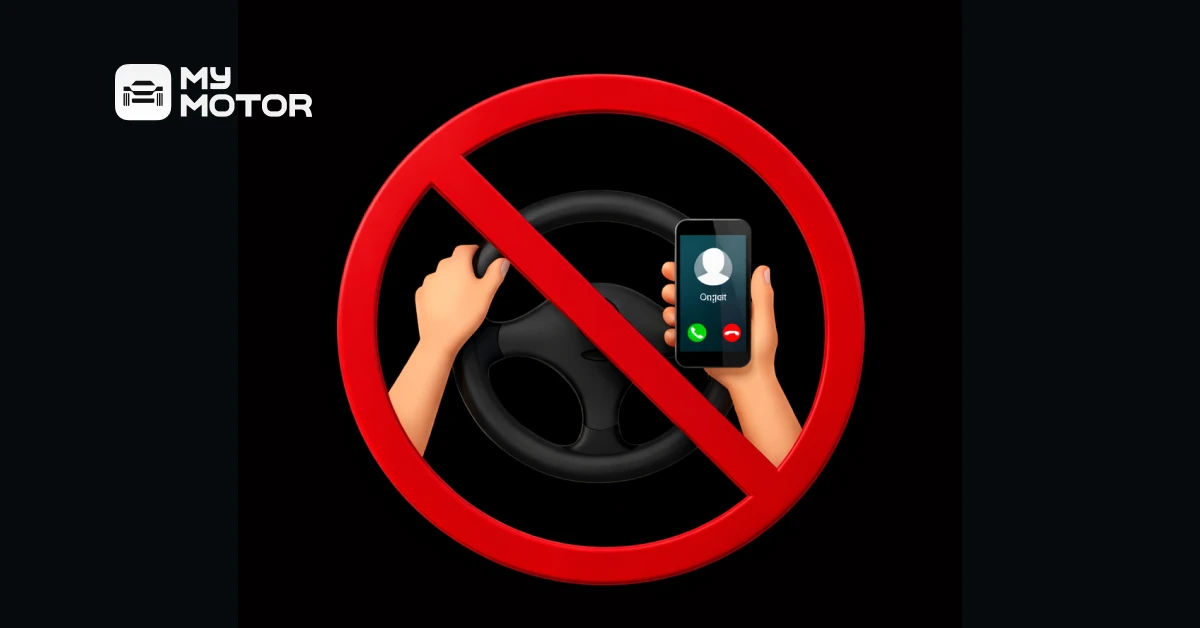
Your phone beeps. You look down.
That look can cost you more than just a fine now. The government has made very strict rules for using a phone while driving. Getting caught can lead to serious trouble.
What is the fine? How do they catch you? What happens to your licence and insurance? This guide explains it all in simple words.
What Is the Fine for Using a Mobile Phone While Driving in India?
The fine for using a phone while driving in India is ₹5,000. This rule came from a big update to the traffic law in 2019 to make punishments stricter and roads safer.
Here’s what you need to know right away:
- The standard penalty: If the police catch you using your phone while driving, you will have to pay ₹5,000. This is for your first time getting caught.
- Why the law changed: Back in 2019, the government changed the old Motor Vehicles Act. They made fines much higher for breaking traffic rules, and using a phone while driving was one of the main things they wanted to stop.
- It’s a serious violation: This isn't a small rule you can ignore. The law calls it a punishable offence because it leads to distracted driving. When you're distracted, you can easily cause an accident.
- What surveys say: The problem is very real. A survey found that 47% of drivers admit they take calls while driving. Even worse, 96% of passengers feel scared or unsafe when the driver uses a phone.
Think about it. Would you feel safe if your driver was looking at their phone? That's exactly why this ₹5,000 fine exists. It's to make everyone think twice before picking up the phone.
Now, you know the basic fine, but what does the law actually say?
Let's break down the exact legal section you're breaking.
What Does The Motor Vehicles Act Say About Phone Use While Driving?
The Motor Vehicles Act of 1988, covers phone use under Section 184, which is for "dangerous or negligent driving." This means the law sees using your phone at the wheel as a very serious act that puts everyone on the road at risk.
Here's a simple breakdown of what the Act says:
- The main law used: Getting caught using your phone falls under Section 184 of the Motor Vehicles Act. This section is not just for phones - it’s for any kind of driving that is rash or careless and could hurt someone.
- It's about danger: When you look at your phone, your focus is not on the road. The law treats this as "negligent" driving because you are not driving carefully and are creating a danger for others.
- Another section mentioned: The excerpt also talks about Section 177. This is a more general rule for disobeying any traffic law. It mentions a fine of ₹100 for a first offence, which shows how much the penalty has increased over time.
- The change in fines: While the old fines like ₹100 under Section 177 were much lower, the big update in 2019 changed everything. This is when the fine for using a phone was raised sharply to ₹5,000 to really make people stop this risky behaviour.
Okay, so the law says it's dangerous driving. But what exactly happens if you get caught?
Let's look at the full list of penalties you could face.
What Are The Penalties And Legal Consequences For Using A Phone While Driving?
The exact penalty is a ₹5,000 fine for a first offence, and up to ₹10,000 and 1 year in jail if you get caught again. But the fine is only the beginning. There are other serious legal consequences that can mess up your driving record and insurance.
Let's go through all the penalties point by point:
- First time fine: You will be fined ₹5,000 for using your phone while driving. Some sources also mention the fine can be between ₹1,000 to ₹5,000, depending on the state.
- Second time is much worse: If you are caught again, the penalty goes up sharply. You could face a fine of up to ₹10,000 and or up to 1 year of imprisonment.
- Your licence can be suspended: Especially for repeat offenders, the police can suspend your driving licence on the spot. This means you can't drive legally at all for a period of time.
- Demerit points on your record: Some states add ‘demerit points’ to your driving licence for this offence. If you collect too many points, it can become very hard to renew your licence later.
- State rules can be different: Big cities and states like Maharashtra or Delhi can impose even higher penalties to stop people from breaking this rule repeatedly.
- Impact on insurance: This is a big one. Car insurance companies see phone use while driving as very risky behaviour. If you get caught, they can increase your insurance premium when it's time to renew your policy.
The key thing to understand is that a challan for phone use is not just a simple fine you pay and forget. It starts a chain of problems that can affect your licence, your vehicle's insurance, and even lead to jail time.
How Do Traffic Police Catch Drivers Using Mobile Phones?
Police catch you by watching for simple signs, like when a driver keeps looking down, and by using cameras that can take your picture. They also have new tools to find out if a phone was used, especially after an accident.
https://storage.googleapis.com/mymotor_blogs/How%20Police%20Catch%20You%20on%20Your%20Phone.webp
Here’s how police find out if you are using your phone while driving:
- Police watching from the road: Traffic police in their cars, on bikes, or even standing on the road are trained to see drivers who are distracted. They look for drivers who are staring down at their lap, who are driving slowly or not in a straight line, or who are slow to move when the traffic light turns green.
- Cameras at traffic signals: The cameras you see at big traffic signals are not just for catching people who jump the red light. These cameras can take clear photos. Police can check these photos later and see if the driver was holding a mobile phone. If they see it, they can send the fine to your home.
- Special police tactics: Sometimes, police do not wear their uniform. They might dress like regular people or even like construction workers near busy roads. From there, they can watch drivers easily. When they see someone using a phone, they tell another police officer in a patrol car to stop that vehicle.
- Using technology to detect phones: In some countries, police are trying new gadgets.
- One gadget can sense the radio signals from a mobile phone that is being used inside a car. It can flash a mobile phone symbol on a sign to warn the driver. But this gadget cannot tell if the driver or a passenger is using the phone, so it is mostly used to study where people use phones the most.
- Another tool talked about is called a ‘textalyser.’ This is not for regular traffic stops. Police might use it after a serious car crash. They can connect it to a driver's phone to see if the person was tapping or swiping on apps like WhatsApp at the time of the crash. This is still a new idea and is being discussed in places like New York because it brings up questions about privacy.
So, these are the ways police can catch you. But what exactly should you not do with your phone while driving? Let's talk about what activities are completely illegal.
What Specific Phone Activities Are Illegal While Driving In India?
In India, it is illegal to hold your mobile phone in your hand for any reason while you are driving. This means you cannot make calls, type messages, or use apps if the phone is in your hand.
The rules are simple: if you are the driver, your hand should not be on the phone. Here is a quick table to show what is not allowed and what is okay, based on the information provided:
https://storage.googleapis.com/mymotor_blogs/%20Illegal%20activities%20While%20Driving.png
Even for legal activities like navigation, you are not allowed to touch the phone or type addresses while the vehicle is moving. Everything must be set before you drive. The excerpt also gives a warning: even talking on a hands-free call can distract your mind, so you must be very careful.
The key point is that if you are the driver, your hand should not be on the phone. If you need to do something with the phone, it should be done before your trip, or you should safely stop the car first.
How Does Using A Phone While Driving Affect Your Car Insurance?
Using your phone while driving makes your car insurance more expensive. Insurance companies see it as risky behaviour and will charge you a higher premium when you renew your policy.
Here's why your insurance costs go up if you use your phone while driving:
- You are seen as a risky driver: Insurance companies check your driving record before they decide your premium. If they see traffic challans for phone use, it tells them you might not follow rules. They think you are more likely to have an accident, so they charge you more money to cover that risk.
- Your premium increases at renewal: Phone use is a traffic violation. Insurance companies can now check your violation history through government systems. When they see these violations on your record, they will raise your insurance premium. You will pay more every year.
- You lose the No-Claim Bonus discount: If you drive safely with no claims, you get a big reward called a No Claim Bonus. This can give you up to a 50% discount on your premium. A challan for phone use hurts your safe driving record. If you then make an insurance claim, you could lose this entire NCB discount. Your insurance will become much more expensive for many years.
The information available explains why premiums go up. It does not provide specific details about what happens if you make an insurance claim after an accident caused by phone use.
Using your phone while driving has a heavy cost. Not just a fine, but higher insurance for years. But how big is the problem really?
Let's look at the actual accident numbers that made the government bring in these strict rules.
What Do Accident Statistics Say About Mobile Phone Use While Driving In India?
In one year, phone use while driving caused over 3,000 deaths in India. These are not just numbers. They are people who lost their lives because a driver was distracted by a phone.
Here is what the latest government road accident report tells us:
- In 2022, a total of 1,68,491 people died in road accidents across the country.
- Out of these, the government officially recorded 3,395 deaths that happened specifically because the driver was using a mobile phone.
- To understand how serious this is, look at other violations. In that same year, jumping a red light caused 1,462 deaths. This means phone use was linked to more than twice as many deaths as running a red light.
We can also see the problem is getting bigger. The total number of people dying on the roads went up from 1,53,972 in 2021 to 1,68,491 in 2022. Phone use is a part of this growing crisis.
So every time you think of checking your phone while driving, remember this: that one glance could be part of a statistic that ends a life. It is not worth the risk.
Refer to this report by the Ministry of Road Transport & Highways to know more!
Why Is Using A Phone While Driving So Dangerous?
Using your phone while driving is dangerous because it takes your mind, your eyes, and your hands away from the road, all at the same time.
https://storage.googleapis.com/mymotor_blogs/Why%20Your%20Phone%20Is%20a%20Driving%20Hazard.webp
Let's break down the three main ways your phone distracts you, which safety experts call the three types of distraction:
- Mental distraction: When you're on a call, even hands-free, your brain is focused on the conversation. This means you're not fully concentrating on driving. Studies show this makes you four times more likely to crash. You might miss a stop sign, not notice a car braking ahead, or make poor decisions.
- Visual distraction: Looking at your phone's screen, even for a few seconds, is incredibly risky. If you check a text for just 5 seconds while driving at 60 km/h, you've driven the length of a football field without looking at the road. You are driving blind.
- Physical distraction: Holding the phone means one or both hands are not on the steering wheel. This makes it impossible to react quickly if you need to swerve or brake suddenly.
But that's not all. Using a phone also has a lesser known, physical effect:
- Slows your reactions like alcohol: Research has found that talking on a hands-free phone can slow your reaction times by about. That's worse than the slowing caused by being at the legal alcohol limit for driving. Your brain is so busy with the call, it can't process road dangers fast enough.
- Makes your driving unstable: A distracted driver often drifts in their lane, forgets to use turn signals, and has trouble keeping a steady speed. This confusion is dangerous for everyone else on the road, especially motorcyclists, cyclists, and pedestrians, who are at the highest risk in a collision.
In short, driving safely requires your full attention. A phone splits that attention. In the crucial half-second you spend looking at a notification, an entire accident can happen that you could have prevented.
How Can You Use Your Phone Safely And Legally While Driving?
The only completely safe and legal way is to not use your phone at all while driving. The law says you cannot hold your phone. So, if you must use it for something important, you have to follow very strict rules to keep it hands-free.
Here are the safe and legal methods based on driving safety guidelines:
- Mount your phone securely: If you need to use your phone for GPS navigation, you must fix it in a holder on your dashboard or windshield. The holder must be strong so the phone does not fall while driving. You cannot hold the phone in your hand at any time.
- Set everything up before you drive: This is the most important rule. You must type your destination into the GPS, connect your Bluetooth for calls, and adjust all settings before you start the car and begin moving. Once you are driving, you should not touch the phone screen or buttons.
- Use voice commands: For things like making a call or changing the music, use voice assistants like Google Assistant or Siri. This lets you keep both hands on the wheel and your eyes on the road.
- Use hands-free for calls: If you need to take a call, you should use a Bluetooth headset or your car's speaker system. Even then, you should keep the conversation short and simple. Avoid stressful or complicated talks.
- Pull over safely for anything else: If you need to read a message, send a text, look at a map again, or do anything that needs you to touch or look at your phone, you must first stop the car in a safe place. Do not try to do these things while driving, even in slow traffic or at a red light.
- Let a passenger help: If you have someone else in the car with you, they can handle the phone for navigation or communication. You, as the driver, should not be distracted.
Remember, even a hands-free call can take your mind off the road. The safest choice is always to put your phone away, on silent mode, and focus only on driving.
Now you know how to stay safe and legal. But what if you still get a challan? Let's look at the steps for how to pay or fight a fine for using your phone while driving.
How Can You Contest Or Pay A Mobile-Use-While-Driving Challan Online?
If you get a challan for using your phone, you have two choices. If you think it's a mistake, you can contest it in court. If you agree you broke the law or lose the case, you must pay the fine.
Option 1: Contesting the Challan
If you believe the challan is wrong, you can challenge it. However, this process takes more time and effort than simply paying.
1. You cannot settle this with the police officer on the street. To officially dispute a challan, you must go to the traffic court mentioned on your challan notice and file a formal case.
2. Simply saying you are innocent is not enough. To have a good chance, you should gather proof like:
- Dashcam video from your car that clearly shows you were not holding or looking at your phone at the time of the alleged offence.
- Witness statements from passengers who were with you and can confirm your story.
- Your mobile phone's detailed call and data records that show you were not using the device at that exact time.
3. Consider Legal Advice: Traffic court can be complicated. It might help to talk to a lawyer who specialises in traffic fines to guide you through the process.
Option 2: Paying the Challan
If you decide not to contest the challan, or if you contest it and lose, you must pay the fine. This is the fastest way to settle the matter.
- The main government website for all challans in India is the Parivahan eChallan portal. You can visit the website, enter your vehicle or challan number, and pay using UPI, card, or net banking.
- State-Specific portals: Many states, like Delhi and Maharashtra, have their own traffic police websites or mobile apps where you can log in and pay fines issued in that state.
- For a streamlined process however, apps like MyMotor provide a user-friendly way to handle this. You can use it to easily check all your pending challan details and pay them directly within the app, making the process more convenient.
A final reminder: Do not ignore a challan. If you don't pay it, the fine will increase with late fees, and it can block your vehicle's registration renewal or even lead to your driving licence being suspended or impounded. If you're sure you're right, contest it with evidence. Otherwise, paying it promptly is the best step.