
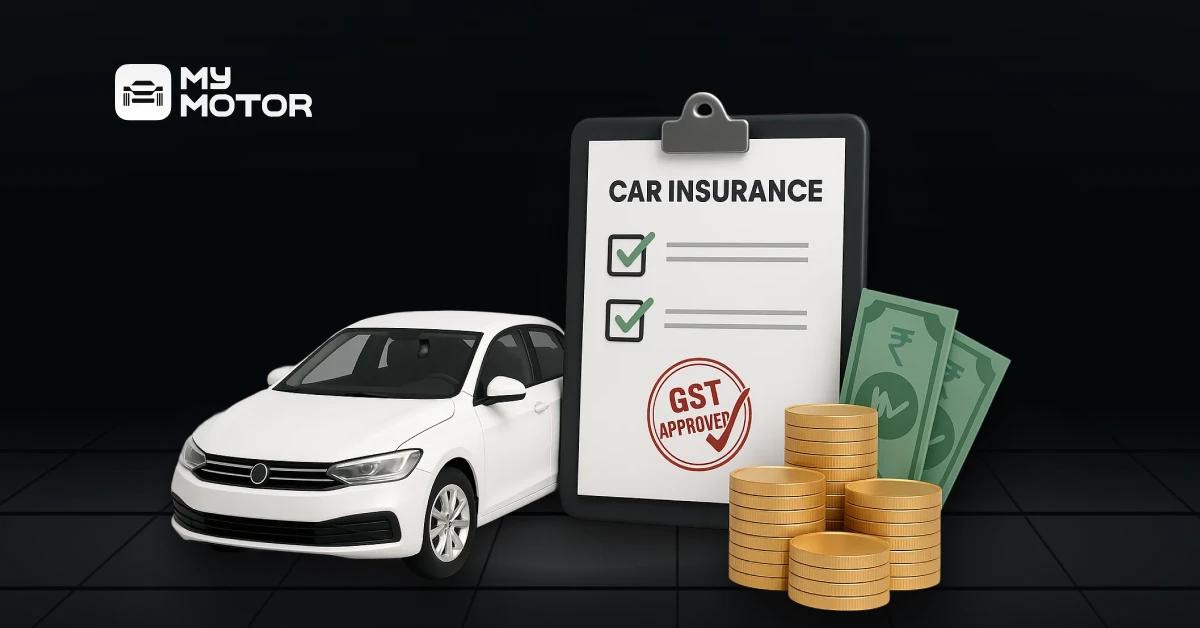
You might have heard that GST rates have been revised and health insurance premiums are now cheaper.
This naturally leads to one question: will your car insurance also cost less?
The short answer is no, the GST on car insurance remains at 18%. The tax rate has not changed for your vehicle's policy. But this change does affect car owners in other ways.
This guide will explain how the new GST rules impact your insurance, whether you are buying a new car or renewing an old policy.
Let's clear up the confusion.
What Are the Revised GST Rates on Car Insurance and Why Should You Care?
The revised GST rates have brought big changes for health and life insurance, but for car insurance, the tax rate stays the same at 18%.
This means the amount of GST you pay on your car's premium hasn't changed with the latest update.
Here’s a simple breakdown of what changed and what didn’t:
- What changed: From September 22, 2025, the GST on individual health and life insurance premiums was cut down to 0% from 18%.
- What didn't change: Your car insurance is a type of "general insurance." The GST on car insurance premiums, whether for a new policy or a renewal, remains at 18%. Compare current 18% GST-inclusive premiums across top insurers instantly.
So, why should you, as a car owner, still care about this?
Because knowing this saves you from confusion. While everyone is talking about lower taxes on other policies, you now know your car insurance math hasn't changed. This helps you plan your budget correctly without any surprises.
Now that you know the GST rate on car insurance is steady, let's break down exactly how this 18% affects the final price you pay.
How Do Revised GST Rates Affect Car Insurance Premiums?
The GST on the car insurance premium itself is still 18%, but the overall premium for a new car can be lower because the car's price (and its Insured Declared Value) went down after the GST on cars was reduced.
Think of it like this: GST is calculated as 18% on your total insurance premium amount. This 18% rate itself has not changed. But the main part of the premium, before adding GST, is based on your car's value. Since new cars are cheaper now, their value for insurance is also lower, which can bring down the final cost.
Let's look at an example. Imagine you bought a new Tata Nexon. After the GST revision on cars, its price dropped.
Key things to note:
- For old cars/renewals: If you are renewing the insurance for a car you already own, you likely won't see a big change. You will still pay 18% GST on your renewal premium.
- Third Party Insurance: This part of the premium is fixed by IRDAI and hasn't changed. The GST reduction on cars doesn't affect it.
- Luxury cars: Big SUVs and luxury cars now have a 40% GST. Their insurance might not get cheaper as their value and repair costs are still very high.
So, while the GST rate on insurance is steady, the lower car prices can lead to some savings on your total insurance bill for a new purchase.
But does this GST change affect all types of car insurance policies the same way?
Let's find out.
Which Types of Car Insurance Policies Are Affected by New GST Rates?
Both comprehensive and third-party car insurance policies have the same 18% GST rate applied to their premiums, and this rate has not changed with the recent GST revision.
The key difference is not in the tax rate, but in how the GST is applied to the final amount you pay for each type of policy.
Here’s how it breaks down for the two main types of car insurance:
- GST on Comprehensive Car Insurance: This is the full package that covers damage to your own car and also includes third-party liability. The GST on comprehensive car insurance is 18% on the total premium. Since the premium is based on your car's value (IDV), and new car prices have dropped, the base premium for a new car can be lower. So, you pay 18% GST on that lower amount. Get comprehensive quotes showing exact GST breakdown for your car.
- GST on Third Party Insurance: This is the basic, legally required insurance that only covers damage you cause to others or their property. The GST on third party insurance is also 18%. However, the big difference is that the base premium for third-party cover is fixed by the government (IRDAI), not based on your car's price. So, the amount on which you pay 18% GST has not changed at all.
In short, the GST on motor insurance is a flat 18% for everyone. But whether your final bill feels the effect of other GST changes depends entirely on which policy type you buy.
Okay, so the GST on the premium is clear. But what about when you renew your policy or, heaven forbid, need to make a claim?
Let's see how GST plays a role there.
How Does GST Revision Influence Your Car Insurance Renewal and Claims?
The GST revision does not change the 18% tax you pay on your renewal premium, and it has no effect on the money you receive from an insurance claim - that amount is always GST-free.
Let's break this down into two simple parts: renewing your policy and making a claim.
1. For Your Car Insurance Renewal:
When you renew your car insurance, you will still see that 18% GST charge on your bill. The recent GST changes did not touch this rate. So, the GST effect on insurance renewal is simple: it's business as usual. Renew online now to lock in current rates before potential hikes.
- The base premium might change a bit based on your car's age or your No Claim Bonus.
- But the GST on car insurance renewal remains a steady 18% on that final amount.
2. For Your Insurance Claims:
Here's the good news. When you make a claim and the insurance company pays you, that money is yours completely. You do not have to pay any GST on it.
- The law says that insurance claim payouts are not considered a "sale of goods or a service."
- So, whether you're getting your car repaired or receiving money for a total loss, the GST impact on insurance claims is zero. You get the full, agreed-upon amount.
Think of it this way: You pay GST when you buy the insurance service. But when you use that service during a claim, the help you get is tax-free.
So, we've seen how GST works with renewals and claims. But is this whole system a good thing or a bad thing for you?
Let's weigh the pros and cons.
What Are the Benefits and Challenges of the Revised GST Rates on Car Insurance?
The main benefit is that lower car prices can lead to slightly lower insurance premiums, while the biggest challenge is the confusion from seeing other insurance get cheaper while car insurance GST stays the same.
Let's break down the good and the not-so-good parts of this update.
https://storage.googleapis.com/mymotor_blogs/the_pros_and_cons_at_a_glance_1x.webp
1. The Benefits
Even though the GST on car insurance itself didn't change, you can still see some positive effects.
- Cheaper new cars mean cheaper insurance (a bit): Since the GST on buying a new small car was cut, the car's price is lower. Your insurance premium is based on this price. So, for a brand-new car, the main part of the premium can be lower, and you pay 18% GST on that smaller amount.
- More people might insure their cars: With cars becoming more affordable, more people might buy them. This is good for the overall system and keeps the insurance market competitive.
- Simple and clear tax: The GST rate for car insurance is a straightforward 18%. There's no confusion about different rates for different parts of the policy.
2. The Challenges
The changes also bring some points that can be frustrating or confusing.
- No direct tax cut on premiums: Unlike health and life insurance, which saw their GST slashed to zero, the GST on car insurance saw no change. This means car owners do not get any direct reduction in their insurance costs from this GST revision.
- No direct savings on renewals: If you already own a car and are just renewing the insurance, you won't see any drop in your bill because of the GST revision. The 18% charge remains.
- Luxury car owners don't benefit much: While the GST on buying big SUVs and luxury cars went down, their insurance is still very expensive. The high repair costs and value of these cars mean the base premium is high, so the 18% GST on that is still a significant amount.
In short, the benefits of revised GST rates for car insurance are indirect and mostly for new buyers, while the challenges with GST changes are more about the lack of direct tax relief for policyholders.
Knowing the pros and cons is one thing, but what can you actually do to keep your insurance costs in check?
Let's talk about some smart moves.
How Can You Manage Your Car Insurance Premiums Amidst GST Changes?
https://storage.googleapis.com/mymotor_blogs/smart_ways_to_lower_your_car_insurance_bill_1x.webp
Even with the GST rate stuck at 18%, you can still lower your car insurance bill by focusing on the base premium and making smart choices.
Since the GST on car insurance is a percentage of your premium, the best way to save is to bring down the amount on which that 18% is calculated. Here are some practical tips to manage car insurance premiums:
- Pick a higher voluntary deductible: This is the amount you agree to pay from your own pocket if you make a claim. If you choose a higher deductible, your insurance company's risk goes down, and they will give you a lower base premium. Since GST is 18% of that premium, a lower premium means you pay less GST too. Learn more in our car insurance deductible guide.
- Be smart with Add-On covers: Don't just tick every box. Only choose add-ons that you really need, like zero depreciation for a new car. More add-ons mean a higher premium, which means a higher GST amount. Buying a bundle of add-ons together can sometimes be cheaper than buying them one by one. Compare add-on bundles like zero depreciation + Road Side Assistance for best value.
- Compare policies every year: Don't just automatically renew with your old insurer. Different companies offer different base premiums for the same cover. Use online websites to compare policies and find a cheaper option. A lower premium from a new insurer automatically means lower GST. Use our free car insurance comparison tool.
- Don't lose your No Claim Bonus (NCB): This is the biggest discount you can get. For every year you don't make a claim, your NCB increases, which slashes your base premium at renewal time. A lower premium directly leads to insurance premium savings on the GST as well.
- Consider a long term policy: If you buy a policy for two or three years at once, you lock in the current premium and GST rate. This can save you money if premiums or even GST rates go up in the future.
By focusing on these areas, you take control of your costs. The goal is to reduce the base premium, and the GST savings will follow.
Related:
- How Can You Get a Duplicate Car Insurance Policy in India?
- Find Lost car Policy Number
- Comprehensive vs Zero Depreciation Car Insurance
- Engine Protection Cover in Car Insurance: Complete Guide
- Guide to Check Vehicle Insurance Status Online
- Rental Car Insurance Guide
- zero Depreciation Car Insurance
- Roadside Assistance Car Insurance Guide
- Third party Insurance India
- Buy Car Insurance Online in India
- Buy Bike Insurance Online in India
- Buy Commercial Vehicle Insurance Online in India