
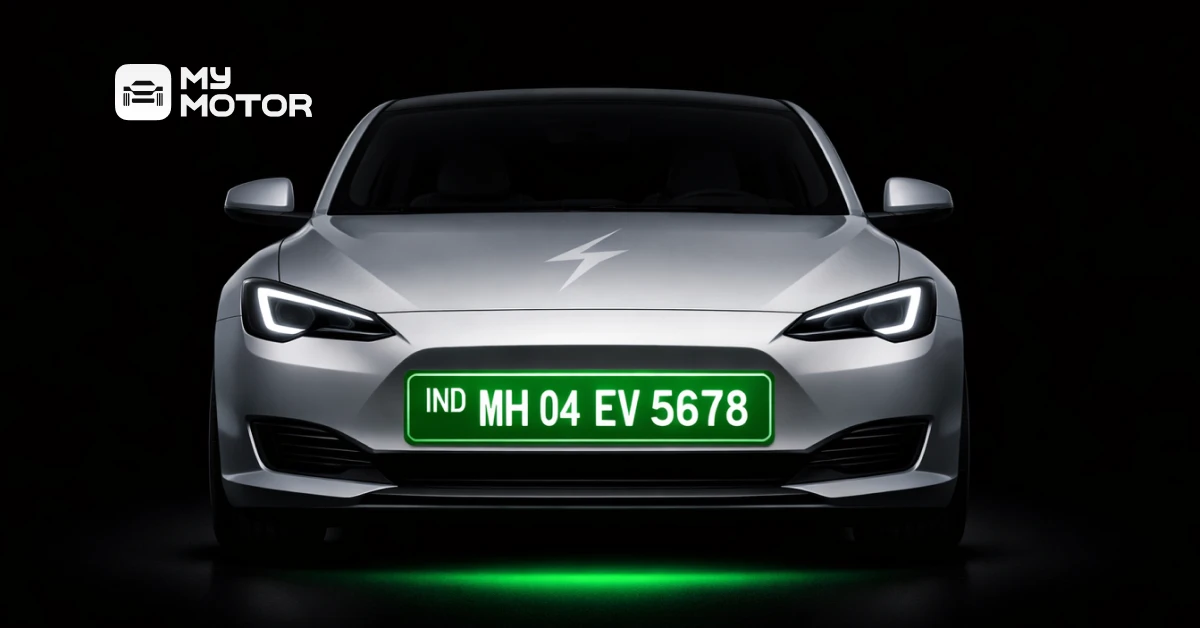
If you have an electric car or are planning to buy one, you might have noticed some of them have a different colour number plate. Not white, not yellow, but green. You are surely aware that it's not a design choice or something the owner did for style. It is the rule now.
The government made this change to separate electric vehicles from ICE vehicles. One look at the plate and you know it is an EV.
This guide will walk you through everything about green number plates. Who gets them, what papers you need, how to apply, and what benefits come with it.
Buckle up!
What Is a Green Number Plate for EVs?
A green number plate is the registration plate given only to electric vehicles in India. It has white or yellow letters on a green background so anyone can spot an EV just by looking at it.
The government introduced these plates because there was simply no way to instantly tell an electric car apart from a regular one earlier. A cop would have to stop you and check your papers to know what you were driving.
This made it hard to track EV adoption and nearly impossible to enforce incentives properly.
Green plates fixed that in one go. One glance and everyone knows that this vehicle runs on electricity and not fuel.
Why Do Electric Vehicles Get Green Plates?
EVs get green plates so the government can identify them instantly and make sure benefits like road tax exemptions actually reach electric vehicles.
Here is the thing. The government offers lower road tax, registration fee waivers, and sometimes even toll discounts for EVs. But if an EV looks identical to a petrol car from the outside, how does a toll booth operator know who gets the discount? Or how does the RTO verify that the vehicle claiming an EV subsidy is actually electric?
Green plates answer both questions. They make identification instant.
There is another benefit from the government's perspective that is not much spoken about.
When you see more green plates on the road, it normalises the idea of electric vehicles. And this visibility, over time, does more for EV adoption than any pamphlet or campaign ever could.
Speaking of EV adoption, you might want to read our detailed breakdown on the future of EVs in India to see why it concerns you.
How Do Green Plates Differ from White or Yellow?
White plates are for private petrol and diesel vehicles. Yellow plates are for commercial petrol and diesel vehicles. Green plates are only for EVs, and the letter colour tells you whether it is private or commercial.
https://storage.googleapis.com/mymotor_blogs/green-plate-differ-red-white.png
Petrol, diesel and hybrid vehicles cannot use green plates. That is an offence punishable by fine or jail.
Who Is Eligible for Green Number Plates?
The green number plate is only for vehicles that run completely on battery power. That means no petrol, no diesel, and no hybrid. If your car has a tailpipe, you cannot get one.
This includes private electric cars, electric taxis, delivery vans that run on battery, and even government vehicles that have switched to electric. All of them qualify. All of them must eventually have a green plate.
The rule was introduced in December 2020.
If you bought your EV after that, the green plate came with the car from the dealer. You didn't have to ask for it separately. If you bought your EV before 2020, your car is still on a regular white or yellow plate. That plate is not valid anymore. You are eligible to upgrade, but you have to visit the RTO and get it done yourself.
Some states like Delhi have already started sending notices. Others may soon follow suit.
Do All EVs Automatically Get Green Plates?
As mentioned earlier, only the new ones. When you buy a new EV from the showroom today, the registration process includes the green plate. The dealer handles it, and you don't need to do anything extra.
But if you own an EV that was purchased before December 2020, the green plate does not appear automatically.
Your car is still running on the old plate it was given at the time of purchase. That could be a white plate if it's a private vehicle, or a yellow plate if it's commercial.
The government wants all EVs to switch, but the responsibility is on you to make it happen.
You need to go to your RTO, fill Form 20, submit your documents, pay the fee, and get the new plate fabricated.
Are Hybrid Vehicles Eligible for Green Plates?
No. Hybrid vehicles are not eligible for green plates, and this is something that confuses a lot of people.
A hybrid car runs on battery, yes, but it also runs on petrol or diesel. It has an engine that burns fuel, and it releases exhaust like any other ICE car. The government only gives green plates to 0 emission vehicles.
Hybrids do not meet this standard.
So if you own a hybrid, your car stays on whatever plate it currently has. White for private use, yellow if you use it for commercial purposes. You cannot apply for a green plate, and even if you try, it will be rejected.
Can Commercial EVs Use Green Plates?
Yes, commercial electric vehicles are fully eligible for green plates.
The only difference is the colour of the letters. Private EVs get green plates with white letters. On the other hand, commercial EVs like taxis, delivery vans, electric buses, or any EV used for business, get green plates with yellow letters.
The letter colour tells authorities what the vehicle is registered to do.
A private EV with white letters cannot be used to pick up passengers for money. A commercial EV with yellow letters can, but the driver must have a valid commercial driving permit. The plate makes both things clear from a distance.
What Documents Are Required for Green Number Plates?
The document list for a green plate is the same as registering any normal car. You just need to prove three things: who you are, where you live, and that the vehicle is yours.
If you are buying a new EV, the dealer usually handles all of this. You hand over the papers, they upload everything, and the green plate comes with the car.
But if you are upgrading an older EV or doing the registration yourself, you need to know exactly what to carry.
Which ID and Address Proofs Are Needed?
1. For identity, any government-issued document works. You only need one:
- Aadhaar card - This is the simplest and most commonly used.
- PAN card - Also accepted, though some RTOs prefer Aadhaar.
- Voter ID or driving licence - Both work as well.
2. For address proof, Aadhaar usually does the job. If your Aadhaar does not show your current address, carry one of these:
- Electricity bill, water bill, or gas bill - Should be recent, preferably within the last three months.
- Rental agreement - If you live in a rented house.
- Passport or bank statement - Also accepted in most cases.
If you are applying offline, carry both the original and a photocopy. The RTO will check the original and keep the copy.
If you are applying online through the Vahan portal, upload a clear scanned copy. Blurry images or photos taken at an angle usually get rejected.
What Vehicle-Specific Documents Must Be Submitted?
This is where you prove the car actually exists and belongs to you.
- Sales certificate - This is the invoice the dealer gives you when you buy the vehicle. It shows the make, model, chassis number, and the price you paid. Without this, the RTO cannot register the car.
- Application form - This is Form CMV20. The dealer usually fills this, but you can also download it from the Parivahan portal or pick it up at the RTO counter.
- Temporary registration - When you buy a new car, the dealer gives you a temporary number plate valid for one month. That paper serves as proof that the vehicle is already cleared for road use while the permanent registration is being processed.
- PAN card copy - Not always asked, but keep it handy. Some RTOs require it.
If you are upgrading an older EV that was bought before 2020, you do not need the sales certificate again. Your existing RC book is enough proof of ownership.
Is Insurance Mandatory for Green Plate Application?
Yes. You cannot register any vehicle in India without a valid insurance policy. The green plate is no exception.
The RTO will ask for a copy of your insurance certificate. It must be active on the day you apply. If your policy expired last week and you haven't renewed it, your application will be rejected at the counter.
For new EVs, the dealer usually includes insurance as part of the purchase package. Just make sure the policy document is in the folder they give you. If you are applying on your own, buy the insurance first, then go to the RTO.
How to Apply for a Green Number Plate in India?
There are two ways to get a green plate. You can do it online through the Vahan portal, or you can visit your local RTO in person. Obviously, the online method is faster and saves you a lot of time.
If you are buying a new EV from a showroom, the dealer usually handles the entire process. You don't need to worry about online or offline. They take your documents, do the submission, and the green plate arrives with the car.
But, if you are upgrading an older EV or registering the vehicle yourself, here is how it works.
https://storage.googleapis.com/mymotor_blogs/ONLINEoffline.webp
What Is the Online VAHAN Application Process?
The online method is straightforward. You do everything from home, upload your documents, pay the fees, and then visit the RTO only once for the vehicle inspection.
Here are the steps:
Step 1: Go to the official Vahan portal.
Step 2: Select your state and the RTO office that covers your area.
Step 3: From the menu, click on 'Online Services' and then choose 'Vehicle Related Services'.
Step 4: Select your RTO location again and click on 'Apply for New Registration'.
Step 5: Fill in the details of your electric vehicle. This includes the make, model, chassis number, and engine number.
Step 6: Upload clear scanned copies of all the required documents.
Step 7: Pay the applicable fees online. We will talk about the exact cost in the next section.
Step 8: Review all the details you have entered. Once you click submit, you cannot edit the form. After submission, download and save the application receipt.
Step 9: The RTO will schedule a date for physical inspection of your vehicle. On the appointed day, take your car to the RTO. An officer will check the chassis number, engine number, and other details to verify they match what you submitted online.
Step 10: Once the inspection is cleared and your application is approved, the RTO will issue a Registration Certificate and assign a permanent registration number. Your green plate can then be fabricated at an approved shop.
The entire process, from application to getting the plate, usually takes about a week to ten days if your documents are in order.
How Does Offline RTO Application Work?
The offline method is the traditional way. You go to the RTO, stand in line, fill forms, submit documents at the counter, and wait for everything to be processed.
It takes more time and effort, but some people prefer it because they can clarify doubts face to face.
Here is how it works:
Step 1: Visit your nearest RTO office that handles vehicle registrations. Carry both original documents and photocopies. The RTO will verify the originals and keep the copies.
Step 2: Get Form CMV20 from the counter. Some states still use the older Form CCVA20, but CMV20 is the standard now. Fill it. Bear in mind, even the slightest mistakes in the form can get your application rejected.
Step 3: Submit the filled form along with your document copies to the designated counter. Make sure you mention that this is an electric vehicle and you are applying for a green number plate.
Step 4: Pay the registration fees at the cash counter. They will give you a receipt. Keep this safely.
Step 5: An RTO officer will inspect your vehicle. This usually happens on the same day or they might give you a later date. The officer checks the chassis number, engine number, and overall condition of the car to verify it matches the details in your application.
Step 6: Once the inspection is done and your documents are verified, the RTO approves the registration. They assign a permanent registration number, and you can get your green plate made from an approved vendor.
The offline process can take anywhere from a few days to two weeks, depending on how busy your RTO is.
What Are the Fees for Green EV Plates?
The fees for a green number plate are not fixed across India. They vary depending on your state, the type of vehicle, and sometimes even the brand of the car.
But here is a general breakdown of what you can expect to pay:
https://storage.googleapis.com/mymotor_blogs/fees-green-ev-plates.png
Something you should keep in mind is that the registration fee is set by the central government, but states can add their own charges on top.
For example, some states levy a small green tax or additional processing fees for EV registration.
Check with your local RTO or the dealer to confirm the exact amount for your city.
Also, the road tax for EVs, which is separate from the registration fee, is not included in this table.
Most states offer full or partial road tax exemptions for electric vehicles, but this is not the same as the plate fees. Road tax is calculated based on your vehicle's price and is paid either upfront or in some cases, waived off completely depending on your state's policy.
What Are the Benefits of Green Number Plates?
The green plate is more than just a marker that tells the government, the traffic police, and the toll booth that your vehicle is electric.
And because it is easy to spot, the government can actually deliver the benefits they promised.
These benefits are not the same everywhere. Some are set by the central government, others depend on which state you live in. But broadly speaking, here is what you can expect:
- Toll concessions: On many national highways, EVs with green plates get discounts on toll fees. The exact percentage varies, but it is common to see 10 to 15 percent off at plazas that have the FASTag system.
- Parking privileges: Some cities have reserved parking spots exclusively for EVs. In places like Delhi and Pune, you might also get discounted or free parking at select locations.
- Access to restricted zones: A few congested areas that restrict entry for regular ICE cars allow EVs to pass through. This is still limited to specific cities, but more are adopting it.
- Green lanes: Some states have experimented with dedicated lanes for electric vehicles in heavy traffic areas, though this is not yet widespread.
And then there are the two big ones that deserve their own explanation: Road tax and PUC.
Do Green Plates Offer Road Tax Exemptions?
Yes, this is one of the main financial benefits of owning an EV with a green plate. Most states in India offer a full or partial waiver of road tax for electric vehicles.
Road tax is the charge you pay to the state government when you register a new vehicle. For a petrol or diesel car, this can be a significant amount that is anywhere from 8 to 12 percent of the vehicle's ex-showroom price, sometimes more.
You pay it upfront, in one lump sum, for the entire 15-year life of the vehicle.
For EVs however, many states have reduced this to zero, or to a very small nominal amount.
The exact exemption depends on where you live. For example, Delhi and Maharashtra offer full road tax waivers for EVs. Gujarat also offers a full waiver.
Karnataka and Tamil Nadu have partial exemptions or caps. A few states are still figuring out their policies.
Can Green Plates Skip PUC Checks?
An electric vehicle has no tailpipe. It does not burn fuel or emit smoke. So the entire purpose of a Pollution Under Control certificate, which is to check if your car's emissions are within legal limits, does not apply to an EV.
There is nothing to measure.
Because of this, many sources say EVs do not require a PUC certificate. And in day-to-day driving, traffic police usually do not ask EV owners for one. You will rarely hear of an EV being fined for not having a valid PUC.
However, the Motor Vehicles Act and the Central Motor Vehicles Rules still list PUC certification as mandatory for every vehicle, without explicitly exempting electric vehicles.
Some RTOs and enforcement agencies interpret this to mean that EVs must still undergo the certification process, even if it is just a formality.
This means that you can probably drive your EV without a PUC certificate and never face an issue. But if you want to be 100 percent compliant with the letter of the law, you should get one.
What Are EV-Specific Rules in Maharashtra?
Maharashtra has its own EV policy that runs from 2025 to 2030. It replaces the older 2021 policy and sets clear targets like, by 2030, 30 percent of all new cars sold in the state should be electric.
1. On taxes and fees
- Full exemption from motor vehicle tax. You pay zero.
- Registration fees are completely waived.
- 100 percent toll exemption on key expressways like Mumbai-Pune and Samruddhi Mahamarg.
2. On purchase subsidies
- Electric cars: ₹1.5 lakh to ₹2 lakh
- Electric two-wheelers: up to ₹10,000
- Electric three-wheelers: up to ₹30,000
- Electric buses: up to ₹20 lakh
3. On charging infrastructure
- Charging stations every 25 km along state and national highways.
- Every fuel station and MSRTC bus depot should have at least one fast charger.
- You can already find live EV charging stations near you across 3,000+ stations on the MyMotor app.
- Mumbai-Pune Expressway and Samruddhi Mahamarg are being developed as dedicated EV corridors.
4. On buildings and housing
- New residential buildings: 100 percent parking spaces must be EV charging ready.
- New commercial buildings: at least 50 percent parking spaces EV ready.
- Existing commercial buildings: minimum 20 percent operational charging points.
- Housing societies can set up community charging points with approval from 50 percent of members.
5. On government commitment
All government offices must have at least one EV charging facility. The Transport Department is the nodal agency, and there is a single-window online system for charging station approvals.
The policy is valid until 2030.
If you live in Maharashtra, these are the rules and benefits that apply to your EV.
Common Issues with Green Number Plate EVs
The green plate system works well for most EV owners, but it is not without its flaws. Since the scheme launched in 2020, a few recurring complaints have surfaced.
- Legibility in low light: The white or yellow letters on a green background are harder to read at night compared to standard black-on-white plates.
- Unwanted visibility: Some owners do not like how much the bright green plate makes their car stand out in traffic.
- Hybrid confusion: Many hybrid owners assume they qualify for green plates. They do not, and the misunderstanding keeps coming up.
- Aesthetics: A number of people simply find the green colour unappealing on their vehicle and wish they had a choice.
- Uneven enforcement: Pre-2020 EV owners in many states have not been urged to upgrade, so you still see white plates on older EVs alongside green ones on newer models.
None of these issues make the green plate a bad policy. But they are worth knowing about, especially if you are someone who notices small details about your car.
And if you really are someone who notices small details about your car, it would be quite the embarrassment, if you didn’t know whether your car had a challan pending or not.
Hopefully not, but why take the risk. Check your challan status right here
Why Do Some EVs Still Get White Plates?
By law, every electric vehicle is supposed to have a green plate. But you still see EVs running on white plates.
- Temporary registration: New cars get a temporary plate valid for one month. Until the permanent green plate arrives, the EV runs on that temporary plate.
- Dealer or RTO delays: In some cities, there is a backlog in issuing HSRP green plates. The car is delivered with whatever plate is available while you wait.
- Hybrid vehicles: Hybrids run on battery and petrol. They are not zero-emission, so they do not qualify for green plates. They stay on white plates permanently.
- Owner preference or non-compliance: Some owners simply do not install the green plate. They do not like the look or think they can get away with it. This is illegal and can attract fines.
So, if it is a pure battery EV, it must have a green plate. White plates on EVs are either temporary or a violation.
How to Handle Green Plate Rejections?
Sometimes your green plate application gets rejected. The key is to figure out why and fix it quickly.
- Identify the cause: Log in to the Vahan portal and check the rejection reason. Common issues are incorrect vehicle details, blurry document scans, or problems with the HSRP specifications.
- Fix your documents: If the problem is with your ID proof, address proof, or sales certificate, upload fresh, clear scans. Blurry or cropped images are a major reason for rejections.
- Talk to your dealer: If you bought the car recently, the dealer can often sort this out directly with the RTO. They have dealt with this before.
- Visit the RTO if needed: If online corrections are not working, go to your local RTO with all original documents. Carry photocopies as well. Explain the situation at the counter.
- Do not use illegal plates: Some people respond to a rejection by simply buying a fake green plate from a local shop. This is a bad idea. Unauthorised plates are easy to spot and attract fines.
- Check the HSRP compliance: Your green plate must be a proper High-Security Registration Plate with the laser-engraved PIN and chromium hologram. If the rejection says HSRP issue, this is likely the reason.
*Remember, do not drive your EV without a valid green plate once the rejection is communicated.
Conclusion
The green plate is not something to stress about. If you are buying a new EV, the dealer handles it. If you have an older EV, one visit to the RTO and you are done.
The fees are small, the benefits are real, and the whole process is mostly online now.
It makes your EV official, unlocks tax savings and toll discounts, and tells everyone that electric cars are already here. Not some future experiment.
Just regular cars that regular people drive. And with the MyMotor EV charging app, finding a charger near you is as simple as opening the map — free on Android.