
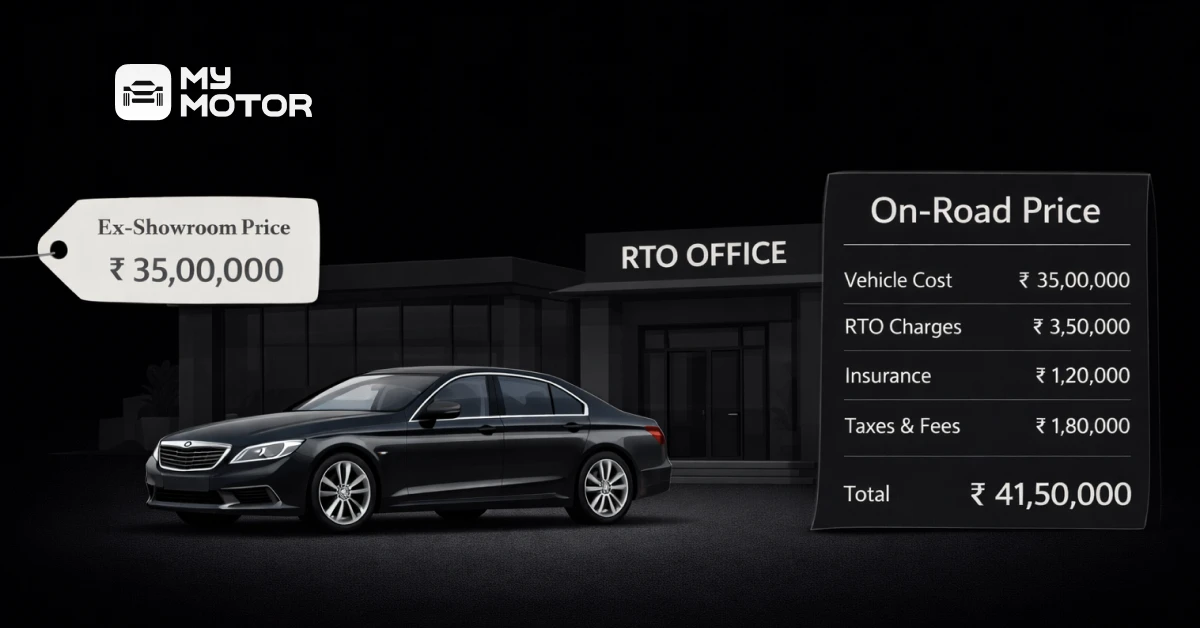
Looking at a new car's price tag can be confusing. You see one number in big, bold letters in the advertisement, but when you talk to the dealer, the final amount is always much higher.
This difference comes down to two main prices: the ex-showroom price and the on-road price.
One is just the cost of the vehicle, and the other is the total cost to actually drive it.
Knowing the difference is the first step to planning your budget correctly and avoiding a surprise when you see the final bill.
What Is the Ex-Showroom Price of a Car or Bike?
The ex-showroom price is the dealer's price for the car or bike, but it is not the final driving price. It is the number you see in advertisements and on the sticker in the showroom.
What Does Ex-Showroom Price Include?
- The cost of making the vehicle at the factory.
- The GST that goes to the government.
- The dealer's own profit for selling it.
What Is Excluded from Ex-Showroom Price?
- Your car's registration charge at the RTO.
- The road tax for your state.
- The insurance for the vehicle.
If you only pay the ex-showroom price, you own the vehicle but you cannot take it on public roads. Driving without a registration certificate, road tax, and insurance is illegal in India.
Without these, you own the vehicle but can't drive it legally – fines await if caught.
So the ex-showroom price is just the first step. It gets the vehicle to the showroom and puts it in your name. To get it from the showroom onto the road, you need to pay more.
That final amount is called the on-road price.
Your car's registration charge at the RTO. Check RC details on MyMotor.
What Is the On-Road Price and Why Does It Matter?
The on-road price is the final, total amount you pay to take your new vehicle from the showroom and drive it legally on the road. This is the real price you need to budget for.
What Does On-Road Price Fully Cover:
- The ex-showroom price (the basic cost of the vehicle).
- The mandatory charges for registration at the RTO.
- The road tax for your state.
- The insurance cost (usually a one year premium).
- Any extra accessories or features you choose to buy from the dealer.
So if you buy floor mats, a better music system, or an extended warranty from the dealer, that cost gets added to your final on-road price.
Why you must know the on-road price before buying:
If you only look at the ex-showroom price, you will get a surprise when you see the final bill. The on-road price is always higher.
For example, a car with a ₹10 lakh ex-showroom price can have an on-road price of ₹11 or ₹12 lakhs. This change depends on your state's taxes and the insurance plan you pick.
To know the exact on-road price, you can use an online price calculator or ask your dealer directly. This final amount makes your vehicle road-worthy and follows all the government rules.
Now, let's see the key difference between these two prices side-by-side.
What Are the Key Differences Between Ex-Showroom and On-Road Prices?
The main difference is simple: the ex-showroom price is just the car's price at the dealer, while the on-road price is the final amount you pay to drive it legally. The on-road price is always higher.
Here is a table that shows the key differences side by side:
https://storage.googleapis.com/mymotor_blogs/Ex-Showroom%20vs%20On-Road%20Prices.webp
So remember, the advertised price is usually the ex-showroom price. But the bill you finally pay will be the on-road price.
Now, let's break down all the extra costs that make up the on-road price.
What Makes Up the On-Road Price Breakdown?
The on-road price is high because it adds many extra costs to the ex-showroom price. Some of these costs are mandatory by law. Others are optional add-ons from the dealer. Here is a breakdown of each part.
https://storage.googleapis.com/mymotor_blogs/What%20Makes%20Up%20Your%20On-Road%20Price_.webp
1. Road Tax Calculated in Different States
Road tax is the fee you pay to the state government for using your vehicle on public roads. It is a mandatory charge, calculated as a percentage (usually 2% to 20%) of the ex-showroom price. The rate is different in each state, which is why the same car costs more in one state than another.
2. Mandatory Insurance Types (Third-Party vs Comprehensive):
Vehicle insurance is mandatory by law. You cannot drive without it. You must buy at least a basic Third-Party policy. A Comprehensive Policy gives you better coverage, including for damages to your own car. The cost of the first year's premium is added to your on-road price. See car insurance types guide.
3. RTO Registration Charges Cover:
This is the fee you pay to the local RTO to register your vehicle and get a number plate. The dealer usually handles this and adds the cost to your bill. If you want a special or fancy number, you will have to pay extra for it. Clear pending challans first.
4. Handling Charges:
These are the costs for transporting the vehicle from the factory to the dealership. This charge is usually already included in the dealer's margin and is part of the ex-showroom price itself, so it is not a separate line item.
5. Tax Collected at Source (TCS):
This is a 1% tax that the dealer collects on the ex-showroom price of the vehicle. It is a mandatory charge sent directly to the government, and it will be added to your final on-road price.
6. Green Cess / Environmental Tax:
This is an extra tax for environmental reasons, decided by the government. It is also calculated as a percentage of the ex-showroom price. The rate can change based on government policy.
Now that you know what makes up the on-road price, let's see how you can calculate it for your own budget.
How to Calculate the On-Road Price for Your Vehicle?
You can calculate the on-road price by adding all the mandatory charges to the ex-showroom price. The easiest way is to use an online calculator or ask your dealer for a detailed cost breakdown.
You can find the formula yourself: On-Road Price = Ex-Showroom Price + Road Tax + Registration Fee + Insurance + TCS + Green Cess
Here is how to do it step by step:
- Start with the ex-showroom price: This is the advertised price of the car or bike.
- Find out your state's rates: The big variables are road tax and registration fee. These change from state to state. You need to find out the percentage rate for your state.
- Get an insurance quote: The cost of a comprehensive or third-party insurance policy will change your final price. You can check online for quotes. Use MyMotor app for quotes & RC.
- Add the fixed charges: Remember to add TCS (1% of ex-showroom price) and the green cess (rate depends on government policy).
- Add optional costs: If you are buying any accessories, an extended warranty, or a maintenance package from the dealer, add those costs too.
Doing this math yourself can be tricky because you need to find the correct tax rates. That is why most people use MyMotor's on-road price calculator. You just enter the car model and your city, and it gives you the final price.
You can also simply ask the vehicle dealer for the final on-road price. A good dealer will give you a full breakdown showing each charge.
Now, let's look at some smart tips to reduce this final on-road price and get a good deal.
Tips to Get the Best Effective On-Road Price
You have some control over the final on-road price. Dealers will try to sell you many extra things, but you can make smart choices to keep the cost down. Here are some practical tips.
https://storage.googleapis.com/mymotor_blogs/Smart%20Ways%20to%20Lower%20Your%20On-Road%20Price.webp
1. Negotiate with the dealer on the ex-showroom price
The first place to save money is on the ex-showroom price itself. This is the biggest part of your bill, so even a small discount here makes a big difference.
- Dealers often have special discounts for cars bought from their showroom. Always ask about this.
- Do your research online to know the average price people are paying. This gives you a strong point to start your negotiation.
- Remember, the ex-showroom price includes the dealer's profit margin. There is almost always some room to negotiate.
2. Compare insurance quotes separately
Never just take the insurance policy your dealer offers without checking other options. The dealer often has tie-ups with companies and might not give you the best deal.
- Get quotes from at least 2-3 other insurance companies online along with RTO registration docs. You might find the same coverage for a lower price.
- Only buy the coverage you need. For example, if you always drive alone, a passenger cover may not be useful for you.
- Choosing a cheaper but good insurance plan is a direct way to reduce your on-road price.
3. Be selective with accessories and warranties
Dealers make good money selling extra items. Think carefully about what you really need.
- Accessories: Separate what is essential like floor mats from what is just nice to have like a fancy music system. Stick to a fixed budget for extras.
- Extended warranty: Your new car already comes with a manufacturer's warranty. Before paying to extend it, think about how much you will drive the car. If you won't drive a lot, you might not need it.
- Maintenance packages: Check what the package includes. Sometimes your insurance already covers some services like roadside help. Don't pay twice for the same thing.
4. Look for seasonal offers & discounts
The timing of your purchase can help you get a better deal.
- Plan your purchase around big festivals like Diwali, Navratri, or the new year. Dealers often give special discounts and offers during these times.
- The end of the financial year (around March) is another good time when dealers want to clear old stock.
Conclusion
So, here is the bottom line. The price you see in an ad is almost never the price you pay.
Always plan your budget for the on-road price, not the ex-showroom price. The on-road price is the real, final amount that makes your car legal and ready to drive.
It includes everything: the car's base cost, RTO registration, road tax, insurance, and other state charges.
Forgetting this difference is the biggest mistake new buyers make. It leads to surprise bills that are one or two lakh rupees higher than expected Plus challan late fees.
Before you get excited about a price tag, ask your dealer for the full on-road price breakdown, use an online calculator, and follow the tips to negotiate.
This way, you will know the real cost and can buy your new car without any bad surprises.