
Your car has been with you for years. Maybe you bought it when you got your first job, or it was handed down from your parents, or it's just been around so long that letting go feels wrong.
But the engine sounds rough now, the mileage keeps dropping, and every few months there's some new repair that costs more than it should.
You're not alone in this. Infact, thousands of people across India are wondering what to do with their old cars.
The government's car scrapping policy keeps showing up as a potential option, but the rules feel confusing. 15 years, 20 years, fitness tests, certificates, discounts. It's a lot to make sense of.
This guide breaks it all down simply.
Just straight answers about what the policy means for you, whether or not your car needs to go, how much money you can save on a new one, and exactly what steps to take.
What Is Car Scrapping Policy in India?
The Car Scrapping Policy is a government rule that removes old, polluting, and unsafe vehicles from Indian roads through a proper legal recycling process.
Once your car gets too old or fails fitness tests, it gets sent to an authorised facility where it's dismantled responsibly and materials are recycled. The policy took effect in April 2022 and applies to both private and commercial vehicles.
Private vehicles older than 20 years and commercial vehicles older than 15 years must pass mandatory fitness tests at certified centres to keep their registration alive.
If they fail, they lose their registration and must be scrapped at a registered vehicle scrapping facility.
Why Was Vehicle Scrappage Policy Introduced?
The government introduced this policy, simply because old cars were creating multiple problems that needed fixing.
Problems like:
- Pollution was getting out of hand: Older vehicles don't have modern emission controls. An old car can pollute a lot more than its modern day equivalent.
- Road safety was being compromised: Cars running for 15-20 years lose structural strength. Brakes fail, parts wear out, engines give up. When an old vehicle breaks down suddenly on a highway, it puts everyone at risk. The policy pulls these off roads before they cause accidents.
- Owners were losing money without realising: Add up what you spend on an old car over a year. Repairs, high petrol bills because mileage has dropped, insurance premiums that keep climbing. Many owners spend more annually than a new car EMI would cost them.
- The old scrapping system was damaging the environment: Cars would end up in backyards where people dumped fluids on the ground. Battery acid and engine oil would seep into the soil, contaminating groundwater and causing significant damage to the environment overall. The policy creates proper centres where scrapping happens safely.
- The auto industry needed a push: Around the year 2019, vehicle sales were down. By encouraging people to scrap old vehicles and buy new ones, the policy helps manufacturers sell more cars. More sales meant more production and more jobs.
How Does the 2026 Update Change Old Rules?
The 2026 update doesn't rewrite the whole policy from scratch. It basically tightens enforcement and closes loopholes. Here's how the rules compare:
| Old Rules | New Rules |
|---|---|
| Fitness tests had manual elements. Inspectors could use discretion, which sometimes meant unfit vehicles passed. | Fitness testing is now fully automated at computerized stations. Machines decide, not people. No room for influence. |
| You could delay scrapping after failing the test. Some kept driving unofficially for years. | Deregistration happens automatically if you don't scrap within the set period. The system cancels your registration with no extensions. |
| Some states implemented the policy strictly, others were slow. People moved vehicles to lenient states to keep them running. | Rules are now uniform across most states. Moving vehicles to escape scrutiny doesn't work anymore. |
| Fines existed but enforcement was inconsistent. Many got away with warnings. | Penalties are much heavier now. Insurance companies also reject renewals without fitness certificates. |
| Only a handful of scrapping facilities existed. People in smaller cities had to travel far. | Over 60 facilities and 75 testing stations now operate across the country. Most regions have a centre within reach. |
| You had to run from counter to counter. Paperwork delays meant benefits took months sometimes. | Incentives are processed digitally. Manufacturer discounts, tax concessions, and registration waivers come through faster. |
Who Is Eligible for Vehicle Scrapping?
Not every old vehicle automatically goes for scrapping. The policy draws a line based on vehicle type, age, and fitness test results.
- Commercial vehicles become eligible once they cross 15 years from their initial registration date.
- Private vehicles get 20 years before mandatory fitness tests. If they fail, they become eligible for scrapping.
- Vehicles that fail fitness tests at any age can be declared unfit if they fail emission and safety tests at a certified centre.
- All central and state government vehicles, including public transport buses, must be scrapped after 15 years. Defence and security vehicles are exempt.
- In some places like Delhi NCR, diesel vehicles over 10 years old face automatic scrapping regardless of fitness test results.
- If your vehicle fails a fitness test and then fails the one retest allowed, the station issues an End-of-Life certificate. This makes your vehicle eligible for scrapping.
If your vehicle falls into any of these categories, you cannot simply ignore it. The system will catch up eventually through registration renewals, insurance checks, or during a traffic check.
Which Cars Over 15 Years Must Be Scrapped?
The policy doesn't say every 15 year-old car must be scrapped immediately. It depends on what kind of vehicle you own.
For instance, commercial vehicles over 15 years must undergo fitness tests at approved Automated Testing Stations. If they pass, they can stay on the road. If they fail, scrapping is compulsory.
On the other hand, private vehicles over 15 years old don't immediately become scrap material. Say your car just turned 15. Your registration is valid for 15 years from the date of purchase after which you need to renew it. But there is a catch.
Renewal, at your vehicle’s current age, requires passing a fitness test at an automated testing station.
If your car passes, you get registration renewed for 5 more years. If it fails, it heads to scrapping.
When it comes to diesel cars, some states have stricter rules over others. In places like Delhi NCR, diesel cars over 10 years old face a good possibility of being scrapped regardless of fitness.
Now, if your car magically passes its fitness test with flying colours, even at year 20, dont get your hopes up. You see, there is a limit
After 20 years, most states make it very difficult to keep running. The policy's intention is clear. They want these vehicles off roads eventually.
Do Private Cars Need Fitness Tests First?
Yes. If your private car has crossed 15 years, you cannot simply pay and renew registration like before. A fitness test at an automated testing station is now mandatory before renewal.
The test checks your car's emissions, brakes, lights, suspension, and overall structural condition.
These are computerised tests where machines decide the outcome instead of human inspectors. If your car fails, you get one chance for repairs and a retest. If you fail a second time, then the testing station issues an End-of-Life Vehicle certificate, and your registration cannot be renewed.
What Is the Step-by-Step Scrapping Process?
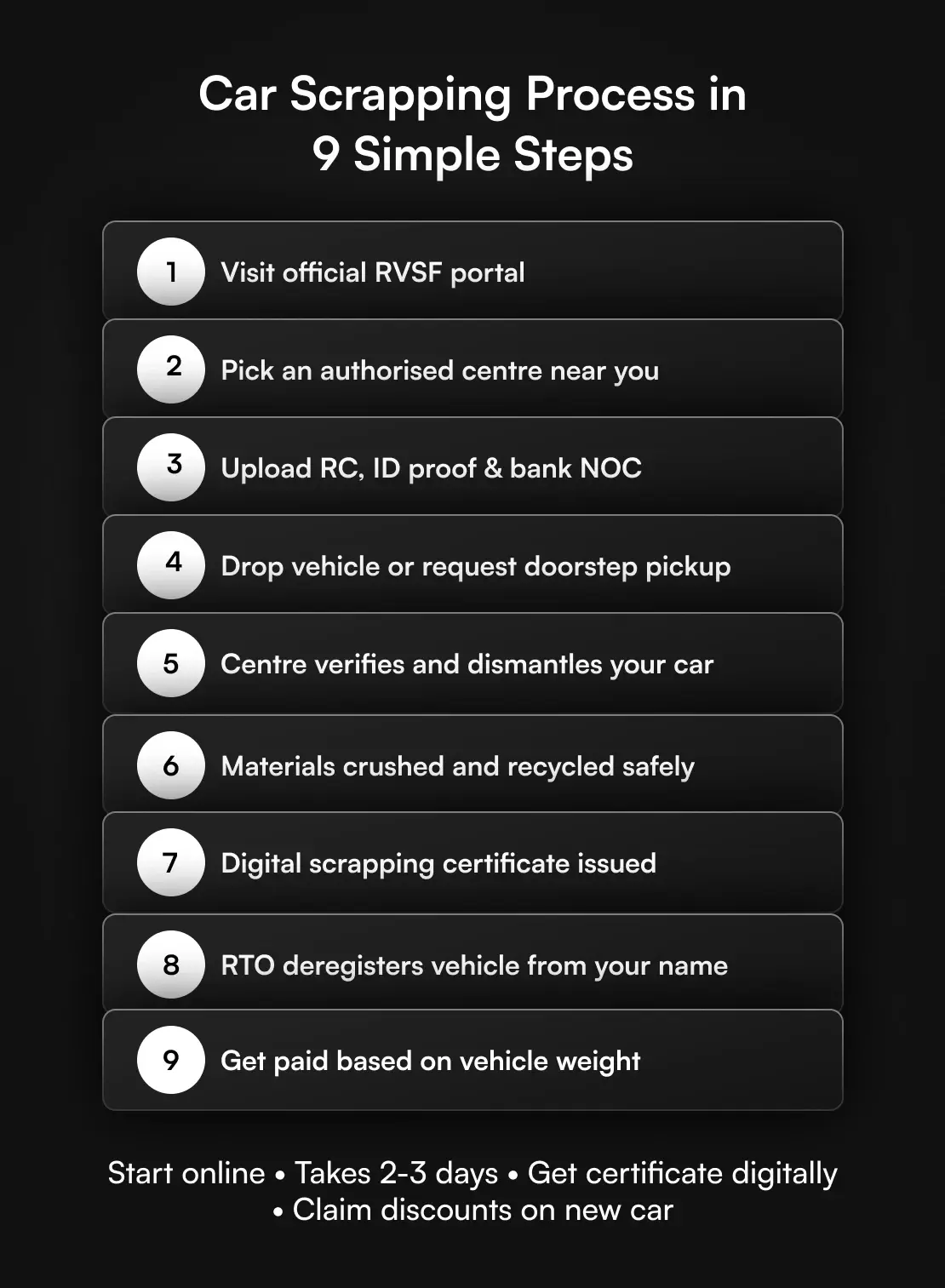
Scrapping your car isn't as complicated as it sounds. The government has set up a clear process through authorised centres, and you can even start it online.
Step 1: Go to the official portal
Visit the government’s official RVSF portal and click on "Apply for Vehicle Scrapping." You'll need your vehicle registration number and chassis number handy.
Step 2: Pick a scrapping centre near you
The portal shows you a list of authorised Registered Vehicle Scrapping Facilities in your area. Choose one based on distance or reviews. You can also call them directly if you prefer the offline route.
Step 3: Upload your documents
You'll need your RC, Aadhaar card or PAN card for identity proof, and a No Objection Certificate from your bank if the vehicle still has an active loan. If your loan is still active, read our guide on car loan eligibility and documents before starting the scrappage process.
Check out our guide on Mandatory Driving Documents to Carry in India if you're unsure what else you should keep handy.
Step 4: Decide how to send your vehicle
You can either drop the vehicle at the centre yourself or request doorstep pickup.
Step 5: Vehicle inspection at the centre
Once your car reaches the facility, they verify the Vehicle Identification Number and chassis number against your documents. Then begins the actual dismantling.
Step 6: Crushing and recycling
The shell of your car, after all the parts have been systematically removed, goes into a crushing machine that turns it into a steel bale. All the usable materials like metal, plastic, and rubber, are separated and sent for recycling. The facility ensures no harmful gas or fluid leaks into the environment.
Step 7: Get your scrapping certificate
Once dismantling is complete, you receive a Certificate of Destruction. This usually takes 2-3 business days and comes digitally through the Parivahan portal or email.
Step 8: RTO deregistration
The scrapping centre contacts your regional transport office and updates them about the scrapping. Your vehicle is officially de-registered in the system. You're no longer the owner, and all future tax or penalty liability ends there.
Step 9: Collect your scrap value
The facility pays you based on your vehicle's weight and condition.
Where to Find a Registered Vehicle Scrapping Facility?
You cannot take your old car to just any local scrap dealer anymore. The policy only recognises scrapping done at government authorised centres called Registered Vehicle Scrapping Facilities.
The easiest way to find one is through the official Parivahan portal at https://vscrap.parivahan.gov.in/
The website shows you a list of authorised RVSFs across India. You can filter by state and city to find the centre closest to you. Each listing gives you the facility's address, contact number, and sometimes user ratings.
As of 2026, over 60 such facilities operate across the country. Major cities have multiple options, and even smaller towns now have centres within 100-150 kilometres in most cases.
Remember to always check if the facility is actually registered on the Parivahan portal before handing over your vehicle, because unauthorised dealers cannot issue a valid scrapping certificate. That means you won't get any benefits on your next car purchase, and your vehicle might not even get properly deregistered.
How to Get a Scrappage Certificate After Dismantling?
The scrappage certificate is the most important document you get from this whole process. Without it, you cannot claim any benefits on your next car purchase.
Once your vehicle is fully dismantled at the authorised facility, they generate your Certificate of Destruction in the Parivahan system. This usually takes 2-3 business days after the physical scrapping is complete.
You don't need to visit any office. The certificate is forwarded to you, digitally.
You can download it directly from the Parivahan portal by logging in with your vehicle details. Most facilities also email a copy to the address you provided during registration.
The certificate contains your name, vehicle details, scrapping facility name, and a unique identification number.
Keep this certificate safe. You'll need it when you buy a new car to claim:
- Discounts from manufacturers (up to 1.5% of ex-showroom price or ₹20,000, whichever is lower)
- Road tax concessions from state governments (up to 25% for private vehicles)
- Waiver of registration fees on the new vehicle
The certificate doesn't expire, so you can hold onto it until you're ready to purchase your next vehicle. but Before you plan the replacement, try our car loan EMI calculator to estimate the next purchase budget.
What Incentives Under Scrapping Policy 2026?
The government isn't asking you to scrap your old car for nothing. They've added real financial benefits to make it worth your while. If you scrap through an authorised facility and buy a new vehicle, you save money in multiple ways.
- You get a discount from the car manufacturer,
- a road tax rebate from the state government,
- and complete waiver of registration fees on your new vehicle.
- Plus you get paid for the scrap metal itself.
These benefits are only available if you scrap at a Registered Vehicle Scrapping Facility and get your Certificate of Deposit. Local kabadiwalas won't give you any of this.
https://storage.googleapis.com/mymotor_blogs/5-things-that-decide-your-od-premium.webp
Do You Get 5-6% Discount on New Car Purchase?
Yes. Most vehicle manufacturers offer a discount when you show them your scrapping certificate. The discount is usually around 5% of the new car's ex-showroom price.
The discount varies by manufacturer and model. Some may offer a flat amount, others a percentage.
Always ask the dealer what scrappage discount they're running before finalising your purchase. You can also compare monthly outgo with our car loan EMI calculator before finalising the new car.
What is The Road Tax Rebate for Scrapped Vehicles?
This is the biggest saving you get from scrapping. Road tax is a significant expense when buying a new car, and the policy cuts it down substantially.
The rebate structure:
- Private vehicles: Up to 25% rebate on road tax when you buy a new car using your scrapping certificate
- Commercial vehicles: Up to 15% rebate on road tax for new trucks, buses, or other commercial vehicles
Say your new car has a road tax of ₹80,000. With the 25% rebate, you save ₹20,000 straight away. If you are comparing new car affordability, also check how car loans are structured in India. That's not a small amount.
Plus you also get:
- Registration fee waiver: You don't pay registration charges on your new vehicle.
- Scrap value payout: The facility pays you for your old vehicle's metal weight.
The road tax rebate depends on your state. Most states have implemented the 25% concession, but always check with your local RTO or dealer before assuming the rate.
Fitness Test Rules Before Car Scrapping
Before your vehicle gets marked for scrapping, it has to go through a fitness test at an automated testing station. This isn't the old visual inspection where the inspector takes a casual look and gives a pass. These are computerised tests with machines making the call.
The test checks your car's emissions, brakes, lights, suspension, steering, and overall structural condition.
If your vehicle is 15 years or older (commercial) or 20 years or older (private), this test becomes mandatory before you can renew your registration.
It's like a final health checkup. If your car passes, you get to use it for another 5 years. If it fails, scrapping becomes the only option left.
What Happens If a Vehicle Fails an Automated Test?
Well, if your vehicle fails the automated fitness test, you get one chance to fix things. Take it to a mechanic, repair whatever the test flagged, and come back for a retest. Fail the retest, and the station approves your vehicle for scrapping.
At this point, the system cancels your registration. You cannot renew it. You cannot legally drive the vehicle on public roads anymore.
The vehicle is now considered unfit. The testing station issues an End-of-Life certificate, and your only legal option is to send it to a Registered Vehicle Scrapping Facility.
If you keep driving it, you're breaking the law. Unregistered vehicles on public roads attract heavy penalties, and insurance companies won't cover you if something goes wrong.
Is PUC Part of Fitness Check for Scrapping?
Yes, emission testing is one part of the overall fitness check. The PUC certificate is already mandatory for all vehicles on Indian roads. But for scrapping eligibility, it's just one piece of the puzzle.
The automated fitness test at the station includes emission checks as part of its comprehensive evaluation. Your vehicle's exhaust gases are measured against prescribed standards. If emissions are too high, that would contribute to a failed result.
But here’s something else.
Even if your PUC is clean, your vehicle can still fail the fitness test. Brakes could be weak. Suspension could be shot. Headlights might not align properly. Structural rust could compromise safety.
The fitness test looks at everything, not just what comes out of the exhaust pipe.
So while having a valid PUC certificate is necessary when you submit documents for scrapping, it doesn't guarantee your vehicle will pass the full fitness test.
How Many RVSF in Pune for 2026 Scrapping?
These are the authorised Registered Vehicle Scrapping Facilities currently operational in Pune.
https://storage.cloud.google.com/mymotor_blogs/RVSF-in-Pune-Scrapping.png
On the official Parivahan portal, you can find the updated list of Registered Vehicle Scrapping Facilities (RVSF) state-wise.
By the way, Tata Motors also recently opened a dedicated scrapping facility in Pune called Re.Wi.Re (Recycle with Respect). It handles both passenger and commercial vehicles using environmentally friendly processes.
What is The RTO Process for De-Registration?
Deregistration is the official cancellation of your vehicle's registration after scrapping. It removes your name from government records so you're not liable for anything later.
Here's how it works:
Step 1: Get your Certificate of Destruction first
Before approaching the RTO, you need to scrap your vehicle at an authorised registered vehicle scrapping facility. They will issue a Certificate of Destruction. This is your proof that the vehicle no longer exists.
Step 2: Gather all required documents
- Original Registration Certificate
- PAN card and Aadhaar of owner
- Address proof
- Certificate of Destruction from the scrapping facility
- An affidavit declaring no pending loans, insurance claims, or court cases against the vehicle
- Photographs of the scrapped vehicle and the removed chassis number
Step 3: Submit application to RTO
Visit your RTO or use the VAHAN portal. Submit a written request for deregistration along with all documents. For RC-related help after deregistration, read how to get a duplicate RC online and offline.
Step 4: RTO verification
The RTO verifies your documents and checks with traffic police and National Crime Records Bureau to ensure no cases are pending against the vehicle. They also confirm the scrapping details with the authorised facility.
Step 5: Deregistration confirmed
Once everything checks out, the RTO updates the VAHAN database marking your vehicle as "scrapped" or "deregistered." Your registration number is freed up for future use.
Step 6: Inform your insurer
If you have an active insurance policy, notify them about the deregistration. You may be eligible for a partial refund on the remaining policy period.
*Make sure all pending road tax and traffic challans are cleared before applying. The RTO will not process deregistration if you have outstanding dues.
What are the Benefits of Scrapping Old Cars in India?
Scrapping your old car isn't just about following rules. There are real benefits waiting if you do it through the proper channel.
1. For the environment:
- Less air pollution because old vehicles emit way more harmful gases than new ones
- Proper recycling of metal, plastic, and rubber instead of dumping
- Safe disposal of toxic materials like engine oil and battery acid
2. For the economy:
- Creates jobs in scrapping facilities and recycling industries
- Boosts automobile sales and manufacturing
- Reduces India's dependence on imported raw materials through recycling
3. For road safety:
- Removes vehicles that are practically death traps with failing brakes and weak structures
- Brings more cars with airbags, ABS, and modern safety features onto roads
4. And last but not least, for you:
- Scrap value: You get paid a percentage of your new car's ex-showroom price just for the scrap metal from your old vehicle.
- Manufacturer discount: Most companies offer around 5% discount on a new car when you show your scrapping certificate.
- Road tax rebate: States give up to 25% concession for private vehicles and 15% for commercial vehicles. 27 states and union territories have already announced these rebates.
- Registration fee waiver: You don't have to pay registration charges on your new vehicle.
About 85,000 vehicle owners have already claimed incentives worth nearly ₹450 crore under this policy, so far.
Does Scrapping Boost New EV Sales Incentives?
The policy doesn't specifically mention extra EV incentives on top of what you already get. But there’s a connection.
When you scrap your old petrol or diesel car and buy any new vehicle, including an electric one, you get the same benefits.
The 5% manufacturer discount, the road tax rebate up to 25%, and the registration fee waiver all apply whether you buy a regular car or an EV.
Some manufacturers may offer additional exchange bonuses for EVs separately. But the scrappage policy itself treats all new vehicles equally.
The government's logic is simple:
‘Get the old polluting cars off roads first. What you replace them with is your choice.’
That said, many states already give extra EV incentives like lower electricity tariffs or additional tax breaks. If you're thinking about switching to electric, check out our detailed guides on The Future of Electric Vehicles in India
How Does This Policy Reduce Road Pollution?
Old vehicles are a major source of pollution. One old, poorly maintained car can emit as much as, if not more than 5 to 10 new, modern day cars. They don't have modern emission control systems like BS6 engines, diesel particulate filters, or advanced catalytic converters.
The policy tackles this in several ways:
- Removes unfit vehicles permanently: If your vehicle fails the automated fitness test, it cannot be renewed, and will be restricted from being used again.
- Makes way for cleaner technology: Newer cars have to meet strict Bharat Stage emission norms. They burn fuel more efficiently and release far fewer harmful gases like carbon monoxide and nitrogen oxides.
- Regular fitness checks: Even vehicles that pass must keep getting tested. This catches pollution issues early.
- Eliminates illegal resale: Since scrapping is now tracked through VAHAN, old vehicles cannot be sold off to someone else who'll keep running them in some other state.
- Safe disposal of toxic materials: Authorised facilities drain oils, coolants, and battery acid properly instead of dumping them into the ground. This prevents soil and groundwater contamination.
- Recycling reduces manufacturing pollution: When metal, plastic, and rubber are recycled, it takes less energy than making new materials.
The numbers prove it's working.
Over 3.6 lakh vehicles have already been scrapped at registered facilities. Of these, about 1.6 lakh were government owned vehicles over 15 years old.
That's a significant amount of pollution removed from Indian roads.
What are the Common Challenges in Car Scrapping Policy?
The scrapping policy sounds good on paper, but the actual experience isn't always smooth. Many vehicle owners run into problems that turn a simple process into a headache.
Here are the main challenges people face:
- The informal scrapping sector attracts owners with higher cash offers, but these dealers dump hazardous materials illegally and never issue a proper certificate.
- Limited number of automated testing stations and RVSFs means people in smaller cities have to travel long distances just to get their vehicle tested.
- Paperwork is heavy and mistakes get the process even more drawn out.
- Vehicle owners remain legally liable after scrapping if they use unauthorised dealers, because the vehicle stays registered in their name in government records.
The good news is that these challenges are reducing as more facilities open and processes get streamlined. But you still need to be careful and go only through authorised channels.
Why is There a Delay in Getting Scrappage Certificate?
The scrappage certificate is supposed to come within 2-3 business days after dismantling. But delays happen for several reasons.
Incomplete documents are one of these reasons. Another one, is verification issues with the VAHAN database which can also cause delays. If your chassis number, engine number, or ownership records don't match what's in the system, everything stops until you get it corrected at the RTO.
Some RVSFs are simply slower than others. The facility itself may have poor systems or backlog, taking weeks instead of days to issue certificates. Checking ratings on the Parivahan portal helps you pick a reliable one.
RTO processing time varies by location. So, busy RTOs with backlogs can take much longer than the usual timeframe.
What If Scrap Value Is Too Low?
This is the most common complaint. You see ads from local scrap dealers offering high prices. Then the authorised RVSF gives you a number that looks much smaller.
Scrap value depends on your vehicle's weight, metal composition, current market rates, condition, missing parts, and logistics cost. A small hatchback with rust and missing engine will obviously fetch less than a complete, heavy SUV.
Unauthorised dealers quote high numbers to get your vehicle, but they don't follow any standard calculation. When they arrive for pickup, the price mysteriously drops. Or they pay cash without invoice, and you get no certificate.
Authorised RVSFs, on the other hand, give you a transparent breakdown. You know exactly what you're getting paid for and why. The price may be lower, but you get a valid certificate, proper deregistration, and eligibility for government incentives.
Those incentives add up to much more than the few thousand extra a kabadiwala might promise. So the lower scrap value from an authorised facility actually works out better in the long run.
If you think the quote is genuinely too low, get prices from multiple authorised facilities on the Parivahan portal. If you’re deciding whether to scrap or upgrade, use our car loan EMI calculator to compare the replacement cost. Compare their offers.
Just make sure they're all registered.
Conclusion
So that's the car scrapping policy in simple words.
The government isn't trying to make your life difficult. They're just clearing out old vehicles that pollute too much, break down too often, and cost you more than you realise.
If your car has crossed 15 or 20 years, scrap it at an authorised centre and claim discounts, tax rebates, and registration waivers on a new one.
Just don't ignore it.
And don't fall for local kabadiwalas offering more cash. They won't give you a certificate, and without that, you get no benefits and your name stays on the vehicle forever.
Scrap the right way. Clear your name. Save on your next car. It's that simple. If you’re moving to a replacement vehicle, start with our car loan guide and EMI calculator.