
By now, you have probably noticed more and more EVs on the road. The white board with a green number plate. The silent scooter that zips past you in traffic. It is not a passing trend anymore. It is actually happening.
The question is whether it makes sense for you. And that is what this guide is for.
This guide will explain to you in detail what changes when you switch from ICE to electric in 2026.
The savings. The subsidies. The driving experience. The charging situation.
Everything you need to know before you decide.
What Are the Top Benefits of EVs in India?
Electric vehicles save you a lot of money on fuel and maintenance, plus they give you a smoother, quicker drive than petrol cars.
If you own a petrol car, you already know the struggle at the petrol pump. ₹100 per litre adds up fast. An EV changes that completely.
You charge it at home like a phone. Most people spend around ₹1-1.5 per kilometre on electricity. A petrol car giving 18 km/l? You are looking at ₹5.5 per kilometre.
Run your car for a month and the difference shows. What you spend on petrol in one month could cover your EV electricity bill for three months or more. That kind of saving adds up to tens of thousands every year… Just on fuel.
How Do EVs Lower Running Costs vs Petrol Cars?
EVs run on electricity, which is obviously a lot cheaper than petrol, and they use that electricity very efficiently.
Here is the thing nobody tells you about petrol cars. They only convert 17-21% of the fuel's energy into actually moving the wheels. The rest is waste. Heat. Noise. Parts moving for no reason.
EVs flip this.
They take 85-90% of the electricity from the grid and put it straight into motion. Less waste means less money.
Charging at home is where the real saving happens.
- Plug into a normal 230V socket overnight and you get about 32 km range by morning. Enough for daily travel.
- Public chargers cost more at ₹15 to ₹25 per kWh, but still cheaper than petrol.
- Some states give rebates on home charger installation. That ₹30,000-50,000 setup cost gets cut down.
No queues at petrol pumps. No watching the fuel meter drop. Just plug in, sleep, wake up with a full tank.
Why Do EVs Offer Instant Torque and Smooth Drives?
EVs give you full power the moment you touch the accelerator. You do not wait for the engine to catch up or gears to shift.
Petrol cars need to build up speed, which naturally takes time. You press the pedal, the engine has to rev higher, the RPM builds, the transmission finds the right gear, and only then does the car actually pull forward. That delay is normal. You have probably gotten used to it.
EVs do not do any of that.
Here is what happens when you press the accelerator in an EV:
- Electricity hits the motor.
- Magnetic fields spin the rotor instantly.
- The wheels turn. Right now.
The delay you feel in petrol cars is gone. That lag between pressing down and actually moving disappears.
EV torque response is under 50 milliseconds.
Petrol takes a few hundred. You feel the difference the first time you drive one.
What this means for you:
- Overtaking becomes easy. One press and you are past them.
- Stop-go traffic stops being annoying. No clutch or gear shifting. Just accelerate, brake, steer.
- The car is silent. No engine noise. No vibration. It's so silent in fact that you actually check the display to see if the car is on.
Manufacturers sometimes add fake engine sounds now because EVs are too quiet and pedestrians could not hear them coming.
That is how silent we are talking.
Which Government Subsidies Boost EVs in 2026?
The central government runs the PM E-DRIVE scheme until 2028, and states like Maharashtra add their own tax waivers on top. Together, they can cut the price of an EV by thousands.
If you buy an EV in 2026, you are not paying full price. The government pays a part of it for you.
Some of that money comes from Delhi, some comes from your state.And if you live in the right state, the savings are big enough that an EV actually ends up cheaper than a petrol vehicle on day one.
What Is the PM E-DRIVE Scheme for Electric Vehicles?
PM E-DRIVE is the central government's main EV subsidy scheme running from 2024 to 2028. It gives you money off the showroom price itself, so you walk out paying less.
- You do not apply for the subsidy or wait for money to come to your bank.
- The showroom deducts the incentive from your bill right there.
- The government later pays that amount back to the company.
The scheme also puts ₹2,000 crore into building public charging stations across the country. So while you save money on your purchase, the government is also working on making sure you have places to charge when you are out. Already, you can find EV charging stations near you across 3,000+ verified locations using the MyMotor app on Google Play.
Every eligible buyer gets an e-voucher at the time of purchase. That is the government's way of tracking who got the benefit and making sure the discount actually reached you.
Do States Like Maharashtra Offer EV Tax Waivers?
Yes. Maharashtra waives road tax and registration fees completely for EVs. On top of that, they add their own state subsidy which brings the price down even further.
The central scheme cuts the price. Maharashtra's tax waiver cuts the price again. Here is what that actually means if you buy in Mumbai, Pune, Nagpur, or anywhere else in the state:
1. Road tax and registration fees: You pay zero on both. That is usually a few thousand on two wheelers and tens of thousands on cars. Waived completely.
2. State subsidy on top: Maharashtra gives you up to ₹1.5 lakh off on a four-wheeler, depending on the battery size. For two-wheelers, you get up to ₹10,000 off. This is not the central scheme. This is the state government putting its own money down.
3. Commercial vehicles get separate benefits: If you are buying an EV for a fleet or business use, Maharashtra has separate incentives for that as well.
So when you add it up, central subsidy knocks off some amount. Maharashtra waives the taxes. Maharashtra also hands you a state subsidy.
That is three separate cuts on the same purchase.
For a car, the total savings can cross well over a lakh. For a two-wheeler, it can bring the price below what you would pay for a similar petrol model.
*Not every state does this. Some still charge you full road tax.
How Do EVs Help the Environment and Air Quality?
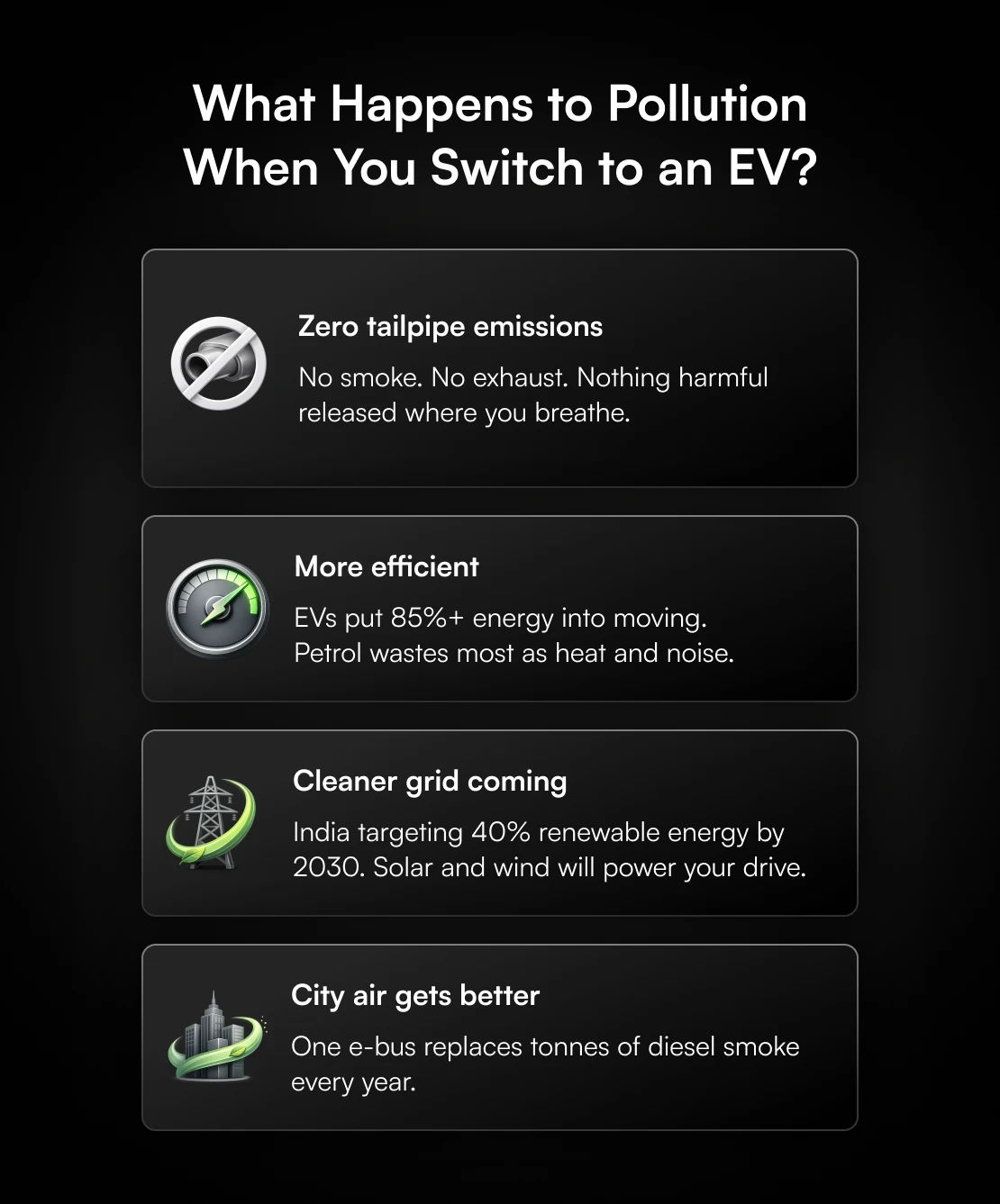
Electric vehicles do not burn petrol or diesel, so they put out zero smoke from the tailpipe. That alone cuts out the main things that make city air dangerous to breathe.
Every time a petrol car moves, it throws out carbon monoxide, nitrogen oxides, particulate matter, and other pollutants. You cannot see most of them, but you are breathing them.
In Indian cities, vehicles are one of the biggest reasons the air turns grey and people keep getting coughs that do not go away.
- An EV has no engine. No combustion. No exhaust pipe pushing out smoke.
- While the petrol car next to you at the signal is idling and releasing poison into the air, your EV is sitting there doing nothing.
- Zero tailpipe emissions is not a mere feature. Infact, that is the whole point.
So when people ask whether EVs are actually better for the environment, you tell them: YES!!!
Can EVs Reduce India's GHG Emissions Effectively?
Yes, but only if two things happen together. More EVs on the road, and more renewable energy going into the grid that charges them.
India is the third largest greenhouse gas emitter in the world. The transport sector alone accounts for 11% of our carbon dioxide emissions. And this number is only going up because more people are buying cars.
One study says the number of four-wheelers on Indian roads will jump by 900% in the next thirty years.
If all those new cars are petrol, the emissions from those ICE vehicles will significantly affect our overall health.
Here is where EVs change the math:
- An EV produces zero tailpipe emissions, so the smoke problem disappears at the source.
- EVs convert over 85% of the energy from the grid into movement. Petrol cars waste 80% of their fuel as heat and noise. Less waste means less energy burned overall.
- The government is aiming for 40% of India's electricity to come from non-fossil sources by 2030. Solar, wind, hydro. When your EV charges on that, your driving becomes almost completely clean.
- Projections for 2030 show India could cut nitrogen oxide and particulate matter by 17%, bring carbon monoxide down by 18%, and reduce carbon dioxide by over 800 million tonnes every year.
But there is a catch.
If the electricity charging your EV comes from a coal plant, you have not eliminated emissions. You have just moved them from your car to the power station. So the real solution is not just EVs.
It is EVs + a cleaner grid.
The government knows this. That is why the renewable push is happening alongside the EV push.
Do EVs Improve Urban Air Quality in Pune?
Yes. Pune's air gets a large part of its pollution from vehicles. Every petrol car that gets replaced by an EV means one less source of smoke on Pune roads.
The biggest gains will come from electrifying vehicles that run the most. Rickshaws, buses and taxis.
One diesel bus replaced with an e-bus removes tonnes of emissions every year from Pune's air. One e-rickshaw means one less autorickshaw leaving that blue smoke trail behind.
Over a few years, if enough EVs replace enough petrol vehicles, the change will show.
What Running Cost Savings Do EVs Provide?
An EV saves you money in two places: What you would have spent on petrol, and what you would have spent on keeping the car running.
Petrol is the obvious one.
Every time you fill up, you watch the meter climb and your wallet shrink. An EV does not need petrol. It needs electricity. And electricity costs way less than fuel for the same distance.
Maintenance is the hidden one.
A petrol car has hundreds of moving parts. Pistons, valves, spark plugs, timing belts, clutches, fuel injectors, exhaust systems. All of them can break. All of them cost money to fix. An EV has a motor and a battery. That is basically it.
Fewer parts means fewer trips to the service center.
How Much Cheaper Are EV Electricity Bills?
Charging at home costs you around one fourth of what you would spend on petrol for the same distance. If you charge during off peak hours, it gets even cheaper.
A petrol car in the city gives you around 18 km per litre. At today's prices, you are paying several rupees for every kilometre you drive.
An EV uses electricity. Most cars need about as much power as a couple of ACs running for a few hours to go a hundred kilometres. At home electricity rates, that works out to just one or two rupees per kilometre.
What you spend on petrol in one month could cover your EV electricity bill for three or four months. That is tens of thousands of rupees saved every year just on fuel.
If you want to save even more (because who wouldn’t):
- Charge after 10 pm. Many electricity companies give you cheaper rates late at night when demand is low. The same power that costs full price at 7 pm costs much less at 11 pm.
- Install a dedicated EV meter. Some states let you have a separate connection just for your car at lower tariff slabs.
- Charge at home whenever possible. Public fast chargers cost more than home charging. Still cheaper than petrol, but home is where the real saving lives.
This is why most EV owners just plug in before sleeping and wake up with a full tank every morning.
What Maintenance Savings Come with EVs?
EVs cost much less to maintain than petrol cars because they have almost nothing that can break.
A petrol car needs oil changes, coolant flushes, spark plugs, clutch repairs, gearbox work, exhaust replacements. Every few thousand kilometres, something needs attention.
EVs do not have any of that.
So, you stop paying for:
- Engine oil. Oil filters. Oil changes.
- Spark plugs. Timing belt. Fuel injectors.
- Clutch. Gearbox. Transmission.
- Exhaust system. Catalytic converter.
Here is what you still need, however:
- Tyres. EVs are heavier, so tyres wear a bit faster.
- Cabin air filters.
- Coolant for the battery. Occasional top up.
- Software updates. Most happen automatically now.
What it actually costs (rough estimate):
A petrol car runs you ₹7,000 to ₹10,000 every year in maintenance. An EV costs ₹2,000 to ₹4,000. Over five years, you save ₹25,000 to ₹40,000 just on servicing.
What about the battery? Batteries come with 6 to 8 year warranties. They last the life of the car. By the time yours needs replacement, you would have upgraded anyway. And battery prices are dropping every year.
Are EVs Eligible for Road Tax Exemptions?
Yes, most states in India waive road tax and registration fees completely for electric vehicles. That is thousands of rupees you do not have to pay on day one.
When you buy a petrol car, a big chunk of the on-road price is tax. Road tax. Registration fees.
States charge you anywhere from 8% to 15% of the car's value just to let you drive it on their roads.
EVs get a pass.
Most states say you pay zero on both. So the price you see on the showroom bill is closer to what you actually walk out paying.
Which States Will Waive Road Tax for EVs in 2026?
Maharashtra, Delhi, Gujarat, Tamil Nadu, and Karnataka all continue to offer full road tax exemptions in 2026. Some also add their own purchase subsidies on top.
However, not every state plays the same game.
Some give you a full waiver. Some give partial. And some give nothing at all.
1. Maharashtra
- Full road tax and registration fee waiver.
- State subsidy up to ₹1.5 lakh on four-wheelers.
- State subsidy up to ₹10,000 on two-wheelers.
- Charging hubs coming up in Mumbai and Pune.
2. Delhi
- Full road tax and registration fee waiver.
- Direct subsidy up to ₹30,000 on two-wheelers.
- Direct subsidy up to ₹1.5 lakh on cars.
- Scrappage incentives and lower loan interest rates.
3. Gujarat
- Full road tax and registration fee waiver.
- Subsidy up to ₹20,000 on electric bikes.
- Subsidy up to ₹1.5 lakh on cars.
- Over 250 new charging stations funded across the state.
4. Tamil Nadu
- 100% road tax exemption until at least 2025. Likely extended.
- Two-wheeler subsidy of ₹5,000 per kWh of battery capacity.
- Hundreds of new charging stations in Chennai and Coimbatore.
5. Karnataka
- Full exemption on registration fees and road tax.
- Strong support for EV startups and charging providers.
- One of the earliest states to have an EV policy, still going.
If you live in one of these states, you save tens of thousands right at purchase.
How Do Green Plates Enhance EV Perks?
Green number plates make your EV easy to spot. That helps governments give you benefits that petrol and diesel cars do not get.
Since 2019, all electric vehicles in India must have a green number plate.
Private EVs get white letters on green. Commercial EVs get yellow letters on green. No green plate means you are not registered as an EV. And if you are not registered as an EV, you do not get EV benefits.
The registration process itself follows specific RTO guidelines for electric bikes and scooters in 2026.
What the green plate actually gets you:
- Preferential parking: Many malls and offices reserve spots near the entrance for EVs.
- Reduced toll charges: Some states offer discounted or waived tolls for EVs. The plate makes verification instant.
- Exemption from restrictions: During odd-even schemes or pollution-driven bans, EVs with green plates are often allowed to drive freely.
- Easier subsidy claims: The green plate is proof that your vehicle is electric. That helps when availing state and central incentives.
That green strip on your number plate is basically the government saying yes, this is what we want more of on our roads.
EV Charging Infrastructure Updates 2026
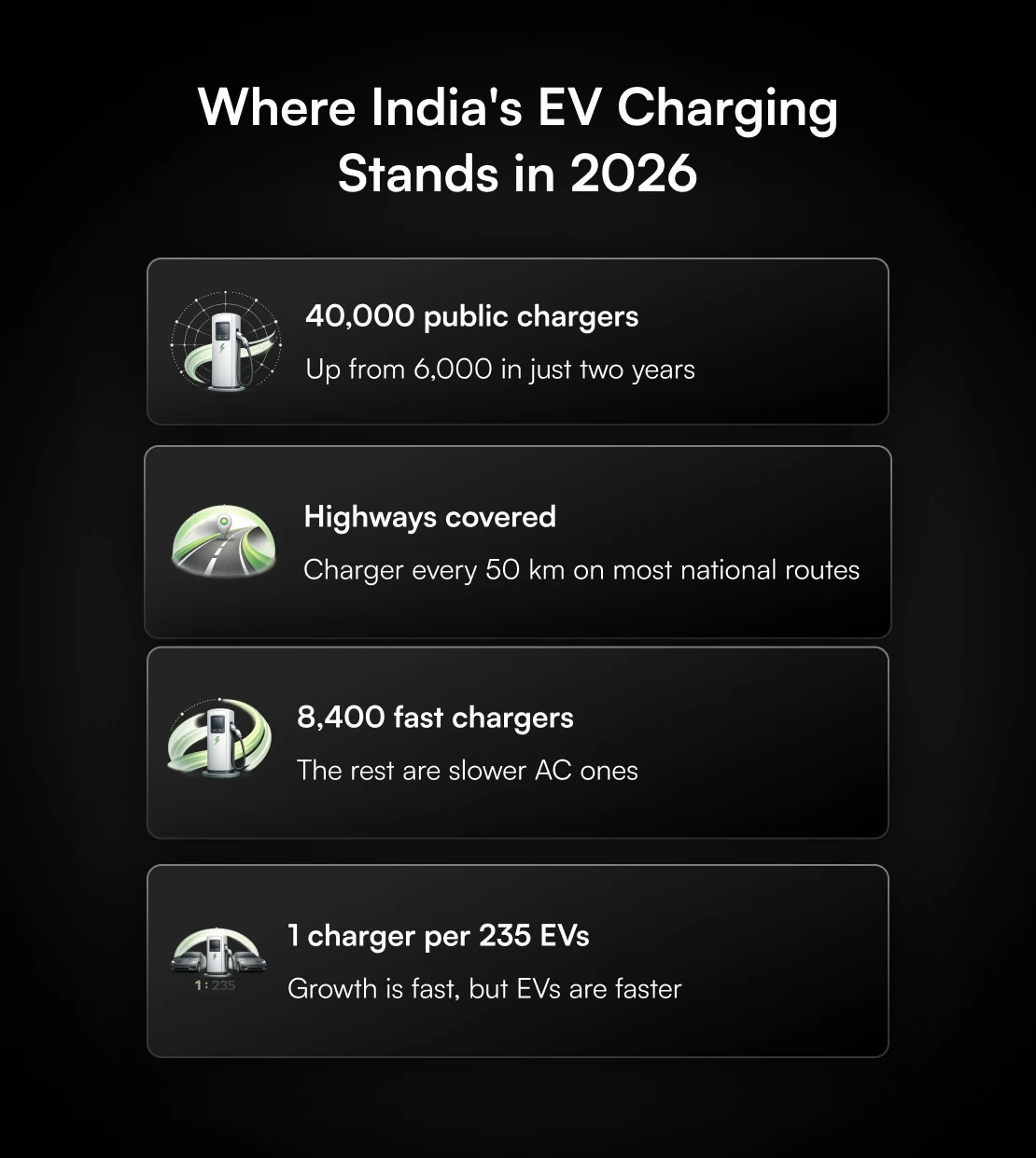
India's charging network has grown fast. From around 6,000 public stations in early 2023 to nearly 40,000 by late 2025.
Highways that felt risky for EVs are now covered. Most national highways have a charger within 50 kilometres.
- India now has about 39,500 public chargers. Roughly 8,400 are fast chargers.
- Maharashtra, Delhi, and Karnataka lead. Other states are catching up.
- Oil companies installed over 22,000 chargers at petrol pumps.
But the number of EVs grew even faster.
- One public charger for every 235 EVs. That ratio is still low.
- In early 2024, nearly half the chargers were nonfunctional. Maintenance is a problem.
- Different networks need different apps. You might need 5 to 10 of them.
The network is expanding. But chargers need to work when you reach them. And you should not need a separate app for every company.
How Many Public Chargers Are Available Now?
India has around 39,500 public chargers as of late 2025. About 8,400 of them are fast chargers.
- Public stations grew five times in two years. From 5,000 in 2022 to over 26,000 by mid-2024.
- Maharashtra and Delhi each have thousands. Smaller states have fewer.
- Oil companies put 22,000+ chargers at petrol pumps by the end of 2024.
- Tata Power crossed 100,000 home chargers installed and is adding public ones.
But one charger for every 235 EVs is still low. In early 2024, nearly half the chargers were out of order. 38% of EV users say unreliable chargers stop them from longer trips.
Can Home Charging Make EVs More Convenient?
Yes. Over 70% of EV charging happens at home. Plug in at night, wake up knowing that your EV is fully charged.
You can use your existing meter or install a separate EV meter. The government allows both. A charger in your parking spot costs little to run.
But only about 55% of EV owners actually have home chargers.
Apartments often say no because of safety worries and the cost of wiring upgrades. Fixing up old buildings can be expensive, and residents without EVs do not want to pay for it.
Home charging works best if you own your place and have dedicated parking. If you rent or your society refuses you would have to rely on public chargers.
EV vs Petrol: Ownership Cost Comparison
An EV costs more to buy but less to run. Over five years, the lower fuel and maintenance bills usually make up for the higher upfront price.
Petrol cars, on the other hand, seem cheaper at the showroom. You pay less to drive out. But every time you fill fuel or take it for service, the gap closes.
EVs cost more at purchase but less to run.
What Are 5-Year Costs for Popular EV Models?
A Tata Nexon EV costs more upfront than a petrol Nexon. But over five years, the lower running costs bring them almost level.
Let us take the Nexon as an example. It sells well in both versions, so the comparison is fair.
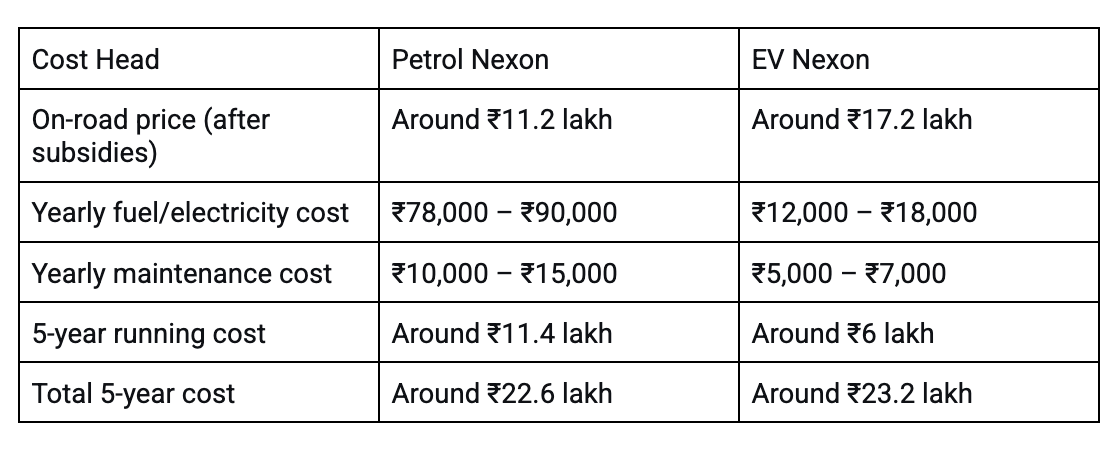
The difference over five years is barely ₹60,000. And if petrol prices rise or you drive more than 1,000 km a month, the EV pulls ahead even sooner.
When Do EV Savings Beat Petrol Cars?
For most city drivers, an EV starts saving you money from year one. But the real gap shows up around the three year mark.
If you drive daily and charge at home, the savings on fuel and maintenance add up fast. By year three, you have saved enough to cover most of the extra you paid upfront.
The more you drive, the sooner it happens. If you do long daily commutes, the payback comes even faster.
If you drive less, it takes longer, but you still save on maintenance and never visit a petrol pump.
Conclusion
Look, no one is saying EVs are perfect. Charging stations still have gaps. Apartments still make it difficult for some owners. And yes, you pay more at the showroom.
But here is what matters.
Every year, the gap between EVs and petrol cars gets smaller and smaller for buyers. More chargers come up. More states waive taxes. More people figure out that home charging is a lot easier than waiting in line at a pump.
And the savings?
Well, they add up. Month after month from the day you drive out.
The government wants this. The states are putting money behind it. And the cars themselves are smoother, quieter, and quicker off the line than anything with an engine.
So if your daily drive is within the city and you have a place to plug in at night, an EV is the smarter way to get around in 2026. Use the MyMotor EV charging app to find, check, and pay at chargers across 30+ networks — free on Android.